





























There is perhaps no individual in the Indian ecosystem wielding more power than the neighbourhood Kaamwali Bai – at least until now. With the rise of new-age platforms like Snabbit and Pronto, the power dynamic is shifting.
The Kaamwali Bai is, after all, once the undisputed apple of a homemaker’s eye, more VIP than the hubby himself and arguably the only person capable of making a South Delhi socialite break into a cold sweat with a single morning text: “Didi aaj nahi aa paungi”.
For decades, the relationship between Indian families and their house-help has been a complex, deeply emotional dance involving morning chai, shared local gossip and negotiated festival bonuses. But a digitisation wave is sweeping our living rooms.
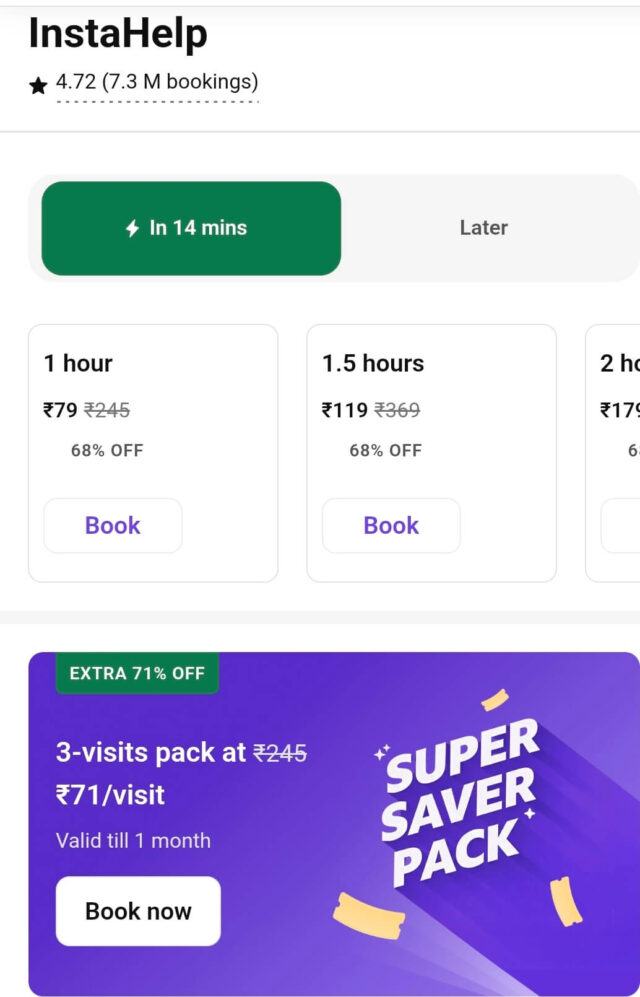
We have algorithmized our food, then groceries and now domestic workers can also be availed at the click of a button. Instant house-help platforms like Snabbit, Pronto and Urban Company’s Instahelp are providing on-demand domestic workers across India, disrupting the traditional Indian dependency on mohalla didis.
From Mohalla to Matrix: The ₹99/Hour Shift
Every mohalla has its own local rates – a nuclear family in South Delhi pays around ₹1500/month for cleaning and dishwashing services. Traditional monthly bargaining and haggling over tea have been revamped into a corporate menu.
These platforms offer domestic services starting from a baseline rate of ₹99/hour, increasing with the number of hours. Snabbit and Pronto, both launched in 2024, have seen a meteoric rise in terms of scale and operations, driven by the digitisation of domestic work.
While these apps offer the appeal of instant help, the economics add up differently. A standard 4-hour daily shift at about ₹99/hour adds up to an exorbitant ₹12,000/month. This is a steep jump from the ₹1500-2000/month that many families pay for traditional long-term help in their own colonies. Is this the hidden cost of convenience?
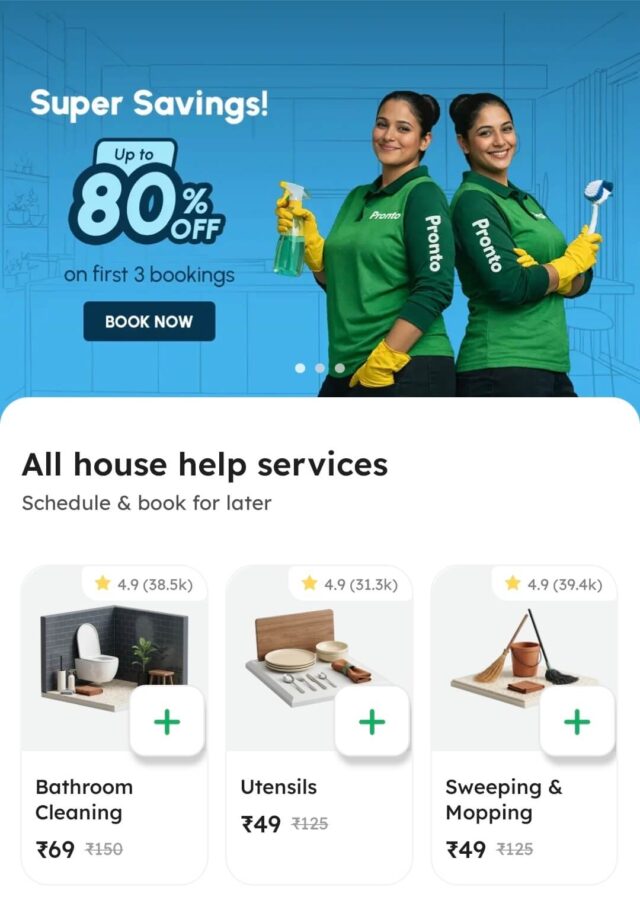
Uniform pricing, rating systems and time-bound services have given definite shape and structure to a highly unorganised and unpredictable sector. Workers are hired on 6, 8, 10 and 12-hour work shifts, meticulously uniformed and trained to be extremely polite.
Payments are structured in the form of a hybrid model – a fixed monthly salary combined with performance-based gig incentives. The real turnaround for the maids lies in bonuses earned by fulfilling maximum bookings, arriving on time and receiving five-star ratings.
Pronto workers reportedly earn a fixed monthly salary of ₹24,000 in addition to other incentives, while Snabbit pays somewhere around ₹20,000-₹30,000/month, based on shift hours.
Sticking To The Timer: The Human Cost Of A 5-star Rating
Yet at times, workers tell a different story. To get a direct pulse on their experiences, I spoke to Jyoti and Meeta, both working for Instahelp. Jyoti shares, “Sometimes customers book us and then don’t open doors when we turn up. Many times, I have been left stranded outside homes ringing the doorbell incessantly.”
Under normal circumstances, a local didi would simply call her employer, grumble and move on to her next house. But in the gig ecosystem, Jyoti was trapped by a ticking in-app countdown timer, which sometimes docked her pay for apparently no fault of hers.
“Some customers get annoyed at the mention of asking for 5-star ratings, not realising how important it is to us,” Meeta complains. Good ratings greatly help these maids claim added benefits and incentives.
App users also have their own stories and anecdotes to tell. Barring occasional instances ranging from unsatisfactory services to maids aggressively asking for higher ratings, most users share positive feedback. Unsavoury instances are presently few and rare, possibly owing to the fact that the workforce is predominantly female. Snabbit even boasts of a 100% female workforce.
Read More: Indian Factory Workers Are Recording Their Work For Free To Train Capitalistic AI Models
The Concert Ticket Craze: Why Gated Communities Are Hooked
For suburban consumers like Rupali, a homemaker based in Greater Noida, all her prayers seem to have been answered: “Just a tap and click to go, I reserve a slot as soon as my regular didi calls for an off.”
For Shashank, a young entrepreneur from Lajpat Nagar, going through a home renovation has become much easier with these platforms: “I always book a slot in advance as they get filled up very fast. Now I don’t have to worry about cleaning up after renovations are done for the day, as Pronto offers its services even at odd hours.”
In many South Delhi areas, getting an active slot is like buying concert tickets – you have to wait 3-4 days in advance to get one. The modern urban Indian household now tracks maid arrivals the same way it tracks grocery deliveries.
A Black Mirror Twist: Corporate Surveillance In The Kitchen
But a recent controversy involving Pronto that erupted on May 22, 2026, has soured the cream for the Bengaluru startup. An investigative report by tech-intelligence platform Entrackr revealed that Pronto was running a pilot program where select workers carried outward-facing body cameras inside private Indian kitchens and living rooms.
An internal memo from Glade Brook Capital, an early backer of Pronto, revealed that Pronto was harvesting this first-person behavioural data, the exact hand angles used to wash a kadhai or fold a pile of clothes, to train advanced physical AI and humanoid robotics.
Glade Brook Capital reportedly claimed in an internal memo, “Pronto is seeking to formalize India’s vast informal labor markets and in the process generate data to help train physical AI and robotics.” The memo further adds that the company was “piloting real world training data with leading physical AI labs.”
According to the Entrackr report, an investor note stated that the company is “developing a data business leveraging its workforce to capture real-world household data for robotics labs” along with how it is “moving quickly to commercialize the strategy” due to an “encouraging” early partnership interest.
Pronto also confirmed this to Entrackr, stating, “We have been thinking about this since our inception,” and that the professionals carry “a small camera that faces outward at the work,” if the customer has voluntarily consented to have their jobs recorded and the footage is shared with them afterwards as well.
The idea of a tech startup mapping the inner sanctuary of an Indian household triggered massive privacy backlash.
Arindam Paul, a well-known startup commentator and consumer brand strategist, tweeted, “This is a serious privacy issue if true. Consent has to be very explicit, ideally.”
Sharing The Economic Times report on X/Twitter, Neetu Garg, a corporate professional and social activist, tweeted on the dangers of misusing household footage and playing with people’s trust.
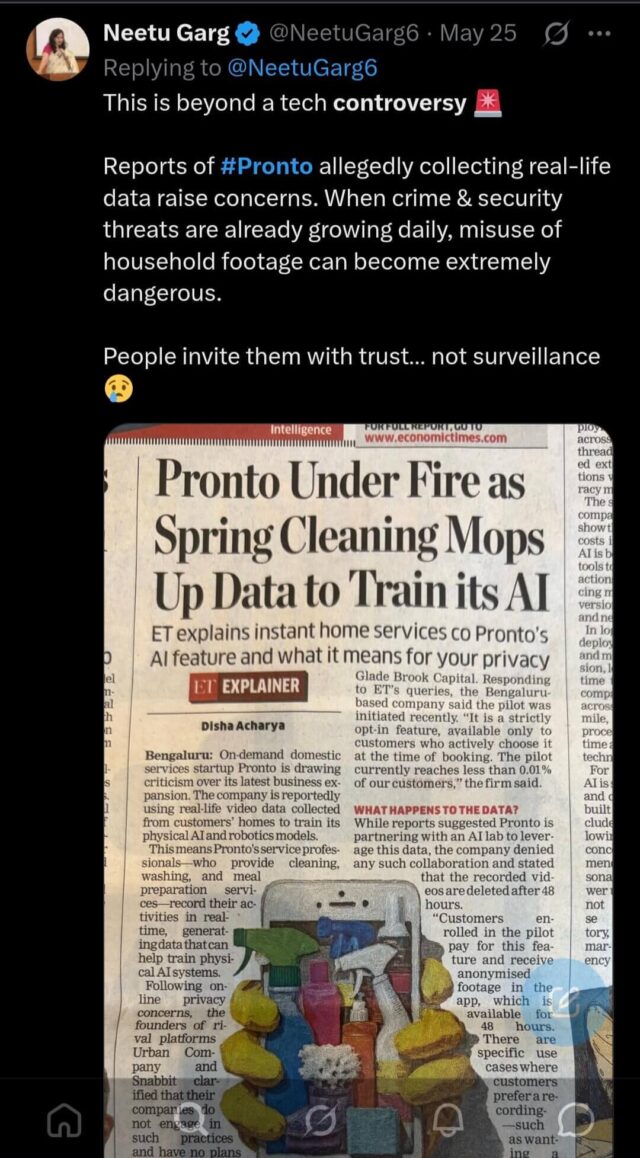
The same report even claims that the Ministry of Electronics and Information Technology (MeitY) has taken cognisance of the events and is gearing up for an active data-compliance inquiry, although it has not issued a formal quote on the matter.
Pronto has defended the move as an explicit, 0.1% opt-in pilot. It clarified, “Unless you have opted-in and paid for the program personally, the Pro doesn’t come to the house with a camera. Opt-in is not a one-time agreement; it must be confirmed before each booking. By default, there is no camera involved, and when there is, it’s impossible to miss.”
Nevertheless, competitor platforms were quick to distance themselves from in-home recording altogether.
“Like many companies in the ecosystem, we explored the space at a very early stage, but we are not recording customers or workers and there is no active deployment of such systems,” a Snabbit spokesperson said.
Even Urban Company’s CEO, Abhiraj Bhal, was quick to retort that they do not engage in such practices. Bhal shared on a post in X/Twitter, writing, “In light of recent reports regarding recordings inside customers’ homes by one of our competitors, many people have asked whether @urbancompany_UC engages in anything similar, or intends to do so in the future.”
He added, “The answer is clear and unequivocal: we do not.”
Amidst these rising concerns of invasions of privacy, are our mohalla didis so easily replaceable? Our localised help has long been known not just for providing local gossip and chitchat, but sometimes for acting as an unlikely ally in the household. The apps have certainly minimised the human touch, not completely removed it, but for how long?
Beyond ‘Blinkit Karle’: The New Vocabulary Of Chores
A few years back, nobody would have guessed that maid absentia would become a thing of the past – the average female homemaker definitely didn’t. It’s not just “Blinkit karle” or “Swiggy it” anymore; it’s progressed to “Snabbit her” and “Pronto kar”.
Apps may have solved the mystery of whether the maid will show up tomorrow. Whether they can replace the trust, familiarity and strange emotional ecosystem surrounding the mohalla didi remains an entirely different question.
Image Credits: Google Images
Sources: Outlook Business, The Economic Times, The Print
Find the blogger: @diptisadh
This post is tagged under: colony maids, Indian households, house-help, mohalla didis, domestic drama, pronto wave, pronto, snabbit, instahelp, digitization, pronto controversy, app maids, pronto under fire, invasion of privacy
Disclaimer: We do not own any rights or copyrights to the images used; these images have been sourced from Google. If you require credits or wish to request removal, please contact us via email.