























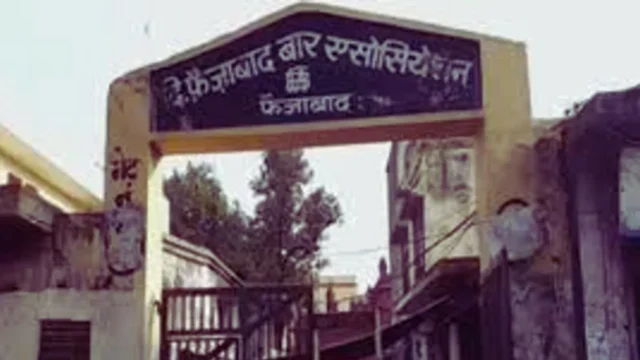
In a move that has sparked legal and ethical debate, the Faizabad Bar Association (often referred to as the Ayodhya Bar Association) has barred its members from representing any of the eight accused in the alleged Ram Mandir donation embezzlement case. Lawyers who defy the resolution will be required to deposit ₹5 lakh as a contribution to the association’s fund.
Why Has The Faizabad Bar Association Refused To Represent The Accused?
The decision comes amid an investigation into the alleged misappropriation of donations made by devotees to the Ram Mandir, Ayodhya. According to the FIR, the accused are alleged to have misappropriated donations made by devotees at the Ram Mandir, allegations that they are yet to contest before a court.
Given the temple’s immense religious significance, the allegations have triggered widespread outrage, with the Bar Association arguing that the issue goes beyond an ordinary financial crime, hurting the religious sentiments of many.
Bar Association President Kalika Prasad Mishra announced the resolution on June 29, 2026, stating that the association would instead support efforts to prosecute those accused in the case.
An FIR in the case names eight accused, including Ramashankar Yadav alias Tinnu, Anukalp Mishra, Avinash Shukla, Karunesh Pandey, Manish Yadav, Lavkush Mishra, Ramashankar Mishra and Subhash Srivastava.
Explaining the decision, Mishra said that the association members had unanimously resolved that no lawyer would appear for the accused. He also announced plans to seek legal action against temple officials and press for a CBI investigation into the alleged financial irregularities.
In a statement to the media, Mishra said, “No lawyer will advocate on behalf of the accused. If any lawyer does so, they will have to deposit a contribution of five lakh rupees in the association’s fund for each name.”
Why Does The Association Want Action Against Temple Officials?
The association has also sought action against senior functionaries associated with the Shri Ram Janmabhoomi Teerth Kshetra Trust, including Champat Rai, Gopal Rao and Anil Mishra, though none of them has been named in the FIR. Mishra argued that such a “massive” financial irregularity could not have taken place without the knowledge of those responsible for the temple’s administration.

The association has also resolved to move the court under Section 156(3) of the Bharatiya Nagarik Suraksha Sanhita (BNSS), seeking the registration of a case against the three officials while demanding a CBI probe into the financial irregularities.
According to Bar Association secretary Shailendra Jaiswal, the association’s decision was driven by the belief that the alleged embezzlement involved money donated by devotees. “The sentiments of all of us have been hurt by the theft of temple offerings. The lawyers of Faizabad have agreed not to plead on behalf of the arrested accused,” he said.
The move has also raised concerns that attaching a financial consequence to lawyers who choose to represent an accused goes beyond a mere appeal. Such a penalty could discourage advocates from accepting the brief, raising questions about whether the resolution has a chilling effect on an accused person’s access to legal representation.
The Bar Association’s decision has not received unanimous support. Vishwa Hindu Parishad (VHP), an organisation closely associated with the Ram Mandir movement, criticised the resolution. While VHP International President Alok Kumar expressed no sympathy for the accused, he argued that denying them legal representation was both unlawful and unethical.
Read more: What Is The Ayodhya Ram Mandir Multi-Crore Donation Scam?
Can A Bar Association Stop Lawyers From Representing An Accused?
The controversy has revived a larger constitutional debate. While individual advocates may choose whether or not to accept a case, can a Bar Association collectively discourage or penalise lawyers for representing a particular accused?
Article 22(1) of the Constitution gives every person the fundamental right to consult, and to be defended by a legal practitioner of his choice.
Article 14 provides for equality before the law and equal protection of the laws within the territory of India. Article 39A, a Directive Principles of State Policy, further requires the state to ensure that opportunities to secure justice are not denied because of economic or other disabilities, including the provision of free legal aid.
The issue is not whether the accused are ultimately guilty or innocent. Under India’s criminal justice system, every accused person is presumed innocent until proven guilty. Legal representation is meant to ensure that the prosecution proves its case through due process rather than public sentiment.
What Has The Supreme Court Said Earlier?
The Supreme Court addressed a similar issue in A.S. Mohammed Rafi vs State of Tamil Nadu. The case arose after a violent clash between lawyers and police personnel, following which the Coimbatore Bar Association resolved that no lawyer would represent the accused policemen.
The matter eventually reached the Supreme Court, which in its landmark 2010 judgment stated, “In our opinion, such resolutions are wholly illegal, against all traditions of the bar and against professional ethics. Every person, however, wicked, depraved, vile, degenerate, perverted, loathsome, execrable, vicious or repulsive he may be regarded by society has a right to be defended in a court of law and correspondingly, it is the duty of the lawyer to defend him.”
The ruling effectively draws a distinction between an individual lawyer’s personal choice and a collective resolution passed by a Bar Association. While an advocate may decline a brief for personal reasons, professional bodies cannot prevent other lawyers from representing an accused or penalise them for doing so.
The principle behind the ruling is that advocates are officers of the court, not arbiters of guilt. Whether an accused deserves punishment is a question for the judiciary after evaluating evidence, not for lawyers or Bar Associations before a trial has even begun.
Courts have also frowned upon similar resolutions passed by Bar Associations in the past. Various High Courts have held that collective decisions preventing advocates from appearing for certain accused persons are contrary to professional ethics and cannot override an accused person’s constitutional right to legal representation.
What Does This Mean For A Fair Trial?
The alleged misuse of money donated by devotees has understandably generated public anger. However, criminal trials are designed to operate independently of public emotion. The Constitution guarantees legal representation precisely because the fairness of a trial cannot depend on how popular or unpopular an accused may be.
As the controversy unfolds, the debate has expanded beyond the alleged embezzlement itself to a broader question. Can Bar Associations discourage legal representation in emotionally charged cases, or does doing so conflict with the constitutional promise of equal justice, due process and a fair trial? Judicial precedent suggests the latter.
Image Credits: Google Images
Sources: The Hindu, Scroll, Hindustan Times
Find the blogger: @diptisadh
This post is tagged under: Faizabad bar association, Ayodhya bar association, bar association bans lawyers, Ram Mandir, Ram Mandir donation scam, Ram Mandir accused, Ram Mandir embezzlement case, legal reprsentation, Supreme Court, Ram Mandir trust, Kalika Prasad Mishra, VHP, right to fair trial, Article 22, A.S. Mohammed Rafi case
Disclaimer: We do not own any rights or copyrights to the images used; these images have been sourced from Google. If you require credits or wish to request removal, please contact us via email.
Other Recommendations:
‘Hindu Temple On Razed Mosque…,’ British MP Slams BBC For ‘Biased’ Ram Mandir Coverage