

















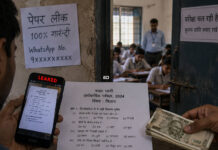











It’s the morning of the most important exam in a student’s life. Across India, millions of aspirants wake up with the fear that their hard work might be undermined by the country’s examination system. Notorious for paper leaks, cancellations, cheating scams and scoring errors, students are clamouring for a complete overhaul of the system.
As India grapples with systemic failures, year after year, we can turn our gaze eastwards for a bout of inspiration. Our neighbouring country, China, has transformed its examination system into a model of consistency.
World’s Biggest Exam
China hosts the largest standardised exam in the world, with more than 10 million students appearing for it every year.
It’s called the Gaokao, and it is China’s national annual entrance examination, much like India’s NEET, JEE or UPSC examinations. In most cases, a student’s Gaokao score largely determines which universities they can attend.
According to the Harvard University Press, it is the largest standardised exam in the world, with a staggering record total of 13.42 million students registering for it in 2024.
The Gaokao is a vertical, state-mandated operation, where each province receives quotas from the Central government, and they set up their cut-offs accordingly.
As per a video titled, “Inside China’s Gaokao: The World’s Toughest Exam?” by MO of Everything, this standardised test is “massive” where “13 million Chinese students still show up.”
The video further notes that the “exam is held every June,” when “cities enforce traffic restrictions, halt construction, and deploy police and ambulances to keep noise and nerves under control.” It also highlights the extreme dedication of students, mentioning that “some students even prepare while hooked up to oxygen tanks in hospitals, just to stay focused.”
The exam held annually in June is conducted over two to four days. The level of security surrounding the exam rivals that of major state operations.
Have the Chinese cracked the code on how to handle large-scale entrance exams with an uber-level of transparency? Why is India still stuck in the loop of exams, leaks, scams, cancellations, and rescheduling?
Controversies around students from the same centre getting perfect scores to faulty OSM scoring in recent CBSE board exams – the aftermath of giving an exam leaves a lot to be accounted for.
Read more: Shocking Confessions By NEET 2024 Paper Leak Arrested Students
How does China Secure The Gaokao
So, what does China do?
Exam papers are given the importance of top-secret documents. They are heavily guarded during transit and administration akin to military-grade security. Papers are printed in highly restricted, 24/7 monitored facilities.
Teachers involved in preparing the question papers are isolated from society for months to prevent any paper leaks.
Police escorts and emergency ambulances are deployed to ensure students arrive safely and on time at testing halls.
Traffic is restricted around testing centres and on routes where papers will be carried. Heavy construction, special shows and events are cancelled or postponed. A stress-free and distraction-free environment is created for students.
During a recent visit to China, influencer @thatindianchick_ witnessed the Gaokao preparations firsthand and was amazed by the extraordinary measures taken to ensure a smooth examination process.
View this post on Instagram
India’s Exam Crisis
Cut to our Indian counterparts
The recent cancellation and rescheduling of the NEET exam to June 21, 2026, is a prime example. Investigations surrounding alleged paper leaks revealed that a pre-circulated guess paper matched significant portions of the actual test, forcing the National Testing Agency (NTA) to cancel the exam on May 12, 2026.
While this was among the most unprecedented disruptions in the exam’s history, paper leak controversies had also surrounded the 2024 examinations.
Concerns have also emerged around CBSE’s On-Screen Marking (OSM) system, with several students alleging missing pages, blurred scans and mismatches between their physical answer sheets and the digitised copies used for evaluation. The controversy has reignited questions about the transparency and accuracy in the assessment process.
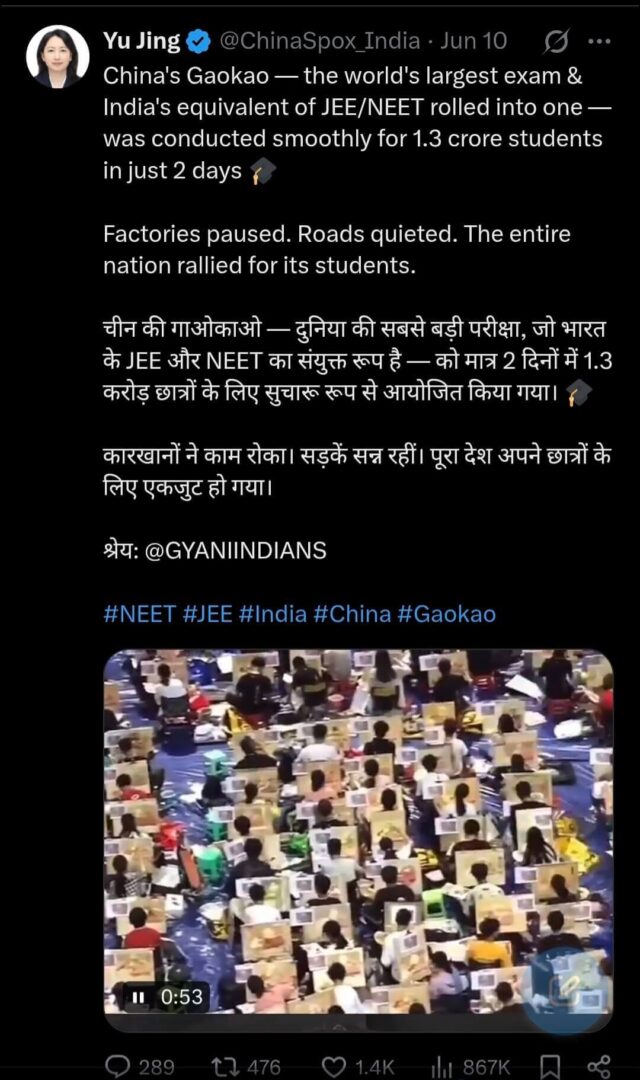
The comparison even entered the diplomatic sphere. Chinese Embassy spokesperson in India, Yu Jing, highlighted the smooth undertaking of the Gaokao in a post on X/Twitter, a move widely interpreted as a subtle dig at India’s exam controversies.
The Real Difference: Accountability
The fundamental difference lies in the chain of custody. The Gaokao is a centralised, state-run operation where accountability is clearly defined. In contrast, India’s system is decentralised and agency-led. When responsibility is spread across a fragmented web of third-party vendors, printers and logistics firms, points of failure are bound to multiply.
Is The Gaokao Really Leak-Proof?
It’s not as if the Gaokao has been free of all controversy. Over the years, Chinese authorities have dealt with cheating rings, technology-assisted frauds and allegations of leaked exam material. However, such incidents remain relatively uncommon and are often met with swift investigations and severe penalties.
The difference lies less in the absence of complete malpractice but in the state’s capacity to enforce accountability when violations occur. The system appears stronger in terms of logistics, security and administrative control.
One Exam, One Gateway
All Gaokao students are tested in three compulsory subjects: Mathematics, Chinese and a foreign language, usually English. Beyond these core papers, students choose additional subjects from disciplines such as Physics, Chemistry, Biology, History, Geography and Politics, depending on their province’s examination model.
Unlike India, where students sit separate examinations such as NEET for medicine, CLAT for law, JEE for engineering and CUET for university admissions, the Gaokao serves as a single gateway for higher education for most Chinese students. This unified structure is one of the reasons why the scale of the Gaokoao is significantly larger than any individual entrance exam conducted in India.
Can India Catch up?
The Indian government is undertaking monumental measures for the rescheduled NEET exam to be held on June 21, 2026.
Unprecedented multi-layered security, with the Indian Air Force reportedly assisting in the transportation of question papers and the CRPF strengthening ground-level security, is underway. Access to the messaging app, Telegram, has been temporarily restricted until June 22, 2026, citing alleged use by organised cheating networks.
Plans are also in the pipeline for completely transforming the exam from the routine Optical Mark Recognition (OMR)- based pen-and-paper format to Computer-Based Test (CBT) mode.
The Human Cost Of Failure
The weight of burgeoning expectations, hours of study, coaching loops and preparation will culminate in that one entrance exam capable of changing a life. But if that examination is considered null and void, the human cost is immense.
We often treat these scandals as administrative inconveniences, but for the student, they are moments of deep trauma. Every time a paper is leaked, it is a betrayal of months of isolation and sacrifices made by families across the country.
Our students deserve a system that works as hard as they do. A system that honours merit, prevents dreams from being shattered and hopes from being expunged.
Image Credits: Google Images
Sources: The Print, The Wire, Firstpost
Find the blogger: @diptisadh
This post is tagged under: exam, examinations, examination system, India vs China, Gaokao, NEET, India exam crisis, NEET paper leak 2026, entrance exams, Gaokao vs Indian Exams, CBSE, exam transparency, China, education, education system, students, aspirants, JEE, CUET, student mental health, National Testing Agency
Disclaimer: We do not own any rights or copyrights to the images used; these images have been sourced from Google. If you require credits or wish to request removal, please contact us via email.
Other Recommendations:
What Will Now Happen To Parents Who Paid Rs. 5-10 Lakh For Leaked NEET Papers