





























Former PepsiCo CEO Indra Nooyi has sparked a heated debate in India following a candid conversation with former U.S. Secretary of State Condoleezza Rice that took place at the Hoover Institution on July 1, 2026. While the interview touched on wide-ranging topics from leadership, immigration, to the shifting geopolitical dynamics between India and China, one segment has dominated the discourse and struck a nerve.
Take a look at the entire conversation here:
What exactly did Indra Nooyi say?
Reflecting on her trajectory from her upbringing in 1960s and 70s India to the pinnacle of American corporate leadership, Nooyi was blunt about her opportunities. “This is where an immigrant could come in with nothing in her pocket and become the CEO of an iconic American red, white and blue company,” she asserted.
“I would never have been CEO in any other country in the world, including in India.” She attributed this success to the American corporate structure, adding, “It’s because the system is a meritocratic system. Mentors don’t care whether you’re male, female, ethnicity, gender. They don’t care. They just want the best brains to rise to the top.”
However, her observations extended beyond the boardroom. She also characterised India as a “chaotic country,” noting that while its “beauty lies in its chaos,” it remains “impossible” for those who prefer an orderly, clean environment. Furthermore, she identified India as a “pivotal” country for the future, particularly regarding the talent pool in engineering and AI, but added that given the “bad neighbourhood” India is in, she believes it is “critically important the U.S. protects India and allows democracy to thrive.”
Why Are People Upset?
These remarks have triggered an immediate and widespread backlash, turning the conversation into a proxy for a deeper, thornier question. Is Nooyi’s assessment a fair reflection of her past, or a dismissive take on modern India’s present?
The establishment pushback began almost immediately. Former Foreign Secretary Kanwal Sibal led the charge, asking why Nooyi felt the need to paint an inaccurate picture of her homeland.
In a post on X/Twitter, he pointed to a growing list of successful Indian women CEOs such as Falguni Nayar, Kiran Mazumdar-Shaw, Radhika Gupta, and Priya Nair, as evidence that the landscape has shifted significantly.
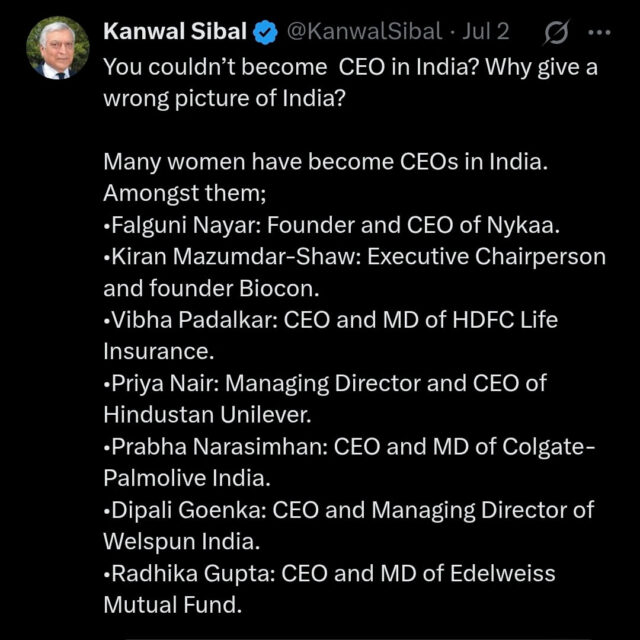
Furthermore, he took sharp issue with her call for India requiring U.S protection. Commenting on Nooyi’s comment that it was “Critical for the U.S. to protect India and allow democracy to thrive”, Sibal proclaimed that democracy in India didn’t need U.S. protection and that a U.S.- India partnership has to be cultivated on mutual benefits and “not one of subservience as this lady is advocating.”
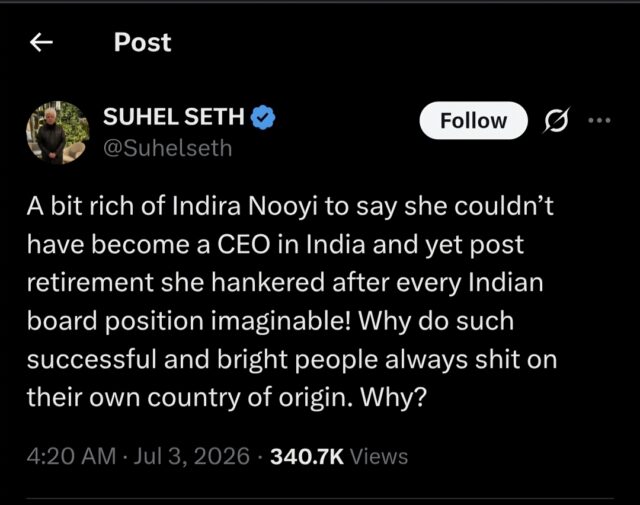
Others took the critique further. Branding consultant Suhel Seth, in a post on X/Twitter, said that Nooyi would claim a career trajectory impossible in India while simultaneously pursuing board seats at major Indian companies during her retirement. His broader question was why successful expats often feel the need to disparage the country they emerged from.
The Internet Reacts
This became a viral talking point, finding a particularly loud echo on Reddit.
On the r/india subreddit, a thread titled “Indra Nooyi says she ‘could never have become CEO in India” is racked up largely with comments of scepticism and annoyance. One user cited examples of “Shikha Sharma, Kalpana Morparia, Prabha Narasmhan, Vibha Padalkar” as women CEOs in India, while saying that they hoped “Indra Nooyi did not mean to diminish professional achievements of women in India.”
They cited figures like Leena Nair, who reached the global CEO level at Chanel while based in the UK, suggesting that meritocracy is not a uniquely American product.
More cynical observers have framed the incident as a “typical NRI mindset of self hating. Only Indians do that. Literally, I have seen asylum seekers still praise their home country.” Users like u/margosi argued that such remarks fit a pattern where successful emigrants “thrash and stereotype” India to “gain favour in west”, also questioning as to “why did we sell Indian companies like Uncle Chips and Thums Up to organisations who think lowly of Indians?”
Read more: Another Indian Becomes The CEO Of A Global Brand; Chanel
Meanwhile, more moderate voices, such as u/BonusFeed4077, have shrugged the controversy off, noting that as a U.S. citizen, Nooyi is entitled to her opinions and that, at this stage in her life, the weight of her comments may be overstated.
Others on social media pushed back against the idea that India needs American “guardianship,” with one user stating, “Nobody asked! India protects itself! We don’t need American guardianship! Stop this colonial mindset!”
Some also pointed to India’s history of leadership, noting that India had a female Prime Minister for over a decade shortly after independence, while the U.S. has yet to elect a female President.
Context Matters
Yet, the online response is not entirely monolithic. Buried under the outrage, some have also tried to bring a more nuanced and reasonable perspective to the debate. Critics who urge a bit of perspective note that Nooyi left India in 1978.
Her career was built entirely within an American corporate structure during the 80s, 90s, and 2000s, when there was a fundamentally different India than the one that exists today. It is possible that her remarks are not a critique of the India of 2026, but a reflection of the India she left behind nearly five decades ago.
The Bigger Debate Over Meritocracy And Modern India
Whether Nooyi’s comments are viewed as an honest reflection of the India she left behind or an unfair assessment of the India that exists today depends largely on perspective. But the reaction to her remarks shows that discussions about meritocracy, opportunity and national progress remain deeply personal for many Indians.
In that sense, the controversy has become less about Indra Nooyi herself and more about how India sees its own journey.
Image Credits: Google Images
Sources: The Economic Times, Moneycontrol, The Times Of India
Find the blogger: @diptisadh
This post is tagged under: Indra Nooyi, Indra Nooyi comments on India, CEO, Condoleezza Rice, Pepsi CEO, PepsiCo CEO, Hoover Institution, India meritocracy, India vs China, India vs U.S., Suhel Seth, Kanwal Sibal, social media debate, viral controversy, women CEOs in India, corporate sector, NRI debate
Disclaimer: We do not own any rights or copyrights to the images used; these images have been sourced from Google. If you require credits or wish to request removal, please contact us via email.
Other Recommendations: