





























Earlier this month, the internet erupted over Janhavi Kapoor’s portrayal in Peddi. Critics pointed to the camera’s lingering gaze on her waist and navel, arguing that her character seemed reduced to her physical attributes. As some viewers quipped online, the only arc her character appeared to follow was the arch of her curvaceous figure.
Janhvi’s character seemed to serve no purpose within the story other than satisfying the male gaze. In light of the intense backlash, the film’s director Buchi Babu Sana apologised and tweeted, “As a filmmaker, I believe cinema should entertain, inspire, and connect with audiences. It should never make anyone feel uncomfortable or disrespected. We have heard the feedback regarding certain scenes in Peddi and have taken it seriously.”
The makers made the related changes to the concerned portions to appease the negativity surrounding the film.
For many, the issue was not merely how much skin was shown, but what the camera chose to emphasise and why.
Yet only weeks later, another film has reignited a similar conversation, but with far less outrage.
Kriti Sanon’s character Ally in Cocktail is introduced through a series of glamorous, body-conscious shots. Bikini sequences, cleavage-centric framing and lingering close-ups are all part of the film’s visual language. The camera is no less interested in the female body here than it was in Peddi.
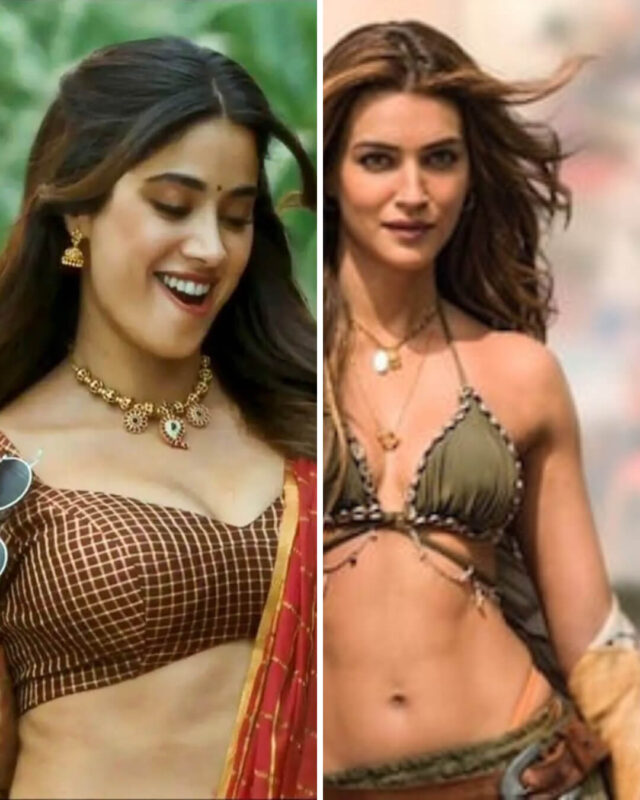
So why has the reaction been so different?
The First Reactions
While both films generated conversations around the way their female leads were filmed, the immediate audience response to both was markedly different.
When Janhavi Kapoor’s scenes from Peddi went viral, a section of viewers on social media criticised the presentation as “cringe”, “forced” and “hypersexualised”.
In contrast, social media reactions to Kriti Sanon’s appearance were overwhelmingly celebratory. X/Twitter users flooded timelines with comments describing her as “hot” and “gorgeous”. User @Nazeerthings wrote “Kriti just shows up and breaks the internet”, while @BontadiBunty called it “hottest anyone has ever looked on Indian screen”. Another user, @MalvikaSena, wrote that “Kriti Sanon lit up the screen.”
The stark contrast in audience reactions soon sparked a wider debate. If both films featured similar visual framing, why was one criticised and the other celebrated?
What Viewers Are Saying
The debate online has been far from unanimous. While some viewers see hypocrisy in the contrasting reactions to Peddi and Cocktail, others argue that context and agency make the two portrayals fundamentally different.
A user on X/Twitter compared the polarising reactions received by both films, calling out the same critics who are praising Kriti while pointing out the objectification in Peddi.
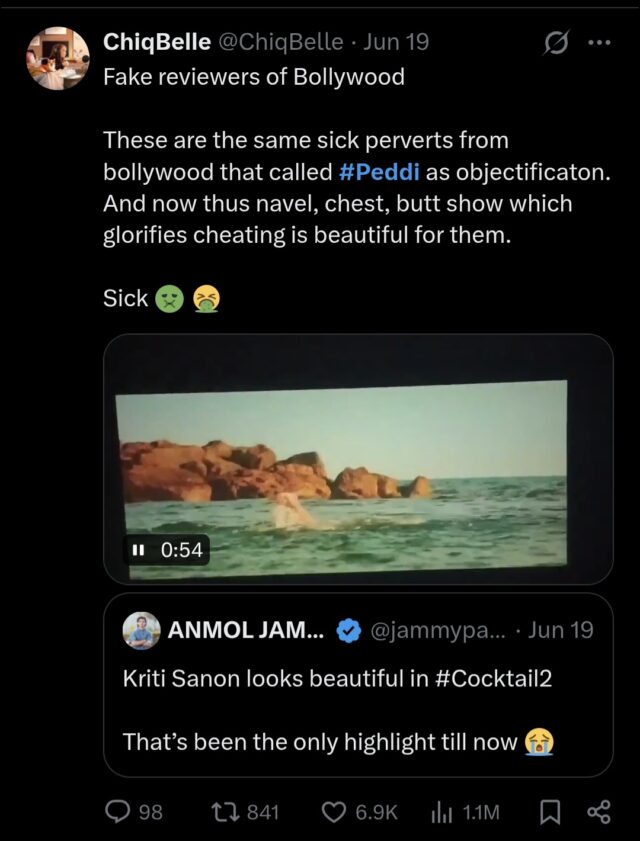
Others disagreed. X/Twitter user @SAMTHEBESTEST_ described the debate as “two different situations” being unnecessarily brought together. The user pointed out that Janhavi’s character “is a girl from backward village” while Kriti’s character “is an urban, free-spirited girl living in Sicily and goes for swimming in beach.”
Similarly, @I_am_stuck argued that Kriti couldn’t have been expected “to wear saree and blouse on beach.” Context and agency both seem to play an important role in viewer interpretation.
Film commentator Anmol Jamwal argued on X/Twitter that “Peddi depicted sexual assault as romance” and repeatedly showed a male lead “stalking and drooling over a woman without her knowledge and consent” while “Cocktail 2 presents Kriti intentionally being suggestive” and “ITS NOT THE SAME THING!!!!”
@user_reddy pointed out, “Which woman walks like how Janhvi does in Peddi? In a village, throwing away her pallu? And then suddenly changes after marrying the male lead?”
Similar sentiments emerged on Reddit. A thread titled, “After the Janhvi Kapoor-Peddi controversy, the makers of Cocktail 2 are now getting slammed for Kriti Sanon’s bikini shots. What are your thoughts?” on r/BollywoodJassos – users are saying that the “issue isn’t the bikini itself, but the way the camera focuses on her body.”
Another said, “Kriti’s character wasn’t being assaulted. She was using her own body the way SHE wanted.”
Another said, “Kriti’s exposure is natural & Janhvi feels f***ing forced damn.”
The comparison raises an uncomfortable question: are audiences applying different standards, or are they responding to meaningful differences in how the two women are framed?
Read more: Janhvi Kapoor’s Peddi Movie Sparks Chat On Paps Zooming In Inappropriate Angles
When Sly Camera Angles Make All The Difference
Cinema doesn’t merely show, it directs attention. A camera angle tells viewers where to look, what to notice and often, what to desire.
Most moviegoers have witnessed this familiar visual grammar. The camera begins at a female character’s face and then moves downward. A slow pan lingers on the waist. A close-up isolates the navel or the cleavage.
In Peddi, the camera often appears more interested in introducing Janhvi Kapoor’s body than in introducing Achiyamma as a character. Before viewers learn who she is, they are repeatedly reminded of how she looks. The angles seem invasive and voyeuristic.
Cocktail 2 uses many of the same techniques. Slow pans, revealing costumes and lingering close-ups introduce viewers to Ally, but they are framed as an extension of a character who is confident, self-aware and comfortable with her sexuality.

When Intentions Speak Louder
Increasingly, audiences are not reacting to the image alone but to the intentions behind it. A revealing costume may draw less criticism if viewers believe it serves character or story. The same can provoke outrage when it appears designed solely to draw attention to the actress’s body.
In Cocktail, Kriti’s costumes don’t feel out of place but merely an extension of her character. But in Peddi, Achiyamma is dressed in a manner that appears designed to draw attention. The intention of the filmmaker behind the lens is clearly visible.
The Question Of Agency
Part of the answer lies in agency.
In Peddi, viewers felt that Janhavi’s character had little agency over how she was presented. The visual focus on her body appeared disconnected from character development, and many romantic interactions with the male lead raised questions about consent and autonomy. The result was a perception that the character was expected to be looked at rather than understood.
Cocktail, however, frames Ally differently. She is presented as someone actively making choices, pursuing desire and shaping her own relationships. The camera may still sexualise her, but audiences are more willing to accept such imagery when it appears to emerge from a character exercising agency, rather than having it imposed upon her.
Why Context Matters
Peddi unfolds in a rustic setting where female characters are expected to embody innocence and traditional femininity. Add to that South Indian cinema’s long-documented fascination with the navel as an object of visual attention. Directors have frequently used close-ups, water droplets and choreographed sequences to highlight this part of the female body.
Cocktail inhabits a glossy, aspirational universe filled with luxury holidays, fashionable wardrobes, bachelorette parties and modern lifestyles. The same camera angle that feels exploitative in one world can appear stylish or even empowering in another.
Perhaps that says as much about audiences as it does about filmmakers. We are more forgiving of objectification when it arrives wrapped in aspiration. If we want the lifestyle, the body and the world being sold to us, we may be less likely to question the methods used to sell it.
While both films have received criticism for their depiction of female characters, the nature and intensity of backlash differ significantly.
The Contradiction Beyond Cinema
The contradiction extends beyond cinema. At a time when debates rage over covering centuries-old sculptures and artworks in the name of modesty, mainstream entertainment continues to benefit from displaying the female form.
Who Controls The Gaze
Perhaps that is why two seemingly similar portrayals have elicited such different reactions. The controversy is really not about Janhvi’s waist or Kriti’s bikini. It is about authorship. Modern audiences are increasingly questioning who controls the gaze, who benefits from it and what purpose it serves.
The body may be the same, the camera angle may even be similar, but intention often shouts louder than what meets the eye.
Image Credits: Google Images
Sources: The Indian Express, The Times of India, Hindustan Times
Find the blogger: @diptisadh
This post is tagged under: Peddi, Cocktail 2, Cocktail, Kriti Sanon, Peddi Controversy, Janhvi Kapoor, Buchi Babu Sana, Camera Angles, Urban Women, Intentions, Male Gaze, Indian Cinema, Bollywood, Objectification Of Women, Women In Cinema, Entertainment Industry, Celebrity Culture, Indian Media, Pop Culture, Women’s Rights, Social Issues, Film Industry, Viral News, Trending News, Entertainment News, Bollywood News
Disclaimer: We do not own any rights or copyrights to the images used; these images have been sourced from Google. If you require credits or wish to request removal, please contact us via email.
Other Recommendations:
Toxic Masculinity, Stalking And Women As Just Plot Devices Are Some Notions Of Romance In Bollywood