






























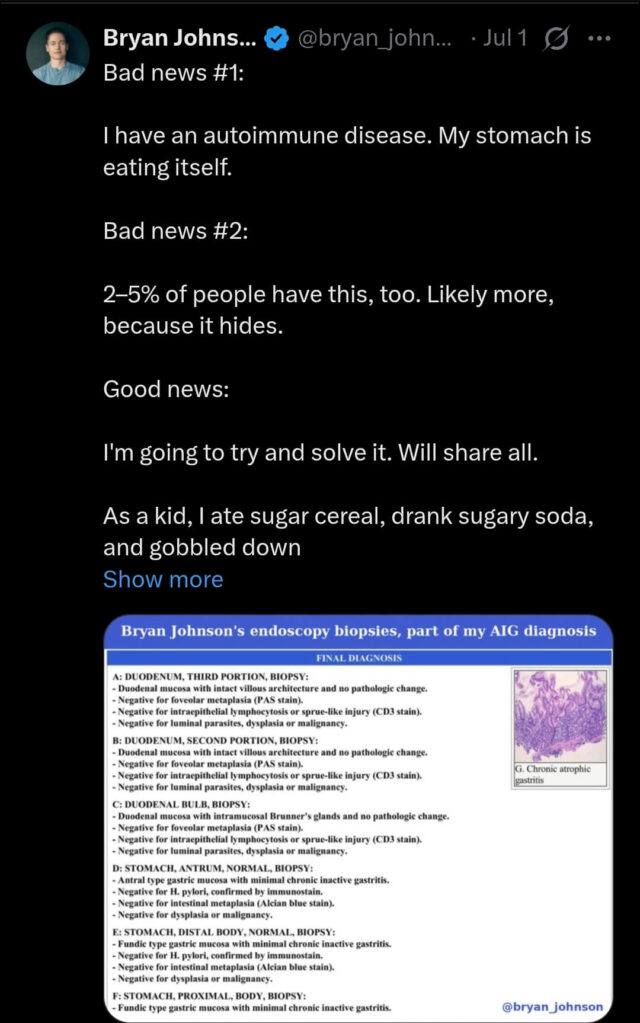
Tech entrepreneur and biohacker Bryan Johnson stunned his millions of followers on X/Twitter when he posted, “Bad news #1: I have an autoimmune disease. My stomach is eating itself.”
For someone who has spent years turning his own body into a public experiment, the announcement immediately sparked a question far bigger than the diagnosis itself. Had years of attempting to outsmart biology finally caught up with him? Had years of playing with nature cost him his health?
Take a look at his post:
Bryan Johnson, 48, is one of the world’s best-known biohackers. After selling payment company Braintree to PayPal in 2013, he shifted his focus almost entirely to longevity, spending millions of dollars on Blueprint, a meticulously documented protocol involving strict nutrition, intensive exercise, dozens of daily supplements and extensive medical testing. His mission, as reflected in his X/Twitter bio, is simple: “Conquering death will be humanity’s greatest achievement.” That quest was also chronicled in Netflix’s Don’t Die: The Man Who Wants to Live Forever.

So when Johnson revealed he had been diagnosed with autoimmune gastritis (AIG), a chronic autoimmune disease that damages the stomach lining, social media quickly asked whether the man trying to defeat ageing had finally been defeated by his own body.
A Diagnosis Years In The Making
Pondering over the diagnosis, Johnson wrote, “I just discovered it in May. I’m unsure how long I’ve had it. AIG causes irreversible damage.”
The diagnosis explained a mystery that had persisted for years. “I had low iron for 11 years,” explaining that despite persistently low ferritin levels, doctors repeatedly reassured him because “my hemoglobin and hematocrit were normal.”
Looking back, he reflected, “No one asked why my iron reserves wouldn’t refill.” Only after antibody testing and stomach biopsies was autoimmune gastritis confirmed.
Rather than presenting the diagnosis as the end of his longevity experiment, Johnson immediately treated it as the next challenge. “I’m going to try and solve it.”
Over the following days, he posted almost daily, documenting not just test results but his changing thoughts about disease, mortality and public reaction.
Did Years Of Biohacking Lead To This?
That question quickly divided both the internet and medical experts.
For years, Johnson has promoted a lifestyle built around rigorous health optimisation. His daily routine of supplements, highly controlled meals and extensive medical monitoring has made him one of biohacking’s most recognisable and polarising figures.
When he announced an autoimmune disease, many assumed the lifestyle itself must have been responsible.
Johnson disagreed. Responding to suggestions that eating meat or spending more time in the sun would reverse the condition, he wrote, “These are unlikely,” adding that he had been “eating meat and in the sun for hours a day”, when the autoimmune process first began.
In another post, he dismissed simplistic explanations, comparing them to “trying to fix corrupted software by changing the room temperature.”
Medical experts who commented publicly reached a similar conclusion.
Speaking to STAT, Dr. Toby Cornish, a gastrointestinal pathologist at the Medical College of Wisconsin, described Johnson’s theory that childhood diet contributed to the disease as “highly speculative.”
Ram Hariharan, director of programs at Northeastern University’s Seattle campus, observed, “Bryan Johnson is arguably the most measured human alive, and this condition still hid from him for years.”
He added that while researchers have become increasingly good at collecting health data, “we’re not yet in a position to engineer our health.”
Jennifer Dowd, Professor of Demography and Population Health at the University of Oxford, offered perhaps the simplest assessment. “You really can’t biohack your way completely out of disease or death.”
Read more: If Indians Want To Live Longer, This Is What They Need To Do
Social Media Couldn’t Agree
While medical experts largely dismissed a direct link between Blueprint and autoimmune gastritis, social media remained sharply divided.
Some users believed Johnson’s relentless experimentation had finally caught up with him.
X/Twitter user @quips_n_jokes wrote, “I’m curious. You’re building a brand around a longevity drink based on all the pills and potions you take. At the same time you reveal you have a stomach problem, which people will naturally connect to all the stuff you’ve been putting into your body.”
@AoDMD38 wrote, “Life and death are not yours to control, maybe then you can actually find a real purpose.”
Others criticised Johnson’s philosophy rather than his diagnosis.
@BasedTorba wrote, “You wrongly assume that everyone fears death as much as you do and upon this false assumption you build your entire worldview.”
The criticism sometimes became deeply personal. X/Twitter user @TonySirico23posted, “Should I feel bad that I hope this guy dies?”
Another user described the diagnosis as “ancient Greece levels of tragicomedy,” arguing there was irony in a longevity advocate developing a chronic illness.
Not everyone agreed.
@AutismCapital wrote, “Happy you found and are managing it. Your vigilance paid off. Stay healthy, Bryan.” Another user, @thelaptoplegend, commented, “I’m grateful that someone with your assiduousness and resources is now battling to find a cure. This gives me hope for the future.”
Reddit discussions were similarly split.
In a thread titled, “Bryan Johnson got Autoimmune Disease”, from subreddit r/SipsTea, user jtizzle1231 argued, “Johnson’s doctors confirmed his AIG is in the early stages… him being proactive probably helped him.”
Meanwhile, Reddit user superpoongoon, who identified themselves as a physician, suggested, “What seems more likely to me is that the weird sh*t he’s been putting in his body caused it to trigger.”
Another Reddit user disagreed entirely. “This disease is essentially a genetic lottery. Anyone can develop it, regardless of how healthy their lifestyle is.”
Another user on thread “Bryan Johnson” from subreddit r/biohackers, wrote, “I tend to agree, taking supplements at concentrations not found in nature is a bit risky.”
Johnson’s Response
Rather than retreating from the spotlight, Johnson continued documenting his experience.
First came gratitude. After receiving thousands of messages from followers, he posted simply, “Thank you. Means more than you know.”
He also reflected on how illness had changed his perspective. “We spend a fraction of our lives truly sober to the preciousness of life.” Adding, “Health is easily forgotten until it’s the only thing that matters.”
When followers flooded his posts with treatment suggestions, Johnson remained gracious. “I know you’re coming from a good place and I appreciate your intent.”
Yet he also challenged how people think about illness. “Getting a diagnosis carries a stigma. That thinking is backwards.”
“People fear false positives. I fear false negatives.”
In another post, Johnson invited followers into the process rather than claiming certainty. “Eager to hear your life advice. What should I be doing?”
Days later, his focus shifted from the disease itself to the reaction it had generated.
Johnson posted that nearly 1,900 articles had covered his diagnosis, turning his diagnosis into global news. While many were thoughtful, he believed “joy dominated the commentary.” He said he felt “the world wants me to die,” and that many people believed “I deserved it because I challenged death.”
Even so, he insisted he would continue. “An incurable diagnosis is a rite of passage for Don’t Die.”
“To overcome death, we have to cure disease. To cure disease, we have to understand disease…….I’m going to try.”
Did Nature Finally Catch Up With Him?
Johnson’s diagnosis has reignited debate about the limits of biohacking, but it has not settled it.
Medical experts who have commented publicly say there is currently no evidence linking Blueprint or Johnson’s supplement regimen to autoimmune gastritis. Instead, the disease appears to have been developing silently for years before his most intensive longevity protocols began.
What the diagnosis has challenged is not necessarily Johnson’s methods, but the belief that even the most carefully optimised body can be completely controlled.
For critics, the diagnosis exposed the limits of trying to outsmart nature. For supporters, it demonstrated the value of relentless monitoring, allowing Johnson to identify a disease that often goes undetected for years.
Johnson, meanwhile, appears to see it differently. Rather than viewing autoimmune gastritis as the failure of his experiment, he has made it part of the experiment itself.
Image Credits: Google Images
Sources: The Print, The Times of India, Firstpost
Find the blogger: @diptisadh
This post is tagged under: Bryan Johnson, Bryan Johnson autoimmune disease, autoimmune gastritis, Bryan Johnson Blueprint, biohacking, longevity, Bryan Johnson health, anti-ageing, Don’t Die Netflix, Bryan Johnson Twitter, longevity science, biohacker, health optimisation, conquering death, Blueprint protocol
Disclaimer: We do not own any rights or copyrights to the images used; these images have been sourced from Google. If you require credits or wish to request removal, please contact us via email.
Other Recommendations:
Man Turns 10 Years Younger In Science Experiment; Here’s How