










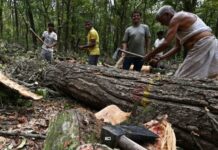



















Thousands of mature sal trees are marked to be felled near Saat Mod, along the Bhaniyawala–Jolly Grant–Rishikesh stretch of National Highway 7 (NH-07), to make way for the ₹743-crore Bhaniyawala–Jolly Grant–Rishikesh Four/Six-Laning Project. The stretch cuts through a forest that forms part of the Rajaji Tiger Reserve landscape and an important elephant corridor, triggering days of protests by residents, students, environmentalists and political groups who argue that the cost of development cannot be measured in kilometres of road alone.
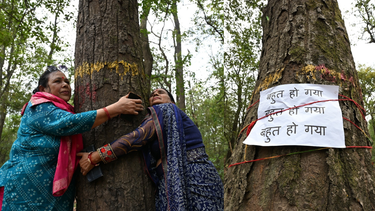
The images emerging from Rishikesh are striking. Residents embracing trees in an attempt to stop them from being cut, protestors sitting before logging machinery, environmental activists raising slogans and police escorting protesters away have drawn inevitable comparisons with Uttarakhand’s historic Chipko Movement. But unlike the 1970s, this battle is unfolding in a world already grappling with the consequences of climate change.
The tree felling is part of the ₹743-crore Bhaniyawala–Jolly Grant–Rishikesh Four Laning Project on NH-07, a nearly 20-kilometre highway expansion being undertaken by the National Highways Authority of India (NHAI). The project aims to improve connectivity between Dehradun, Jolly Grant Airport and Rishikesh, reduce congestion during the Char Dham Yatra and accommodate the region’s steadily increasing traffic.
In a press release dated July 7, 2026, the Ministry of Road Transport and Highways (MoRTH) said the project reflects NHAI’s “commitment to developing future-ready highway infrastructure that addresses increasing traffic demand while safeguarding Uttarakhand’s forests and wildlife. By combining engineering innovation, environmental sensitivity and statutory compliance, the project demonstrates that sustainable infrastructure development and ecological conservation can progress hand in hand.”
Yet it is precisely that claim of an environmentally responsible highway that many residents are questioning.
The Protests
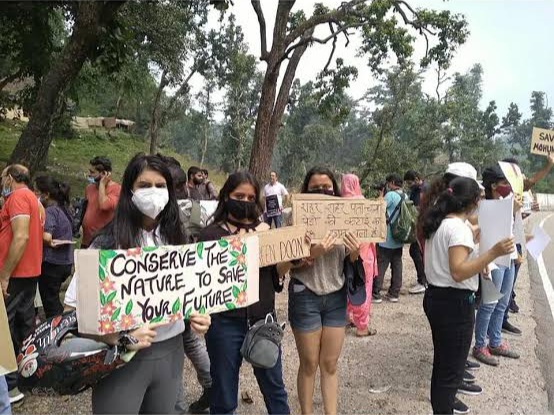
What began as local opposition has now grown into one of Uttarakhand’s most visible environmental protests in recent years. For more than a week, residents, students, environmental activists and members of the Uttarakhand Kranti Dal (UKD) have gathered daily near Saat Mod, demanding an immediate halt to the felling of thousands of mature sal trees. They argue that while roads can be rebuilt and widened, decades-old forests and wildlife corridors cannot simply be recreated once they are destroyed.
An active participant in the protest, advocate and local resident Ashutosh Kothari told ANI, “We’ve been protesting here for five days to prevent the sal trees from falling… those who are leaving the country are constantly saying that India is beyond repair. Uttarakhand is our only hope, that we can at least repair our state… don’t cut down these huge trees that give us oxygen. You’ve uprooted their canopy. All the sunlight is falling on the road. Now the heat will increase.”
Another protestor, Devanash Sharma, while speaking to TOI commented, “I am a resident of Ghamuwala near Bhaniyawala. Amid soaring temperatures, we fear the road widening through the Shivalik forests because it will only increase pollution of every kind.”
Their concerns extend beyond the immediate loss of trees. Protesters say mature sal forests regulate local temperatures, support wildlife movement and cannot simply be replaced through compensatory plantations.
Videos from the protest site show residents standing in front of logging machinery, hugging trees, chanting slogans and breaking down as mature sal trees were felled despite their resistance. Several protesters were heard shouting, “Cut me, not the trees,” as workers continued the felling operation. Take a look at this video, showing agitated protestors:
View this post on Instagram
Read more: Number Of Trees Cut Down In Amazon Reaches A High Since 2006
Among those consistently documenting the movement has been Dehradun-based social activist Anoop Nautiyal, who has shared regular updates, photographs and videos from the protest site on X/Twitter, while urging greater public attention to the issue.
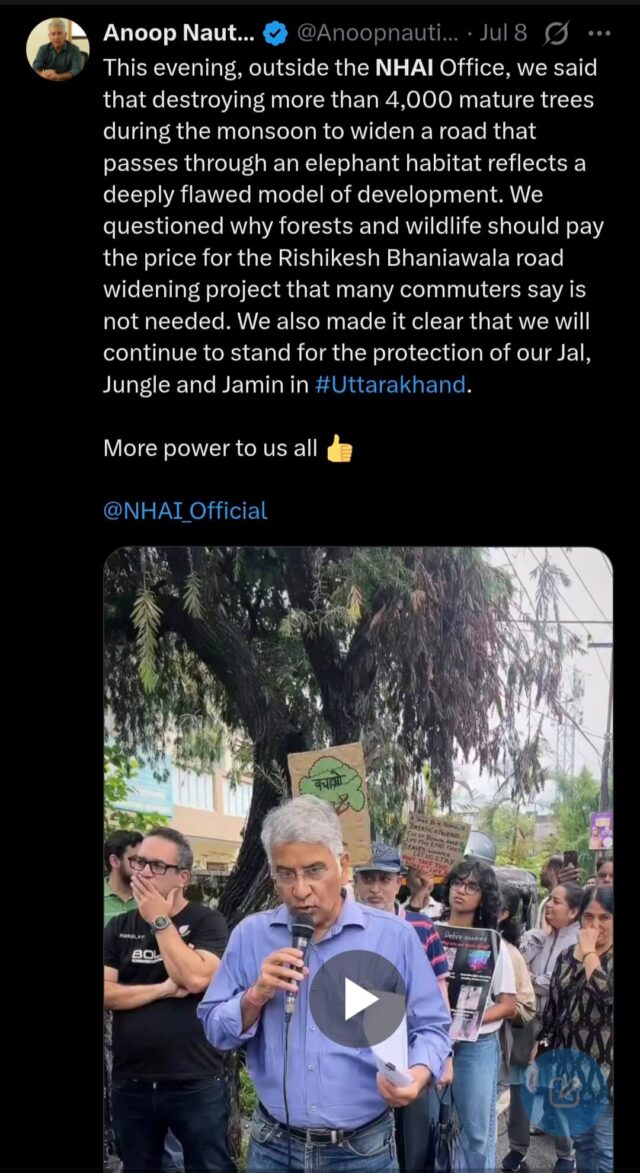
While many X/Twitter users described the protests as “Chipko 2.0”, @montybhadri wrote, “Why the haste? Where is the afforestation plan, the transparency and the accountability? Uttarakhand deserves answers.”
While @1company_slave wrote, “Be ready to die as lack of trees will cause extreme heat.”
The movement has also taken on a symbolic dimension. Environmental groups called on people across Uttarakhand to observe ‘Kala Harela’ (Black Harela) on July 15, transforming the state’s traditional Harela festival, which celebrates nature, greenery and tree planting, into a day of protest. The appeal came as the state prepared its annual Harela plantation drive. Protesters argued that celebrating afforestation while thousands of mature sal trees were being cut down sent contradictory messages about environmental conservation. Speaking to Amar Ujala, environmental activist Himanshu Arora remarked, “The government has an axe in one hand and pretends to water a sapling with the other,” arguing that symbolic plantation drives cannot compensate for the loss of decades and centuries-old forests.
The Legal Battle
The controversy has also shifted to the courts, where environmentalists have challenged the large-scale felling of trees, arguing that the highway expansion threatens a vital elephant corridor and could cause irreversible ecological damage.
Earlier this year, the Uttarakhand High Court disposed of one PIL after observing that issues relating to the elephant corridor had already been considered by the Supreme Court in earlier proceedings, while broader questions relating to tree felling were already pending before the apex court. The High Court also clarified that an earlier interim order restraining tree felling had not been extended, meaning there was no operative stay.
On July 11, the High Court dismissed a contempt petition alleging violation of its previous orders, holding that NHAI had not breached any judicial direction because no stay against tree felling was in force.
The matter is now before the Supreme Court, where petitioners have sought an immediate halt to tree felling. At the time of writing, no order from the apex court had been reported.
Meanwhile, as protests intensified, police registered an FIR against around two dozen protesters under Sections 132 and 3(5) of the Bharatiya Nyaya Sanhita. Several activists, including members of the Uttarakhand Kranti Dal, were detained after attempting to block construction machinery.
Why The Debate Extends Beyond Rishikesh
The timing of these protests has made them difficult to view in isolation.
Across Western Europe, June 2026 became the hottest June ever recorded. A prolonged heat dome pushed temperatures to unprecedented levels, with Germany recording 41.7°C and Poland 40.5°C. According to the World Health Organization (WHO) and EuroMOMO, the extreme heat has been linked to more than 10,000 excess deaths, the overwhelming majority among elderly people. Rail services buckled under the heat, power grids came under pressure and several countries battled wildfires alongside soaring temperatures.
India is witnessing a similarly worrying trend.
During the summer of 2026, 97 of the world’s 100 hottest cities were in India, with Balangir in Odisha touching 48°C. Across northern and eastern India, temperatures between 45°C and 48°C have become increasingly common, disrupting daily life, straining electricity and water supplies and contributing to heat-related deaths. According to the India Meteorological Department (IMD), heatwaves across India’s core heat zone have become both more frequent and longer-lasting over the past several decades.
In that context, forests are no longer viewed merely as green spaces. Scientists increasingly describe mature forests as natural climate infrastructure.
Speaking to Mongabay India, environmentalist Ravi Chopra, founder of the People’s Science Institute and former chairperson of the Supreme Court-appointed High Powered Committee on the Char Dham project, believes Uttarakhand is already paying the price for prioritising infrastructure over ecological limits.
“Environmentally, I would say Uttarakhand is in quite a bad shape and it is getting worse. For example, in Dehradun city, something like 22,000 full-grown mature trees of all kinds are being cut down to widen the roads so that more tourists can go up to Mussoorie. But in these places, the carrying capacity is exhausted.”
He warns that the consequences may only become obvious when it is too late.
“Eventually, when the climate change impacts become unbearable, then, as they say, necessity is the mother of invention. Then, we will wake up and we will try and become more sensitive to nature and the environment. But in the meantime, a lot of people would have suffered, and most of the people who will suffer will be the poorer ones.”
A Global Question About Development
The questions being raised in Rishikesh are not unique to highways.
Around the world, governments are increasingly being forced to examine whether major infrastructure projects should undergo deeper environmental scrutiny before construction begins rather than after ecological damage has already occurred.
The rapid expansion of artificial intelligence has triggered one such debate. Large AI data centres consume enormous quantities of electricity and water for cooling, prompting policymakers to examine their long-term environmental impact.
In New York, Governor Kathy Hochul announced a temporary pause on new hyperscale AI data centres while the state develops a stronger regulatory framework.
“As datacenter development threatens to hike up utility bills, deplete our natural resources, and create uncertainty for New Yorkers, it’s my responsibility to take action and lead.”
While the two cases involve different sectors, both raise the same policy question. Should environmental costs be fully understood before irreversible decisions are made?
Beyond The Highway
The Bhaniyawala–Jolly Grant–Rishikesh highway will almost certainly improve connectivity, reduce congestion and make travel easier for thousands of commuters, tourists and Char Dham pilgrims. Few would argue that Uttarakhand does not need better infrastructure.
The question raised by the protests at Saat Mod, however, is whether development can still be called sustainable when its environmental costs are paid upfront while its ecological safeguards are debated later. Once a mature forest disappears, it cannot simply be recreated by planting saplings elsewhere.
Whether the Supreme Court ultimately intervenes or the highway proceeds as planned, the protests have already achieved something significant. They have transformed a local road-widening project into a national conversation about how India intends to build in an age of climate change.
The people embracing sal trees in Rishikesh are not merely trying to save a patch of forest. They are asking a question that governments, planners and citizens are likely to confront with increasing urgency as the planet warms. Should development be judged only by the roads we build, or also by the forests we choose not to lose?
Image Credits: Google Images
Sources: The Times of India, India Today, The Guardian
Find the blogger: @diptisadh
This post is tagged under: Rishikesh, Rishikesh tree felling, Uttarakhand protests, NH-07, sal trees, Bhaniyawala Jolly Grant project, Rajaji Tiger reserve, elephant corridor, Chipko movement, NHAI, environmental concerns, heatwave India, climate change, forest conservation, deforestation, Supreme court, tree felling, Uttarakhand Kranti Dal, infrastructure
Disclaimer: We do not own any rights or copyrights to the images used; these images have been sourced from Google. If you require credits or wish to request removal, please contact us via email.