




























On June 4, 2026, the promise of emergency medical care failed a young man, Sunil Jha. A victim of a stabbing incident, Jha’s life did not end because his injuries were untreatable, but because his family alleged that treatment was stalled due to a demand for an upfront payment.
The allegations, raised during a Jan Sunwai with Delhi CM Rekha Gupta, held in Shalimar Bagh between June 18 and June 20, 2026, have triggered an official inquiry into Fortis Hospital, Shalimar Bagh.
What Is The Case?
Sunil Jha, a resident of Shalimar village, was attacked near the BC block in Shalimar Bagh on June 4, 2026. CCTV footage from Fortis Hospital shows Jha entering the emergency department on his own, in his injured state.
Mithilesh Jha, father of the victim, alleged that despite his son’s critical condition, treatment was delayed because hospital staff first demanded an advance payment. The family claims the delay proved fatal and that prompt medical care could have saved his life.
Taking cognisance of the complaint, Chief Minister Rekha Gupta ordered an inquiry into the incident. A multi-departmental inspection led by the Central District Magistrate examined CCTV footage, emergency records and the hospital’s compliance with statutory norms.
The inquiry also flagged several irregularities, including unauthorised construction, misuse of basement areas, significant deficiencies in fire safety systems and several lapses in standard operating procedures.
“The team also examined CCTV footage and found that the youth who later died after suffering the stab injury had walked into the emergency department on his own. This suggests that had he received timely treatment, his life could have been saved,” the inquiry findings stated.
“In view of these irregularities and the negligence in patient care, it has been decided to initiate action against the hospital,” the district administration said
The hospital in question has assured complete co-operation with authorities, commenting, “Fortis remains committed to the highest standards of patient care, clinical excellence, and regulatory compliance. We will review the details once formally shared with us and extend our full cooperation to the authorities. Patient safety and well-being continue to be our foremost priority.”

While allegations against Fortis are under investigation, the case has once again reopened a long-standing debate. Should a hospital’s first instinct in an emergency be to save a life or secure a payment? Indian courts have repeatedly answered this question, yet similar allegations continue to surface.
The Right To Life Cannot Wait
Under Article 21 of the Indian Constitution, the Right to Life and the Right to Emergency Medical Care are absolute. The Supreme Court of India has consistently reinforced that both public and private hospitals must prioritise the stabilisation of a patient over financial transactions. The landmark Supreme Court judgement in the Parmanand Katara case (1989) firmly established that:
“Every doctor, whether at a government hospital or otherwise, has the professional obligation to extend his services with due expertise for protecting life. No law or State action can intervene to avoid/delay the discharge of the paramount obligation cast upon members of the medical profession.”
Demanding payments as a prerequisite for life-saving treatment is not just an ethical failing but illegal, too.
The Fortis case is not an isolated one. It is part of a disturbing trend of hospitals prioritising billing over humanity.
On June 7, 2004, a road accident victim was denied treatment from Maharaja Agrasen Hospital for failing to deposit admission fees of ₹10,000.
In another shocking incident from Uttar Pradesh in 2000, a pregnant woman delivered her baby outside the government hospital as she was refused entry inside because she was unable to pay.
Courts have repeatedly condemned the practice of detaining patients or withholding bodies to settle billing disputes.
Read more: Denied Medical Attention, A 12-Year-Old Dies On His Father’s Shoulders While He Carried Him, Doctor To Doctor
In 2017, Onkar Singh, a former policeman, was allegedly detained over a disputed ₹13.45 lakh medical bill by Sir Ganga Ram Hospital. His son filed a habeas corpus plea against the hospital.
The Delhi High Court ruling established that withholding a patient’s release to extract money is a violation of personal liberty, stating clearly, “Merely because the dues of the hospital treating the patient are outstanding, that certainly cannot be a reason to withhold the release of the patient, particularly when the next of kin of the patient is desirous of removing him at their own responsibility”
Similarly, in January 2026, a high-profile case emerged where a hospital was reported to have refused to release a patient’s body for seven hours over unpaid dues, whereas in 2025, Jehangir Hospital, Pune, faced allegations of holding a patient hostage over disputed billing issues, sparking protests and police intervention.
During the Covid-19 pandemic, this issue reached a boiling point where multiple hospitals across Bengaluru, Ranchi, and Mumbai held patients hostage or refused to release bodies over partial payments, often forcing families to involve police or political figures to secure an intervention.
In 2018, the Bombay High Court, in a ruling issued in favour of a patient, explicitly declared that detaining a patient declared fit for discharge over unpaid fees is illegal and curtails personal liberty.
Cost Of Healthcare
The debate extends beyond emergency admissions.
Over the years, patients have increasingly complained about inflated hospital bills, unnecessary diagnostic tests, expensive consumables billed at marked-up prices and opaque pricing structures. While private hospitals argue that high-end infrastructure, technology and specialist care inevitably increase costs, consumer groups have repeatedly questioned whether profit motives are beginning to overshadow patient welfare.
Path to Accountability
Recognising these concerns, the Ministry of Health and Family Welfare released the draft charter of patient rights in August 2018, outlining the protections every patient is entitled to while seeking healthcare, transparency in billing, informed consent, access to medical records and treatment with dignity.
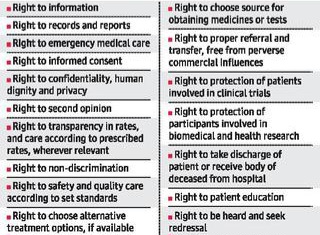
Some of the key rights include:
- Right to Emergency Medical Care: No patient should be denied life-saving treatment because of an inability to pay or complete formalities. Hospitals are expected to stabilise the patient first before addressing administrative or financial issues.
- Right to Transparency in Billing: Patients are entitled to clear, itemised bills that explain the charges for treatment, medicines, investigations and procedures, allowing them to question unexplained or excessive costs.
- Right to Informed Consent: Except in genuine emergencies, doctors must explain the nature of the treatment, its risks, benefits and alternatives before obtaining the patient’s consent.
- Right to Access Medical Records: Patients have the right to obtain copies of their prescriptions, investigation reports, discharge summaries and other medical records, enabling them to seek second opinions or pursue legal remedies if necessary.
- Right to Dignity and Respect: Every patient has the right to be treated with courtesy, privacy and without discrimination, irrespective of their financial background, gender, religion or social status.
While the Charter is intended to guide hospitals towards patient-centric care, health rights activists have repeatedly called for stronger implementation so that these protections are uniformly enforced across both public and private healthcare facilities.
In the event of any alleged wrongdoing by hospitals, several legal remedies are available.
Contacting the local police or calling 112 remains the quickest course of action where a patient’s liberty or access to emergency treatment is threatened.
Complaints regarding excessive billing, denial of services and unlawful detention can also be taken before the National Consumer Disputes Redressal Commission (NCDRC). Victims may also seek compensation for any deficiency in service.
Professional misconduct can be reported to the National Medical Commission (NMC) or state medical councils, which can take disciplinary action against medical professionals and facilities.
Patients are also entitled to ask for detailed, itemised bills and seek clarification on significant charges.
As public dissatisfaction grows, the outcome of the official inquiry will determine the responsibility in this particular case. But irrespective of its conclusion, the controversy has once again revived an uncomfortable question about the increasing commercialisation of healthcare.
For generations, doctors have been regarded as lifesavers and hospitals as places of refuge. When patients or their families fear that financial clearance may come before emergency care, public trust begins to erode. In a healthcare system built on the promise of saving lives, billing should never come before breathing.
Image Credits>: Google Images
Sources: The Indian Express, Hindustan Times, The Hindu
Find the blogger: @diptisadh
This post is tagged under: hospitals, emergency care, right to life, hospital probe, fortis hospital, fortis hospital shalimar bagh, stabbing incident, delhi government, emergency care denied, healthcare, doctors, patients, jan sunwai, patient welfare, right to dignity
Disclaimer: We do not own any rights or copyrights to the images used; these images have been sourced from Google. If you require credits or wish to request removal, please contact us via email.
Other Recommendations:
Ex-Finance Minister’s Son Talks About Horrors Of Facing Police, Hospitals, Courts In India










I think your breakdown of the tragic Fortis Hospital inquiry and the broader pattern of commercialized medicine is incredibly powerful, particularly your concluding stance that “billing should never come before breathing.”
I suggest you can turn this pressing discussion into an even more impactful digital content series by pairing these case breakdowns with a simplified, visual masterclass or checklist of the Draft Charter of Patient Rights, doing so would empower vulnerable readers with actionable legal leverage right when they need it most while positioning your platform as an essential hub for healthcare accountability.