




























Former UK Home Secretary Suella Braverman has reignited a long-running debate over the legacy of the British Empire after suggesting that “former colonies should pay the British back for the considerable investment, effort and contribution that this country made which laid the foundation for many flourishing democracies today.”
Braverman is an Indian-origin British barrister and politician. Born in London to parents of Indian-origin, she served twice as the UK’s Home Secretary under former Prime Ministers Liz Truss and Rishi Sunak. She was elected to Parliament as a member of the centre-right Conservative Party in 2015 but defected to the right-wing populist party Reform UK in January 2026, saying the Conservatives had failed to control immigration and uphold conservative values. She has frequently courted controversy over her comments on immigration, multiculturalism and Britain’s colonial past.

What Sparked The Exchange
Braverman’s remarks were made in response to Bell Ribeiro-Addy, Labour MP representing Clapham and Brixton Hill. The Labour Party is Britain’s governing centre-left party. Ribeiro-Addy, who has long campaigned for reparatory justice over Britain’s role in slavery and colonialism, shared a report about Jamaica’s plans to petition King Charles III for reparations, writing that it was becoming “harder and harder for British institutions to maintain their favoured tactic of simply ignoring calls for repair.” It was this post that prompted Braverman’s response.
The controversy began after Jamaica intensified its long-running campaign for reparations over Britain’s role in the transatlantic slave trade. Announcing the move in Parliament, Jamaica’s Minister of Culture, Gender, Entertainment and Sport, Olivia Grange, said, “We are taking our demand for reparations from the United Kingdom for the enslavement of our African ancestors into another phase.” Jamaica is preparing to send a delegation to the UK later this year to formally petition King Charles III for reparations. Jamaica estimates Britain owes around £7.6 billion, arguing that when slavery was abolished in 1833, the British government compensated slave owners not the enslaved people themselves. Britain has repeatedly rejected reparations, maintaining that slavery was legal at the time and preferring to focus on present-day partnerships rather than historical compensation.
Reacting to Ribeiro-Addy’s post, Braverman wrote on X/Twitter:
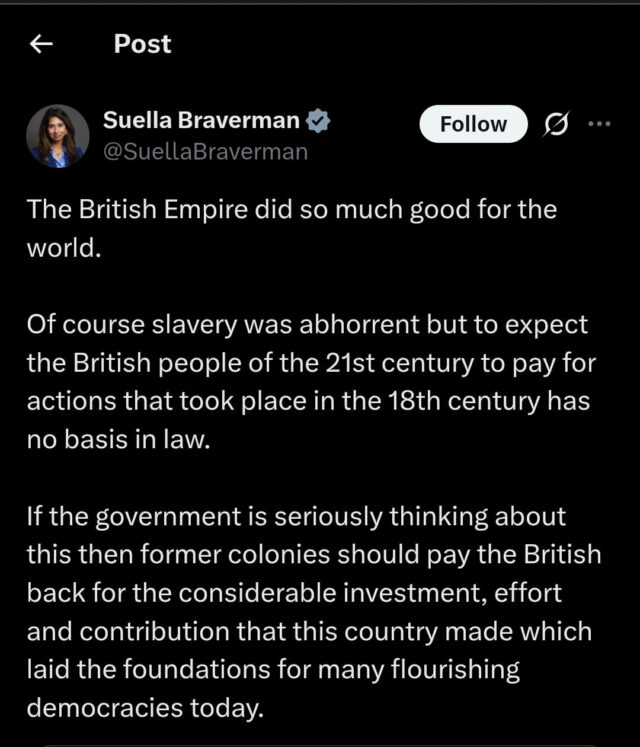
Braverman responded that “to expect the British people of the 21st century to pay for the actions that took place in the 18th century has no basis in law.” Her comments stating that, “The British Empire did so much good to the world”, quickly drew criticism online, with many questioning whether colonialism could ever be framed as a benefit for the countries it ruled.
Not New To Controversy
This is far from the first time Braverman has found herself at the centre of controversy. During her tenure as Home Secretary, she described the arrival of migrants across the English Channel as an “invasion on our southern coast,” a phrase that drew widespread criticism.
In a speech at the American Enterprise Institute in Washington in 2023, she called mass immigration an “existential challenge for the political and cultural institutions of the West” and argued that “multiculturalism has failed.”
In 2024, writing for The Daily Telegraph, she criticised a parliamentary report examining Britain’s colonial legacy, saying it was wrong to make “white people feel guilty” for living in majority-white areas.
The comments reinforced Braverman’s reputation as one of Britain’s most outspoken conservative politicians.
Her recent remarks triggered an immediate backlash on X/Twitter.
A Debate That Refuses To Disappear
Braverman’s comments also sparked sharp reactions on social media, with many users arguing that infrastructure cannot erase the human and economic costs of colonial rule. Others defended the view that Britain’s institutions helped shape modern states across the former empire.
Historian Thomas Soede, commenting that he did not know how to react to the post and found it sickening, further wrote on X/Twitter, “The British Empire did not simply ‘invest’ in other countries. It extracted from them. It took land, labour, minerals, taxes, crops and human lives.”
Journalist Tapashish Chakraborty posted alongside a photograph from the Bengal Famine, “Pray tell, how much do we owe you for our genocide, Ms. Braverman?”
Another user @Dja712901145 wrote, “The ‘investment’ wasn’t charity. Much of it was financed by Indian revenues, while British investors received guaranteed returns backed by Indian taxpayers. Railways were largely built to move raw materials to ports and troops across the country.”
@KELVINOMAY wrote, “After all the British did to our people during colonialism years by torturing, raping, killing and slavery and yet you have gut to say that;infact, the British regime is the one supposed to pay.”
Not everyone disagreed. One X/Twitter user, @Dreamsxml posted, “We built every nation on this planet without earning a shilling. So, tell me what should we be paying for?”
The backlash also revived a question historians have debated for decades- Did British rule develop India, or did it primarily serve Britain’s own interests?
Read more: Trevor Noah Causes Massive Burns To White Racists On Rishi Sunak Becoming UK PM
The Case Often Made For The British Empire
Supporters of the British Empire often point to the railways, the English language, the legal system, civil services and parliamentary institutions as Britain’s enduring contributions to India. These institutions undoubtedly shaped modern India and continue to exist today.
Braverman’s remarks echo this similar line of thinking that Britain’s investments left former colonies better off.
But historians argue that this tells only part of the story.
Who Did Colonial Infrastructure Really Serve?
Many scholars contend that much of the infrastructure built under British rule was designed primarily to strengthen the Empire rather than develop India.
Railway historian Ian J. Kerr noted that the railways primarily served imperial administrative and commercial needs, while Shashi Tharoor has argued they were designed to facilitate the extraction of Indian resources rather than India’s development.
Economist Lakshmi Iyer of Harvard Business School, in her paper, Direct versus Indirect Colonial Rule in India: Long-Term Consequences, found that “areas that experienced direct British rule have significantly lower levels of access to schools, health centres and roads” than many former princely states, suggesting that direct colonial governance did not necessarily produce better long-term development outcomes.
The Economic Cost Of Colonial Rule
Perhaps the strongest challenge to Braverman’s argument comes from economists and historians who dispute the idea that the British Empire’s infrastructure and institutions outweigh the costs of colonial rule.
In a widely watched speech at the Oxford Union in 2015, author, former UN diplomat and MP Shashi Tharoor rejected the claim that railways or parliamentary democracy justified Britain’s rule over India.
“Britain’s rise for 200 years was financed by its depredations in India,” he argued.
Tharoor noted that India’s share of the global economy fell from around 23% before British rule to under 4% by Independence, arguing that colonial rule coincided with a massive transfer of wealth from India to Britain. Dismissing the idea that Britain’s institutional legacy compensated for centuries of exploitation, he added, “It is a bit rich to oppress, enslave, kill, torture, maim and deprive a people for 200 years and then celebrate the fact that they are democratic at the end of it.”
He ended his speech by making a symbolic case for reparations, “As far as I’m concerned, reparations would do. One pound a year for the next 200 years.”
Many historians make similar arguments. Historian Mike Davis, in Late Victorian Holocausts, argued that British economic policies, including grain exports and the government’s reluctance to intervene during food shortages, intensified India’s devastating nineteenth-century famines. Philosopher Will Durant described British rule as “the destruction of a high civilization by a trading company,” while Karl Marx, writing in The British Rule in India (1853), said colonialism exposed the “profound hypocrisy and inherent barbarism of bourgeois civilization.”
The disagreement reflects a larger debate that extends well beyond one politician or one viral post.
Was British Rule A Gift?
History offers no simple answer.
Few historians deny that British rule left behind institutions that independent India adapted and retained. But many argue those institutions came alongside economic extraction, political subjugation and repeated humanitarian crises that benefited the Empire far more than its subjects.
Braverman’s remarks may have reopened an old argument, but they have also highlighted why the legacy of colonialism remains contested. More than seven decades after India’s independence, the debate is no longer simply about what Britain built in India, but whether those institutions can ever be separated from the economic extraction, political subjugation and human suffering that accompanied them.
Image Credits: Google Images
Sources: The Guardian, India Today, BBC
Find the blogger: @diptisadh
This post is tagged under: Suella Braverman, Suella Braverman comments, colonialism, British empire, British colonialism in India, ex colonies, Jamaica, Jamaica reparations, Bell Ribeiro-Addy, Shashi Tharoor, colonial legacy, UK politics, India history, King Charles III, British rule in India, British empire debate, repayment, British empire legacy, former colonies, Indian-origin politician
Disclaimer: We do not own any rights or copyrights to the images used; these images have been sourced from Google. If you require credits or wish to request removal, please contact us via email.