




























Pooja makes a mean butter chicken and is extremely passionate about food. She loves feeding family and friends, and is ready to take the plunge – start her own restaurant.
But Pooja is despondent. She has the moolah in her pocket, but the mountains of paperwork and legal formalities standing between her and her first customer are enough to make any aspiring entrepreneur think twice. This is where the debate over deregulation becomes personal.
An FSSAI certificate, a municipal eating license, a police eating house permit, and a fire NOC are a few of the hurdles she must cross to get to her finish line.
The knife suddenly cuts to the Jan Vishwas Bill (Amendment of Provisions), 2026, a major legislative reform designed to elevate Ease of Doing Business (EoDB) and Ease of Living for every citizen. The bill aims to decriminalise hundreds of minor, technical and procedural offences across 79 central acts.
What Is The Jan Vishwas Bill Of 2026?
The Jan Vishwas Bill (Amendment of Provisions), 2026 was proposed officially by the Ministry of Commerce and Industry in the Lok Sabha on March 27, 2026.
Ultimately, the government is aiming at these deregulation measures to allow more freedom to industries, entrepreneurs and citizens to manage their operations and stay less entangled in the throes of bureaucracy and red tape.
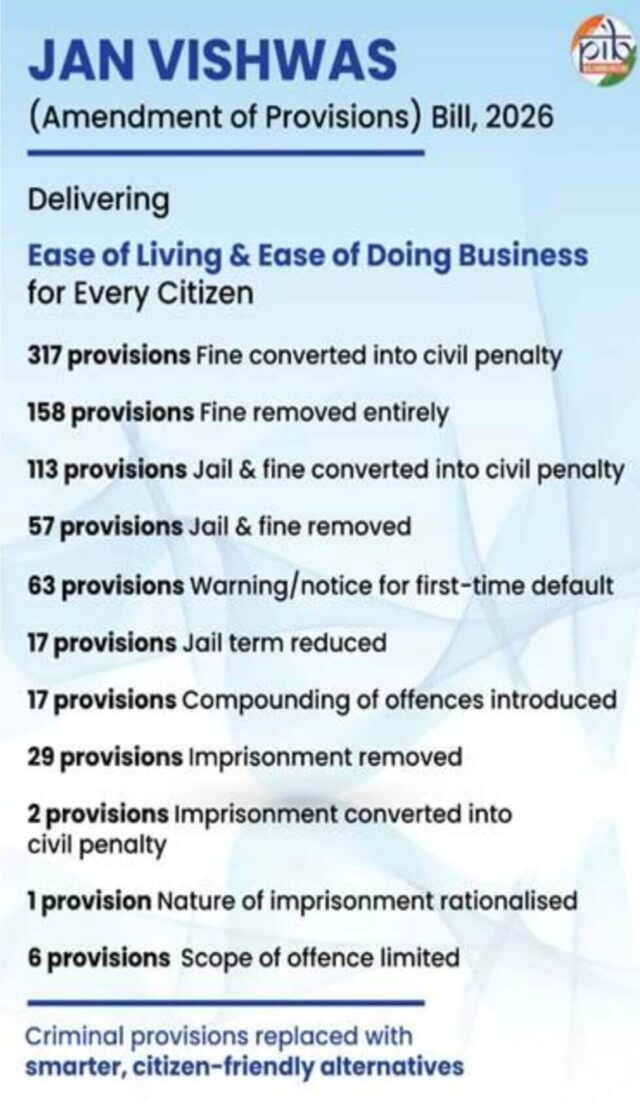
The new bill proposes to remove criminal penalties for minor procedural lapses and replace them with fines, civil penalties and administrative mechanisms. It is built on four main pillars –
- Warning before punishment
- Proportionate penalties
- Faster and fair resolution
- Dynamic penalty framework
Hundreds of fines and imprisonment clauses will be converted into civil penalties, while many will be removed altogether.
The Jan Vishwas (Amendment of Provisions) Act, 2023, laid the foundation for the revised Jan Vishwas Bill, 2026, to build upon. The bill has been passed in both houses, the Lok Sabha and the Rajya Sabha.
The bill introduces amendments in notable sectors like:
- Motor Vehicles Act, 1988
- New Delhi Municipal Council Act, 1994
- Drugs and Cosmetics Act, 1940
- Railways Act, 1989
- MMDR Act, 1957 (Mines and Minerals)
Has the government finally taken cognisance of the fact that it takes entrepreneurs years to build a business rather than working on the actual product?
The Blueprint Of Deregulation
Take the Food Safety and Standards Act (FSSA), which governs every commercial kitchen in the country. If a young entrepreneur like Pooja were to make any administrative mistake – such as operating while her formal license application was delayed or filing incorrect compliance paperwork – she would have faced up to six months of mandatory jail time and/or a penalty of up to ₹5 lakh (Sections 61 and 63).
Deregulation aims to ensure public safety without coercing entrepreneurs through criminalisation and providing a buffer for existing red tape.
The bill is poised to replace imprisonment terms with civil penalties of up to ₹10 lakh. Perpetual validity for Food Safety and Standards Authority of India (FSSAI) registrations has also been approved, and a tiered system of fines for first, second and subsequent offences has been introduced.
Compliance burdens for Micro, Small and Medium enterprises (MSMEs) and businesses have been reduced by introducing graded enforcement, such as advisory notices and warnings before penalties.
Many businesses argue that even small procedural mistakes like a missed filing deadline, a wrongly filled form or a minor paperwork error often count as criminal offences, leading to disproportionately harsher penalties. Entrepreneurs are forced to prioritise risk aversion over product innovation.
In a viral LinkedIn post back in December 2025, Rohit Shroff, founder of Aflog Group, quipped, “I’m done living the ‘building in India’ dream. The goal is to move out of the country… despite being fully compliant, the constant scrutiny and layered regulations left me frustrated.”
It is important to note that while this post was not a commentary on the Jan Vishwas Bill, it highlights the lack of ease of doing business and the tax compliance burdens faced by entrepreneurs in India.
Anuradha Tiwari, Indian entrepreneur and vocal social media influencer, observed in one of her X/Twitter posts, “Businesses spend more time fighting the system than running the business.”
Deregulation fundamentally aims to minimise this risk, along with reducing the paperwork, bureaucracy, and red tape involved in creating and growing new businesses. The government is pushing to repeal archaic laws and eliminate redundant regulations across governance.
Read more: Delhi Government Issues Electricity Bills Payable By 14th April To Commercial Establishments, But Can Businesses Pay?
Navigating the shift
Consider this: the city’s bus service is under strict government regulations. A standard Contract Carriage or Stage Carriage Permit, Registration Certificate, and Pollution Under Control certificate – these are just a few of the several permits required. In addition to this, a bus operator has to adhere to strict codes of uniform and routes, making him reluctant to start a new bus line, fearing failure due to any missed procedures.
But now the government is offering greater flexibility to bus operators by reducing the burden of harsher punishments. Operators can now run bus operations in accordance with the existing code of conduct, without the constant fear of strict legal consequences.
The Motor Vehicles Act and the Road Transport Corporations Act have been amended to reclassify various petty offences. Punishments for seat-related violations, carrying excess passengers, or unauthorised hawking are now restricted to fines rather than jail time.
Previously, even a one-day lapse in renewal of a driving license rendered a driver technically non-compliant. These reforms mark a transition from a zero-tolerance framework to a more pragmatic system.
Reforms under the Motor Vehicles Act, 1988, have introduced a 30-day grace period for renewal, shielding ordinary drivers from abrupt penalties and providing a reasonable window for renewal. Even ticketless travel will now be handled as a civil violation with penalties of up to ₹500.
The government stops playing the aggressive manager and steps back into the role of an umpire. This reduced state interference might act as a catalyst for boosting local manufacturing and empowering MSMEs.
The passing of the steering wheel is precisely what the new-age Indian entrepreneur has been waiting for. For a generation that’s growing up with ideas like startups, unicorns, app inventions, heaps of unending paperwork, unnecessary bureaucracy, and red tape was a sure shot buzz killer.
Fuelling The Next-gen Startup Engine
The current landscape is brimming with startups and new-age ideas. There is heightened focus on product research and development. But age-old regulations and compliance are only slowing down the new age creators, who are more willing to tackle innovation than study policy and compliance.
Infosys co-founder, N.R. Narayan Murthy, has been outspoken about the struggles of starting a business in India: “In 1976, if you wanted to start a company in India, you had to get 60 licenses. If you wanted to import a computer, it took 1 year and you had to go to Delhi 50 times. Today it is much easier, but we still have a long way to go to make our regulatory processes frictionless.”
Deregulation fundamentally removes the psychological tax of starting up. In a press conference held on April 3, 2026, Commerce and Industry Minister Piyush Goyal said that these reforms are a significant step towards simplifying laws and reducing compliance burden and fear of penalties. The aim of this bill is not to control common people but to enhance trust-based governance.
He asserted that this legislation demonstrates the trust shown by Narendra Modi’s government in the common man, small businesses, start-ups and entrepreneurs. He added that this bill is an important milestone in the country’s journey towards Viksit Bharat 2047.
But is India’s young startup ecosystem genuinely mature enough to handle this newfound freedom?
We live in a country where garbage is disposed of on the streets as soon as nobody’s watching. So what actually happens when the watchdogs are relaxed and we are left to operate on self-policing protocols?
Is India Ready?
Is the consumer going to be the biggest loser? Without safety nets, can we expect product value and ethical practices by brands and entrepreneurs?
Instances of babas promoting sales of hundreds of faulty, substandard products in the name of Ayurveda aren’t few and far between. Should food businesses, transport operators and manufacturers, who deal directly with public safety and consumer welfare, go unchecked?
This is the true crucible for India’s next-gen founders. Deregulation has cleared the hurdles for entrepreneurs like Pooja, replacing the choking fear of criminal red tape with an unprecedented model of trust. The government has willingly passed over the steering wheel.
But if self-regulation is to succeed, our startup ecosystem must prove that “free will” does not equal a free pass to compromise on consumer safety, data privacy, or product integrity. The ultimate success of India’s economic shift won’t just be measured by how many new companies are built, but by how responsibly they are run when the watchdogs are finally looking away.
Image Credits: Google Images
Sources: The Economic Times, pib.gov.in, The Times of India
Find the blogger: @diptisadh
This post is tagged under: deregulation, jan vishwas bill, Indian government, amendment of provisions, bureaucracy, red tape, entrepreneurs, startups, MSMEs, young entrepreneurs, industries
Disclaimer: We do not own any rights or copyrights to the images used; these images have been sourced from Google. If you require credits or wish to request removal, please contact us via email.
Other recommendations:
ResearchED: Are There More Entrepreneurs Than Employees? How Will Companies Run?