

























In a democracy, the opposition is not just an enemy of the state but an indispensable pillar of the political ecosystem. But a growing pattern is hard to ignore, our ruling faction, the BJP, is clearly outnumbering the opposition by following sublime tactics. Whether you call it political strategy, ruthless electoral management, or something more sinister, the BJP appears to have developed a remarkably effective playbook for reducing opposition parties to shadows of their former selves.
Although this piece carries no political alignment with any political party, it is an attempt to map a pattern, not endorse or condemn any of it.
Most of these parties on BJP’s radar cannot claim to be particularly clean themselves.The Congress gave us dynasty politics and corruption scams. Shiv Sena has a history of religion-centric and violent street politics. Nationalist Congress Party (NCP) was seen by many as a family enterprise. Aam Aadmi Party got entangled in its own anti-corruption web. Trinamool Congress faces serious allegations of political violence in West Bengal.
Plagued by poor governance and corruption scandals, several of them have squandered public trust over decades. The failure to provide a convincing alternative being their biggest folly in recent times.
None of these are the heroes of this story. But that’s exactly the point worth sitting with. A democracy doesn’t need a good opposition to function. It needs an opposition. Strip that away and however flawed the opposition is, you don’t get a cleaner government. You get one with nobody left to ask it questions.
Over the last decade, a pattern has repeated itself with almost mechanical precision, weakening a rival party from the inside, peeling off enough legislators to claim legitimacy, and watching the original organisation hollow out. Whether this is a deliberate blueprint or simply the natural outcome of one party’s dominance is up for debate. What isn’t up for debate is that it keeps happening, the playbook is now identifiable enough to predict, and the BJP has kept getting stronger while its rivals haven’t.
In a recent statement on X/Twitter, Congress leader Dr. Syed Naseer Hussain highlighted these same observations.
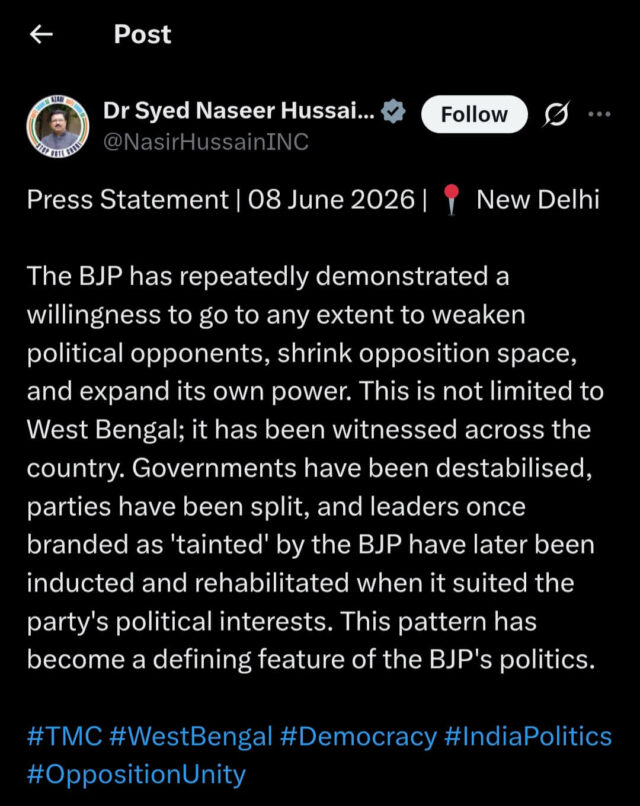
Whether one agrees with that assessment or not, the sequence of events across multiple states is striking enough to examine on its own. Let’s look at a chronology of the events in this supposed playbook.
The “Pappufication” of Rahul Gandhi
Taking over from a party that had governed India for most of its post-independence history was never going to be simple, especially one run on dynastic succession, where leadership passed down like a family heirloom.
Rahul Gandhi was introduced as the Congress’s heir apparent in November 2007. His misstatements, verbal blunders and awkward television appearances soon became political ammunition for his opponents, eventually leading to the nickname, “Pappu”.
The run up to the 2014 Lok Sabha elections saw the moniker firmly attached to his name, when Amit Shah used the term publicly while addressing a public meeting, “The Congress thinks the prime minister’s chair is Pappu’s birth right. But this is a democracy, you need people’s blessings, and people’s blessings are with Narendra Modi. We have declared our PM candidate (Narendra Modi). Who will be the Congress candidate? Pappu? No, they won’t make Pappu their candidate as they are afraid of losing.”
It has also been attributed to Kumar Vishwas, who contested against Gandhi in Amethi that year and has often publicly taken credit for popularising it.
The term soon spread far beyond campaign speeches, finding its way into television debates, memes, WhatsApp forwards and social media, until it became almost inseparable from Rahul Gandhi’s public image.
The campaign appeared to follow a simple, ruthless policy. Repeat an idea a thousand times and it becomes the truth in the minds of the public.
By the time, Congress was reduced to 44 seats in 2014, the “Pappu” image had fused with Gandhi’s public identity. It took the 2022-23 Bharat Jodo Yatra, a massive public outreach campaign to dilute its effects, along with Gandhi fighting back fiercely to emerge as a more enabled leader of the opposition with stronger and sharper criticisms aimed at the ruling government.
The Shiv Sena Split
The Shiv Sena hadn’t been the same force since Bal Thackeray’s death, with internal friction between Uddhav and Raj Thackeray already weakening its grip.
In June 2022, senior leader Eknath Shinde walked out with a majority of the party’s MLAs, toppling Uddhav Thackeray’s government overnight.
What followed was a battle not just for power, but for identity itself. This is where the blueprint first became visible. The objective wasn’t merely to form a new government. It was to replace the original organisation itself.
Both factions approached the Election Commission claiming to be the real Shiv Sena.The rebel MLAs were transported to BJP-governed states like Gujarat and Assam, where they remained together while the political crisis unfolded. BJP leadership backed Eknath Shinde for the Chief Minister’s position while BJP’s Devendra Fadnavis took the Deputy Chief Minister role, allowing the new alliance to form the government. The rebel faction also avoided immediate disqualification under the anti-defection framework while the legal battle continued.
The Election Commission’s ruling, in February 2023, came down to numbers. Shinde’s 40 MLAs had won nearly 76% of the total votes cast for Shiv Sena candidates in 2019, against the Thackeray camp’s 15 MLAs and 23.5%. The Commission also noted that the party’s own 2018 constitutional amendments had weakened its own democratic structure, a factor that counted against Uddhav Thackeray’s claim.
Shinde walked away with the Shiv Sena name and the bow-and-arrow symbol. Thackeray’s faction was left with Shiv Sena (UBT) and a flaming torch. Summing up his grievance after the decision, Thackeray remarked, “They stole my party, its name, and even my father’s photograph.”
The Same Playbook, A Year Later
In July 2023, the script repeated itself almost beat for beat. Senior NCP leader Ajit Pawar exited with a bloc of MLAs and joined the BJP-led alliance, becoming Deputy CM of Maharashtra. The party Sharad Pawar had built over decades was suddenly fighting his own nephew for its name and symbol.
The Election Commission again leaned on legislative majority to settle the dispute, awarding Ajit Pawar’s faction the NCP name and its iconic clock symbol in February 2024, even as the Supreme Court later questioned whether that test should have been decisive on its own. Sharad Pawar was left to rebuild under Nationalist Congress Party – Sharadchandra Pawar (NCP-SP) and a new symbol of a man blowing a turha.
Reacting to the developments, Sharad Pawar accused the BJP of systematically weakening its allies, saying, “Those who join hands with the BJP and share power get politically destroyed eventually. To steadily weaken its political allies is the BJP’s policy.”
Read more: ResearchED: Why Was AAP Given National Party Status While TMC, NCP, CPI Lost Theirs?
Pehle AAP
The Aam Aadmi Party had built a genuine Delhi stronghold on free electricity, free water, and mohalla clinics, positioning itself as a party of the aam aadmi, by the aam aadmi. The BJP’S approach here was different from that in Maharashtra. Not a legislative split, but a direct assault on its leadership through central agencies.
Second-in-command Manish Sisodia was arrested by the CBI on February 26, 2023, and its national spokesman, Sanjay Singh was arrested in October 2023, under the Prevention of Money Laundering Act.
The party that had branded itself as India’s anti-corruption alternative found itself fighting corruption cases of its own.
Then came the biggest political moment. In March 2024, months before the Lok Sabha elections, Delhi CM Arvind Kejriwal himself was arrested, the first sitting Chief Minister in India’s history to be arrested while in office. Responding to his arrest, Kejriwal responded, “They can do whatever they want. Nothing will happen. I am not going to bow down to them. They say ‘come to BJP, we won’t trouble you’. No, not at all, I won’t join them.”
The strain of corruption allegations and arrests led to AAP’s sharp defeat in the 2025 Delhi Assembly Elections.
But the cleanest version of the playbook came later. In April 2026, Rajya Sabha MP Raghav Chadha, once one of AAP’s founding faces, announced that he and six other AAP MPs were leaving to merge directly with the BJP, invoking the Constitution’s two-thirds merger provision to do so. No intermediate real party cover story was even needed this time.
Chadha, who had once called the BJP a party of “illiterate goons,” said the AAP he’d “nurtured with blood and sweat” had “deviated from its principles.” Kejriwal called it Operation Lotus while Sanjay Singh called the defectors “traitors.”
The Trinamool Congress
If you want to see the blueprint executed in real time, look at what happened in West Bengal this June. After the Trinamool Congress’s defeat in the 2026 Assembly election, the party fractured on two fronts simultaneously.
A legislative rebel faction led by expelled leader Ritabrata Banerjee, broke away with 58 MLAs and claimed control of the party’s legislative wing.
Around 20 of the party’s 28 Lok Sabha MPs, led by Kakoli Ghosh Dastidar, broke away from the parliamentary party joining NCPI. Until that announcement, NCPI was a barely-registered party with a few hundred members. The rebel MPs framed the merger as the only lawful route under the Tenth Schedule’s anti-defection rules.
The TMC alleged that the rebellion did not happen in isolation. It argued that several leaders were simultaneously facing sustained pressure from central investigative agencies, making the defections part of a broader political strategy.
Reacting to the developments, Mamata Banerjee accused the BJP of attempting to dismantle constitutional democracy, saying, “BJP has made it their life’s mission to dismantle Babasaheb Ambedkar’s Constitution brick by brick, tearing apart India’s democratic fabric.”
Who’s Next?
Speculation has already turned to the Samajwadi Party. In mid-June 2026, Uttar Pradesh minister OP Rajbhar publicly claimed a major split was brewing within Akhilesh Yadav’s party, alleging senior leader Ram Gopal Yadav had approached the Centre amid pressure linked to corruption cases. Akhilesh dismissed the claim outright, accusing the BJP of a history of engineering defections. As of now, nothing has materialised, but the pattern means the speculation alone is enough to put SP on every political observer’s watchlist.
In a recent post on X/Twitter, senior Congress leader Ashok Gehlot highlighted these exact concerns, noting that while the NDA coalition faces no visible strain at the Centre, it continues to break away MPs from parties like the Trinamool Congress, Shiv Sena, and BJD. Gehlot termed this continued poaching a “direct and open challenge to the people’s mandate,” arguing it demonstrates the BJP’s reliance on “money power and muscle power”.
The Sweet Revenge
A recurring feature across nearly every one of these cases is the role of the Enforcement Directorate and CBI. Opposition parties have dubbed it the “BJP washing machine”, alleging that investigations against leaders lose momentum once they join the ruling side. The BJP has consistently rejected these allegations and maintained that investigative agencies function independently.
The pattern has hard numbers behind it. In 2023, fourteen political parties petitioned the Supreme Court over the alleged misuse of central agencies, citing that since 2014, the ED had investigated 121 political leaders and 115 of them were from opposition parties.
Ajit Pawar himself was under ED investigation over alleged irregularities involving sugar mills and cooperative banks before his 2023 switch. A closure report in the related case was filed within months of him becoming Deputy Chief Minister. Praful Patel, another NCP leader, also saw proceedings against him conclude after joining the ruling alliance.
One politician who switched reportedly summed up the perception with a single line, “Now ED won’t touch me.”
How The Law Makes This Legal
None of this works without a specific quirk in India’s anti-defection law, the Tenth Schedule of the Constitution.
The law originally allowed a split exception. If at least one-third of a party’s legislators broke away together, they were protected from disqualification. This was so widely abused for engineering wholesale defections that Parliament deleted it entirely through the 91st Constitutional Amendment in 2003.
What survived is the merger exception. If two-thirds or more of a party’s legislators in a given House agree to merge with another party, none of them can be disqualified, even if no actual merger has happened at the parent organisation’s level.
In practice, this has become a pure numbers game. Assemble two-thirds of a legislative bloc, declare a merger with any willing registered party, and the law has little room to intervene. This is exactly the mechanism that has featured in several recent political battles.
Legal experts and the Law Commission have flagged this loophole for years, arguing Parliament effectively reconstructed the very one-third split provision it deliberately killed in 2003, just at a higher threshold.
The Blueprint
By this point, the sequence almost writes itself.
First, identify the opposition party that poses the greatest electoral challenge.
Then weaken it internally, either by encouraging defections or by tying up its leadership in prolonged legal and political battles.
If enough legislators move together, use the merger provisions under the anti-defection framework to protect the rebellion from immediate disqualification.
Fight for the original party’s name, symbol and organisational legitimacy.
Leave the parent organisation politically crippled, stripped of legislators, organisational strength and often even its own identity.
Meanwhile, investigations, court cases and political firefighting consume the attention of the remaining leadership.
Whether this reflects extraordinary political strategy or a worrying distortion of democratic competition depends entirely on one’s political perspective. But viewed together, the similarities across multiple parties are difficult to ignore.
Why This Isn’t Just Political Gossip
Here’s where the stakes stop being about any one party’s survival. In April 2026, the BJP-led NDA government tried to pass the Constitution (131st Amendment) Bill, the delimitation-linked legislation tied to women’s reservation and fell short by 54 votes in the Lok Sabha. Constitutional amendments need two-thirds support of members present and voting: in a 528-member House that day, that’s roughly 352 votes.
Since then, the arithmetic has shifted dramatically, not through any election, but through defections. The TMC’s 20 rebel MPs alone could push the NDA’s count from 293 toward 313. Add the seven AAP Rajya Sabha MPs who crossed over, and the breakdown of the Congress-DMK alliance, and government strategists believe they’re now within striking distance of the number they need.
This is the part worth sitting with. A bill that voters’ elected representatives explicitly rejected in April could pass by year’s end and not because public opinion shifted, but because enough individual legislators changed addresses. That’s not democracy expressing a new mandate. That’s the original mandate being quietly worked around.
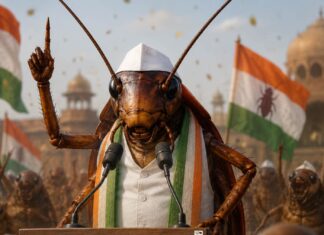
Is The Cockroach Janta Party
Abhijit Dipke’s Cockroach Janta Party, born out of satire, exploded to 20 million Instagram followers in under a week, overtaking the BJP’s own official handle. The government’s response was swift. Ministry of Electronics and Information Technology (MeitY) blocked CJP’s X account within days of launch under Section 69A, citing national security concerns. Dipke publicly claimed death threats via WhatsApp allegedly demanding he shut down or join the BJP. At Jantar Mantar, where CJP held its sit-in demanding Education Minister Dharmendra Pradhan’s resignation over the NEET-UG paper leak, police cut power, restricted water access, and warned of legal action for overstaying permitted hours. The protesters stayed overnight anyway, with climate activist Sonam Wangchuk announcing a hunger strike if Pradhan didn’t resign.
No raids. No FIRs. No defection offers, because there’s nothing institutional left to defect from. The BJP’s playbook needs legislators to peel away, symbols to contest, and leadership to tie up in cases. CJP has none of these. What was deployed instead looks like the early-stage toolkit. Digital suppression, administrative friction, and the quiet hope it fizzles out.
Whether it does remains to be seen. Viral movements in India have a complicated relationship with longevity. But for now, the cockroaches are still at Jantar Mantar. And the government is still watching.
Whether a deliberate, single blueprint really exists is something reasonable people can debate. What isn’t debatable is the scoreboard. Over the last decade, the BJP has consistently grown stronger while almost every one of its principal rivals has grown weaker, splintered, or disappeared.
Is that clever politics, or a slow erosion of the thing that’s supposed to keep any government honest? That’s the question every Indian voter needs to be asking right now.
Image Credits: Google Images
Sources: The Hindu, Hindustan Times, The Wire
Find the blogger: @diptisadh
This post is tagged under: BJP, AAP, TMC, NCP, Shiv Sena, BJP oppositon strategy, BJP alleged playbook, opposition parties, Rahul Gandhi, Amit Shah, Narendra Modi, Congress, Eknath Shinde, Uddhav Thackeray, Ajit Pawar, Sharad Pawar, Mamata Banerjee, Samajwadi Party, anti-defection law, defection, Indian democracy, ED, CBI, Cockroach Janta Party, Arvind Kejriwal, Abhijit Dipke, Raghav Chadha
Disclaimer: We do not own any rights or copyrights to the images used; these images have been sourced from Google. If you require credits or wish to request removal, please contact us via email.
Other Recommendations: