




























The simpleton from a small town arrives in a bustling metro city, imagining life through rose-tinted glasses. But as he slowly adapts to the bustling city life, the stark reality of it all hits him hard.
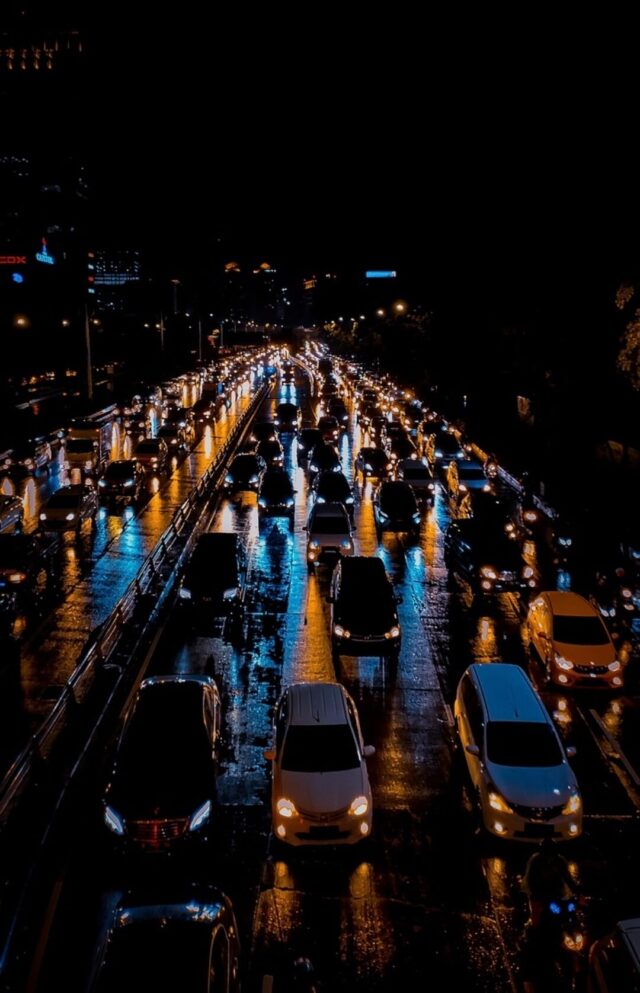
The young IT professional in Bangalore is stuck in an hour-long traffic jam; the Delhiite is battling with smog; the Mumbaikar is managing to commute on waterlogged roads; Kolkata is battling ageing infrastructure, and Hyderabad is facing an acute water crisis.
What was once touted as the dream life is slowly crumbling to pieces.
Are Indian metro cities the worst to live in?
Driving Engines Of The Economy
Indian metros are virtually running the country’s economy and contribute to almost two-thirds of the total GDP of India, attracting a major share of the country’s Foreign Direct Investment (FDI).
A new report by non-profits Janaagraha and Jana Urban Space Foundation highlights that approximately ₹8.36 lakh crore has been invested in cities since 2015. The Ministry of Housing and Urban Affairs (MoHUA) and the 14th and 15th Finance Commissions (FC) grants corroborate this data.
But even so, why are our cities still losing their spark?
Broken infrastructure, severe traffic and waterlogging reduce overall productivity. How are metros to attract more foreign investment when they can’t manage their own sewage or water?
The very act of moving through our metro cities has become a burden on national productivity. An annual traffic index released by TomTom NV, a Dutch multinational developer of location technology, from 2024 features Kolkata, Bengaluru and Pune among the top five in the list of slowest cities in the world. On average, urban commuters in India lose over 90 to 120 hours a year just sitting in traffic congestion for short 10-kilometre journeys.
The Smoke Behind The Smog
35 of the world’s 50 most polluted cities are in India. A report by environmental research firm Climate Trends noted that no major Indian cities met safe Air Quality Index (AQI) levels at any point between 2015 and November 2025.
Delhi, the national capital, the rape capital and now the pollution capital, seems to collect the worst titles a city can hold.
AQI levels peaked above 250 in 2016, averaging above 180 this year, but the National capital has failed to revert to healthy air quality standards. Mumbai, Bengaluru and Chennai all have moderate AQI levels, but even they don’t reach the optimal safety levels.
Pollution from vehicles, industries and crop burning is a major factor in play. Geography also plays an important part, with southern states recording better AQI levels than their northern counterparts. Air pollution and toxic smog are among the leading global causes of early mortality.
India’s 1.3 billion people live in areas where the “annual average particulate pollution level” exceeds the WHO safe limit of 5µg/m³. Chronic respiratory diseases, cardiovascular stress, and children constantly falling prey to airborne diseases are commonplace.
A recent BBC investigation highlights the human cost of this crisis through the story of Khushboo Bharti, 31, who had to rush her one-year-old daughter Samaira to the emergency room after a violent coughing fit. These aren’t just statistics but a lived reality for many of us. When our air quality reduces life expectancy by 5 years, are we really “developing”?
Can The “Waste” Wait?
Rapid urbanisation, poor household segregation and overwhelmed landfills are leading to a severe waste management crisis in Indian metro cities. Overflowing trash piles, clogged and open drains, lack of proper waste management and segregation protocols are turning many parts of the capital into disease hotspots.
According to the estimates of the Central Pollution Control Board (CPCB), Mumbai and Delhi alone generate about 11,000 and 8,000 tonnes per day of solid waste, respectively.
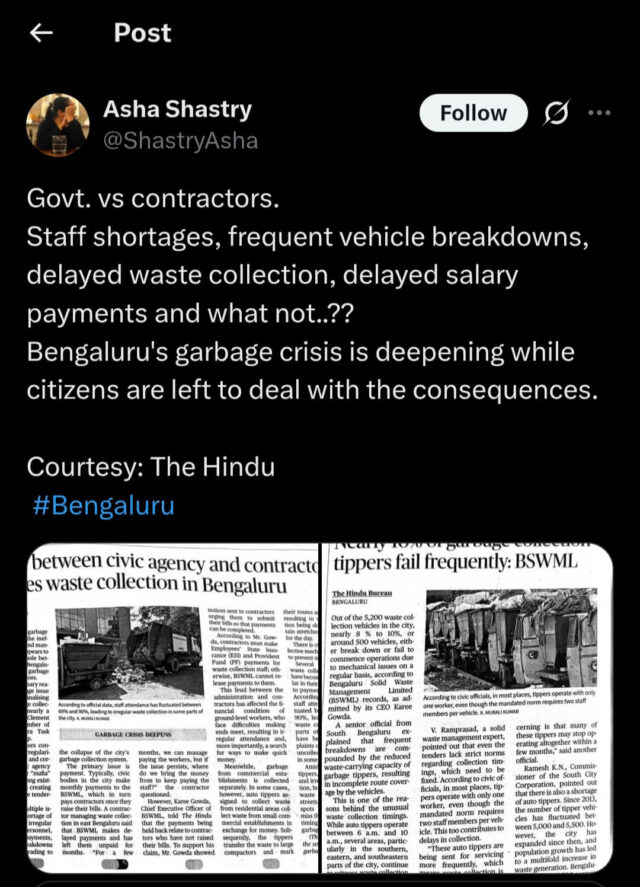
The “blackspot problem” in Bengaluru, referring to the illegal and open garbage dumping in corners of the city, has become a widening menace for daily commuters. Irregular garbage collection and monsoons have only accelerated the issue.
The gap between government promises and the ground reality is widening. An insight into Bengaluru’s waste management problem, shared by a resident on X/Twitter, exposes the failure of urban governance.
The Rising Water Crisis
The National capital is also struggling with a severe water crisis. Many residential colonies report receiving no water for days, while many areas receive a water supply that is unfit for use. A depleting Yamuna, summer heatwave and a demand-supply deficit are adding to the woes of the general public.
Even cities like Hyderabad, Bengaluru, Mumbai and Chennai are frequently struggling with dry taps due to rapid urbanisation, climate change and groundwater depletion.
The Rising Gender Crisis
According to the National Crime Records Bureau (NCRB) “Crime in India 2024” report, the capital recorded 13,396 cases of crimes against women, making it the most unsafe metropolitan city for women in India, for the fourth consecutive year. Mumbai and Bengaluru recorded the second and third highest numbers of crimes against women, respectively.
From the infamous Nirbhaya Case, 2012, to the recent R.G. Kar Medical College trainee doctor’s case, 2024, have all our united protests and candle marches been in vain? The state of women’s safety issues remains almost the same in these uber-transitioning metro cities. Almost a decade apart, two cases shook the nation, but the data suggest we’re still in the same place.
Poorly lit streets, lack of surveillance and ineffective police-municipal coordination are just some of the factors responsible.
Behind the smog, the garbage, the unsafe streets, there is a single common thread – the spectacular failure of urban governance.
Read more: Indian Cities Delhi, Mumbai, Chennai Are Slowly Sinking
Urban Governance: A failure
Recent tragedies like the Malviya Nagar B&B fire, the death of UPSC aspirants by flooding in old Rajinder Nagar, and the building collapse in Saidulajab near Saket metro killing UPSC aspirants are not just mere accidents indicative of systemic failure.
In November 2010, a five-storey building in Lalita Park near Laxmi Nagar collapsed, killing around 70 people and injuring dozens more. From the 2019 Anaj Mandi fire in Delhi to the Vivek Vihar Hospital fire, all point towards a grim pattern.
Unplanned construction, congested settlements and poor compliance are hindering the city’s progress and claiming hundreds of innocent lives.
Areas like the Lal Dora villages – areas demarcated since 1908 to separate village dwellings from agricultural land – have unofficially become part of the city but are historically exempt from standard building by-laws, leading to major unplanned and unsanctioned construction.
For the thousands of students and migrants, these areas provide the only form of affordable housing. More than 30% of Delhi’s population lives in these areas, making them a dense vote bank easily manipulated by political parties. Successive governments have prioritised regularising these settlements for electoral gains over the long-term work of safe, modern urban planning.
Lack of infrastructure and fragmented urban governance are among the paramount reasons for this systemic failure. State interference and lack of financial autonomy hinder the day-to-day functioning of municipal bodies.
Cities are growing faster, and urban local bodies are unable to cope.
Unplanned expansions in metros and population expansion have left local governing bodies at a loss. There is just too much to do and too little that has been done.
The Janaagraha report stresses that unplanned urban expansion has expanded the country’s urban footprint to 2.5 million hectares between 2005-06 and 2022-23, making basic infrastructure development more expensive and difficult.
NITI Aayog and MoHUA data note that affordable housing in major cities fell from 40% of total housing construction in 2019 to just 16% in 2024.
The mayors we elect are only for ceremonial roles and have no real power. The real power sits with the Municipal Commissioner. A Reddit thread on the subreddit r/India titled “Why India falls in urban governance, we don’t have cities like New York, London, Singapore,” from six months back, opines that the reason we don’t have cities like New York and Singapore is that our urban governance is completely broken.
“There is no single point of accountability. States don’t want powerful mayors. This keeps urban power with the state, but at the cost of city development.”
The Taxation Paradox
Indian metro cities contribute an estimated 40% – 50% of the country’s direct total taxes, with Mumbai, Bengaluru and Delhi topping that list. This massive inflow is fuelled by the presence of MNCs, tech giants and financial institutions in the urban metros.
But here is the bitter irony: the more wealth our metros generate, the less control they have over how it is spent.
Taxes paid by metro city residents go to the Central and State Governments, and then are redistributed nationwide through the Finance Commission. Only a small fraction stays with the city’s local Municipal Corporation.
Beyond the Income Tax deducted directly from salaries and the GST we pay on everything from coffee to clothing, we are effectively fuelling the national exchequer. Yet, basic amenities continue to elude us.
Governments often divert funds toward Tier-2 and Tier-3 cities in the name of political equity. Consequently, our metros are left with crippling and outdated infrastructure. The very engines of the economy are left wanting more.
Rs. 8.36 lakh crore has been invested into our cities since 2015, and this is what we have to show for it? We’re paying a premium for a dream life that is, in reality, a daily struggle for the bare minimum.
We have more highways, but what about cleaner air? More connectivity, but what about safety? In the rush to build the “new”, we have fundamentally failed to fix the “existing.” It’s time we stop pretending that a high-rise view compensates for cities that are slowly becoming unlivable.
Image Credits: Google Images
Sources: The Print, The Wire, The Hindu
Find the blogger: @diptisadh
This post is tagged under: Indian metros, infrastructure, air pollution, smog, water crisis, traffic, waste management, taxation, urban governance, urban planning, economic growth, urbanisation, municipal administration, women’s safety, rape capital, pollution, fire tragedies, government, India
Disclaimer: We do not own any rights or copyrights to the images used; these images have been sourced from Google. If you require credits or wish to request removal, please contact us via email.
Other Recommendations:
Delhi’s Malviya Nagar B&B Fire Deaths: Owner Or Authorities’ Fault?