



























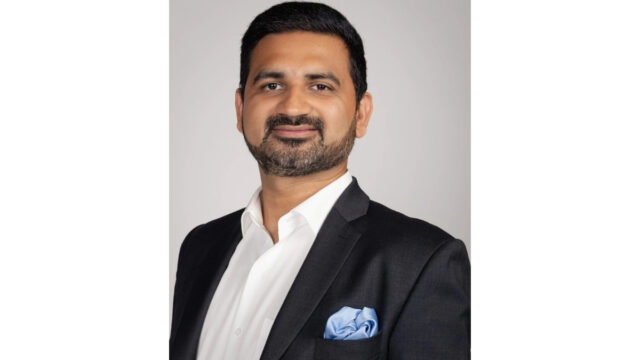
Kinshuk Kocher, Co-Founder, Caredose
Every experienced investor eventually develops an instinct for recognising patterns. In healthcare, where innovation sits at the intersection of technology, regulation and patient care, those patterns often become visible only after evaluating hundreds of companies across different stages of growth.
For Kinshuk Kocher, that perspective has been shaped by more than reviewing pitch decks. Before evaluating healthcare startups, he spent years building one himself.
Today, as Director of Investment Operations and Special Projects at Cedars-Sinai Technology Ventures in Los Angeles, Kocher has evaluated more than 500 health-tech startups through the Cedars-Sinai Accelerator+ and contributed to over US$20 million in institutional investments across more than ten portfolio companies. The experience has given him a unique view of why some healthcare companies move beyond pilot programmes into everyday clinical practice while others struggle despite strong technology and funding.
“After evaluating hundreds of companies, certain patterns begin to emerge,” says Kocher. “The technology is important, but it is rarely the only reason a company succeeds or fails.”
Looking Beyond the Technology
Healthcare startups often focus on solving technically complex problems. Many introduce sophisticated artificial intelligence models, predictive analytics or digital platforms designed to improve care delivery. While these innovations have enormous potential, Kocher believes they are only one part of the equation.
The stronger companies, in his experience, begin by understanding the clinical problem before deciding how technology should solve it. They invest time in understanding how physicians work, how nurses manage workflows, how pharmacies operate and how patients navigate treatment outside the hospital.
Products developed with that level of understanding are generally better positioned for adoption because they fit naturally into existing systems of care instead of requiring healthcare professionals to fundamentally change the way they work.
“Healthcare operates within highly structured environments,” Kocher explains. “Technology creates value when it supports those environments rather than assuming they can be redesigned overnight.”
Lessons From Building Caredose
These observations are rooted in Kocher’s own entrepreneurial experience.
In 2017, he co-founded Caredose, a medication management company focused on improving medication adherence among patients living with chronic conditions. Rather than approaching the challenge purely as a technology problem, the team worked closely with patients, caregivers, pharmacies and healthcare providers to understand where treatment plans became difficult to follow.
That understanding shaped the company’s solution. Caredose simplified medication management through organised, dose-wise packaging and structured dispensing processes that helped patients manage multiple medicines while supporting pharmacy workflows.
Over four years, the company managed more than one million medicine doses across India, improved medication adherence from below 50 per cent to above 80 per cent among provider partners, built integrations with Apollo Pharmacy and Max Hospitals, and collaborated with organisations including the World Health Organization (WHO), USAID and the Gates Foundation.
For Kocher, the experience reinforced an important lesson that continues to influence his investment decisions today.
“Building Caredose taught me that assumptions change quickly once a product reaches real clinical environments,” he says. “The closer founders are to understanding patients, providers and healthcare workflows, the stronger their solutions usually become.”
What Successful Founders Have in Common
Having evaluated hundreds of companies, Kocher has found that the most promising founders share several characteristics regardless of the specific technology they are building.
They spend time understanding the healthcare environments they hope to improve before designing solutions. They seek continuous feedback from clinicians, providers and patients throughout product development rather than relying solely on early assumptions. Most importantly, they recognise that adoption depends as much on usability, workflow integration and trust as it does on technical performance.
This mindset often determines whether a company progresses beyond early pilots into broader clinical adoption.
Healthcare organisations do not evaluate technology in isolation. They assess how new products fit into existing clinical workflows, whether they reduce operational complexity and whether they improve outcomes without creating additional burdens for healthcare professionals.
Founders who appreciate those realities from the outset are generally better equipped to build products that healthcare systems can adopt at scale.
Building Around the Patient
As healthcare continues to embrace artificial intelligence and digital innovation, Kocher believes the industry’s greatest opportunities will come from combining technological capability with a deep understanding of patient care.
The most effective healthcare companies are unlikely to be those with the most advanced technology alone. They will be the ones that begin with a clearly defined clinical problem, understand the realities of care delivery and then apply technology in ways that make those experiences better for both patients and providers.
For Kocher, that philosophy has remained consistent throughout his career. Whether building Caredose or evaluating startups at Cedars-Sinai Technology Ventures, the central question has always been the same: does this solution address a real healthcare problem in a way that fits naturally into how care is delivered?
In healthcare, lasting innovation begins not with technology, but with understanding the people it is intended to serve.
About Kinshuk Kocher
Kinshuk Kocher is Director of Investment Operations & Special Projects at Cedars-Sinai Technology Ventures in Los Angeles. He previously co-founded Caredose, a MedTech company focused on improving medication adherence for patients with chronic conditions. He holds an MBA from the University of Oxford.
Read more:
Does Your Passport, Career, Or Foreign Study Get Impacted By Protest FIR?