












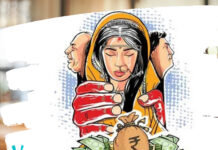













What is the first thing that comes to mind when you think of the word ‘leftover’? Probably day-old rice, or food that was not finished in the day itself, that you put in the fridge and eat the next day. However, in China, that term is used for women.
Yes, as if an entire gender was just like a bowl of day-old rice, the concept of ‘leftover women’ is very true in China.
Women, in practically every society, are constantly held to a level where they must be the upholders of morality, dignity, family values and yet be the punching bag if anything goes wrong as well. China did this by coining the term ‘leftover women’ for the unmarried women over the age of 27. The unfortunate thing is, this is not something isolated to just China; it can be seen in various other countries.
Women across the globe, in India, South Korea, Japan, the United States, across the Arab world and Western Europe, have always been told, in one way or another, that their worth is tied to their marriageability. That ambition, a career, or even just a preference for the right partner over the nearest available one constitutes a kind of failure.
The word might be different, the meaning may be tweaked a bit here or there; however, the core message remains consistent across cultures and centuries: a woman who is not a wife is a problem.
In China, however, this pressure was institutionalised, state-sponsored, and given a name sharp enough to sting: sheng nü. Leftover women.
What Does The Term ‘Leftover Women’ Mean?
The term sheng nü (剩女), pronounced shèng nǚ, is most commonly translated into English as “leftover women.” The translation, though, doesn’t really capture the insensitive nature embedded in the original Chinese.
The Chinese word “sheng” refers mainly to leftover or spoiled food, the stuff that must be discarded, the remains scraped off a plate. Applied to a woman, it does not simply mean single or unmarried. It implies she has been passed over. That she has sat too long on the shelf. That she is, in the language of kitchens and waste, no longer fresh.
In China, Sheng nü is a derogatory term that classifies women who remain unmarried in their late twenties and beyond. This sexist term is widely used to describe an urban, professional female over the age of 27 who is still single. She typically has a university degree. She likely has a career. She may own her own apartment.
The term was coined by the state-backed All-China Women’s Federation in 2007 when they used it in a report to describe females in their late 20s who had not gotten married yet. In a declaration, they wrote, “Leftover women are modern urban women, most of whom have high education, high income, and high IQ. They are nice-looking, but they are relatively demanding in choosing spouses, so they haven’t found ideal partners for marriage.”
Confucius, the ancient Chinese philosopher and political figure, whose ideas essentially became the bedrock of East Asian civilisations. According to him, “The Chinese girl was brought up, then as now, with matrimony in view as her goal,” and “the woman follows the man. In her youth she follows her father and elder brother; when married, she follows her husband; when her husband is dead, she follows her son”.
Thus, according to reports, marriage in China is more associated with societal stability and duty to family than something to be borne out of love or individual choice.
According to the official, state-run Xinhua News Agency, the term was adopted by China’s Ministry of Education in its official lexicon. The state media also promoted the term’s usage through various media, including reports, cartoons, surveys, and more, where they would refer to urban, educated and professional women who “cannot find a husband” as a “crisis.”
Read More: Archaic Ancient Beauty Tradition In China Oppressed Women And Was Almost A Form Of Torture
Leta Hong Fincher, author of “Leftover Women: The Resurgence of Gender Inequality in China”, speaking with The Diplomat in a 2014 interview, also commented on this campaign.
She said, “The ‘leftover’ women media campaign is also aimed at the parents and other older relatives of young women, so even if a young woman rejects the sexist media messages, she still comes under intense pressure from her parents and others to get married once she hits her mid-20s. Arranged marriages are supposed to be a thing of the past, but I see quite a lot of young women not thinking clearly and rushing into marriage with a man pushed on them by their relatives, just because they are afraid of winding up “leftover” in their late 20s or early 30s.”
This can be seen from this excerpt from the 2011 article published by the All-China Women’s Federation, titled “Leftover Women Do Not Deserve Our Sympathy.”
The excerpt states: “Pretty girls do not need a lot of education to marry into a rich and powerful family. But girls with an average or ugly appearance will find it difficult. These girls hope to further their education in order to increase their competitiveness. The tragedy is, they don’t realise that as women age, they are worth less and less. So by the time they get their MA or PhD, they are already old — like yellowed pearls.”
Not Their Fault?
According to Dr Sandy To, a sociologist who conducted a four-year study at the University of Cambridge between 2008 and 2012, the fault is not with the women, but the men or families who reject them for… basically having achievements?
As per Dr. To, “During China’s early reform era, management-level women faced discriminatory treatment in the marriage market,” adding how “Four decades later, my research found that highly-educated women in today’s post-reform era still suffer from the same discrimination, as they are passed over for less-educated, less career-orientated women instead.”
Dr. To’s conclusion was pointed: “Many of them want to pursue the traditional path of marriage and even end up seeking higher-status husbands in an effort to do so. Ironically, most are shunned by men because of their own accomplishments. These women can hardly be blamed for their ‘leftover’ status, because they are the ones who are being rejected.”
As Hong Fincher wrote after conducting dozens of interviews: “In all my interviews, I found it demoralizing that time after time, I would talk to women who should have the world as their oyster, with master’s degrees, great careers. And they just give it all away, because of the fear they won’t find a husband.”
Image Credits: Google Images
Sources: The Atlantic, The Conversation, The World Economic Forum
Find the blogger: @chirali_08
This post is tagged under: China, China women, China feminism, Chinese society, Chinese society women, China fertility rate, China population, China marriage, China leftover women
Disclaimer: We do not own any rights or copyrights to the images used; these images have been sourced from Google. If you require credits or wish to request removal, please contact us via email.
Other Recommendations:
Are Indian Women Paying ‘Marriage Penalty’ With Careers? Report Tells