




























Children have long been considered the ultimate blessing in Indian culture, the final milestone in the script of a successful life. Once you are married, the social interrogation begins.
In-laws, colleagues, distant relatives, and even strangers all start asking the same question: “When are you having kids?” But for an increasing number of urban Indian couples, the answer to this question is changing. Their life script is going through a radical, deliberate rewrite. It’s not a rejection of the blessing itself but rather stems more from factors like financial pragmatism and the changing landscape of the world we live in.
It’s a global trend that has filtered into India as well. A Pew Research Centre survey found that 40% of non-parents aged 18-29 are unlikely to have kids.
According to the US Census Bureau, the percentage of parents living without children rose from 52.5% to 71.3% between 1967 and 2016. India’s DINK (Double Income, No Kids) population is estimated to be rising at a rate of 30% annually. Studies tracking family trends note a steady rise in childless marriages, increasing from 7% (2015-16) to 12% (2019-21), with the sharpest spike occurring in urban areas.
The Financial Trap
High living costs, expensive housing, lifestyle factors, rising education costs, and demanding careers are some of the reasons holding couples back from taking the parenting plunge.
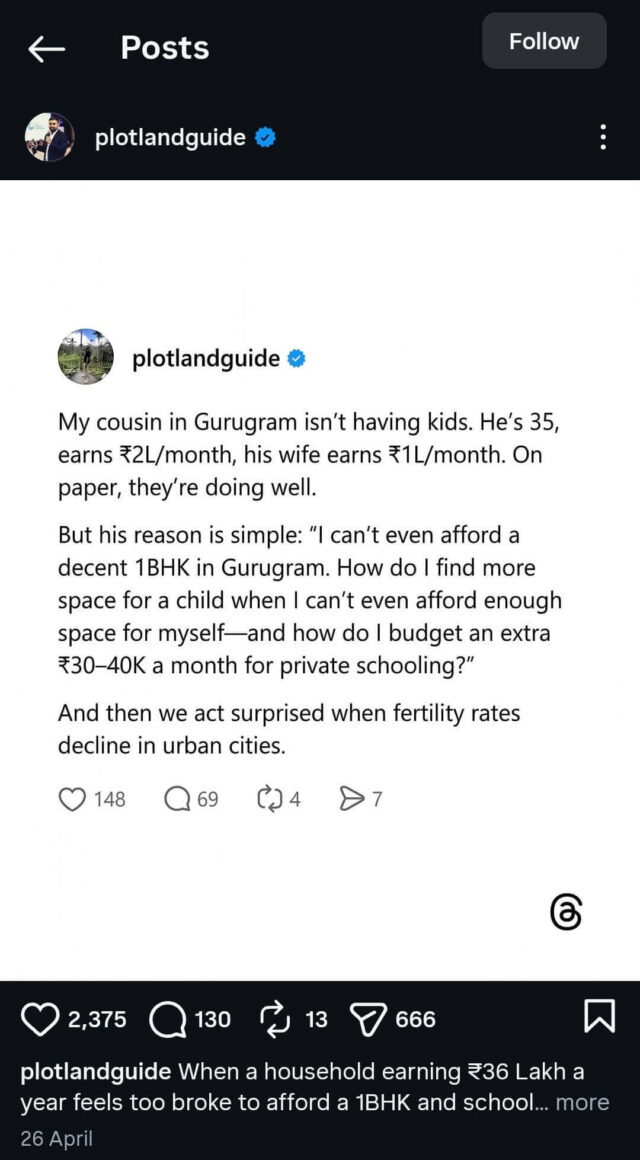
For an urban, middle-class family, the total cost of raising a child from birth through college ranges from ₹45 lakh to ₹1 crore. In a viral Instagram post from April by real estate investor Harsh, he stated that his cousin and his wife, earning ₹36 LPA, don’t want to have kids because of the high living costs in Gurugram.
They claimed that it was difficult for them to afford a 1BHK in Gurugram, and to go beyond that was far-fetched. Add to that the additional cost of schooling and other expenses in an urban space like Gurugram.
 In a subreddit r/gurgaon, titled “New parents – What is the tentative monthly expenses in Gurgaon to raise a baby?” – users record varying opinions.
Some say that raising a child is only expensive in urban cities, while some say it’s a personal choice, whether you choose to raise them on ₹30k–₹40k or feel you can’t manage even on ₹2 lakh.
Juzzybee90 says that, “Corporates have made it (parenthood) an experience with decoration and cakes and everything. Nothing wrong with it, unless the parents get into peer pressure to opt for it even when they are struggling with money.”
The Bandwidth Burden
Beyond the bank account, there is an emotional budget that couples are struggling to balance. Modern parenting has evolved from the hands-off style of previous generations to the gentle parenting model.
While being more child-centric and child-sensitive, it demands greater attention to detail. It demands constant presence and communication, which is exhausting for a couple with already draining jobs. Many couples feel they don’t have the mental bandwidth and patience to raise a child.
Demanding careers, running nuclear households, hiring nannies, and managing them become strenuous. Raising kids today has turned into a full management role. Between school expectations, playdates, and the pressure to enrol kids in excess extracurricular activities, managing a child’s social life alone becomes a full-time job.
Many couples feel they lack the mental bandwidth to sustain this without burning out. Many women also feel that the greater onus of raising kids falls on them.
Couples want to increasingly prioritise themselves, their time and their own growth. They want to travel the world, try new things, and go on spontaneous outings. Rearing children does come with its own set of sacrifices and choices.
Read more: Even If An Indian Woman Can Produce Babies, Doesn’t Necessarily Mean That She Is Obliged To Produce One
Pop Culture’s Take
Stand-up comedy has also taken note of the DINK lifestyle. Rohit Swain, in a reel from May 28, jokingly argued that these couples have more clarity of thought than millennials, who are only obsessed with having kids. He hits the financial pragmatism argument with comedic brutality and even lauds the Prime Minister as the ultimate DINK.
View this post on Instagram
Many famous DINK couples on Instagram seem content with the lifestyle they have chosen. Couples like @jodianoorabh, @neetiandraman, and @karanandnate share content focusing on travel, career growth, financial freedom and everyday relationship dynamics, in the posts that they share, giving a peek into the DINK lifestyle.
While not having kids is a personal choice, the financial ramifications are giving couples a lot to think about. Although for many couples, being childless is not a choice but a sad reality. India’s Total Fertility Rate (TFR) has fallen to 1.91 (dipping below the replacement level of 2.1), fuelling the rise of smaller households and child-free couples.
The Whole Spectrum
The child-free movement is as diverse as the individuals behind it. You might encounter various terms, each representing a different rationale:
- DINK – Double income, no kids
- SINK – Single income, no kids
- DINKWAD – Double income, no kids with a dog
- GINK – Green inclinations, no kids
GINK couples refer to those who refuse to have children, owing to environmental reasons. They do not believe in adding to the planet’s ecological woes.
The Flip Side
Of course, there are two sides to every coin. There is a persistent societal narrative that these couples will eventually regret their decision. They will feel left out when surrounded by peers who celebrate their kids’ birthdays and other milestones. Loneliness in old age or lack of a safety net and support system will hound them.
Even those couples who opt for pet parenting are criticised for trading one responsibility for another. Vishal Bhargava, in a post on X/Twitter dated April 30, says that “A silent pandemic is underway in Indian cities. Far too many couples are opting to not have kids at all. It is the wrong decision. Most will regret it.”
One user warns of societal collapse, while another user cites an accumulation of the “heaviest karmic debts known to Sanathan Dharma.” Sushant on X/Twitter shares that they were on the way to the DINK lifestyle when better sense prevailed. They narrowly escaped a life that was “cool on the outside, but hollow on the inside.”
We also have individuals who support the decision to remain childless, citing it as a smart choice when you are not well prepared to shoulder the responsibility of raising a human being. Yet many couples argue that they are not avoiding responsibility but simply choosing to prioritise their own pursuit of wanderlust, career mobility and personal growth, while the choice is still theirs to make.
Choice And Autonomy
The Indian dream is not just about continuity and legacy anymore, with many choosing to focus on personal growth rather than expanding their lineage. We often consume dystopian stories like The Handmaid’s Tale, where fertility is rare, and society is collapsing under the weight of infertility.
But are we closer to that reality where child-free societies exist by choice? Even so, the ultimate test of an independent and evolving society is one that provides a choice, free from the weight of unsolicited expectations and societal judgment.
Image Credits: Google Images
Sources: Moneycontrol, Hindustan Times, India Today
Find the blogger: @diptisadh This post is tagged under: Indian couples, DINK, urban Indian couples, child-free couples, modern Indian parenting, double income no kids, indian family trends, cost of living India, expensive schooling, expensive housing
Disclaimer: We do not own any rights or copyrights to the images used; these images have been sourced from Google. If you require credits or wish to request removal, please contact us via email.
Other recommendations:
Couples Are Using TikTok’s Bird Theory To Test How Strong Their Relationship Is