





























Prada sells our humble Rs. 70 Kolhapuri chappal for Rs. 1.16 lakh. Ralph Lauren came under fire for pricing our everlasting Rs. 50 jhumkas at Rs. 77,000. Dior used Indian textile art Mukaish without acknowledgement in a Rs 1.7 crore jacket. Louis Vuitton thought an autorickshaw bag was a fun accessory.
Now, is there anything wrong with Western brands taking inspiration from classic Indian cultural items and bringing them to a global stage? Absolutely not.
However, you know what a common thread seen among all these incidents was? It was the fact that not a single one mentioned it being inspired by Indian heritage, its cultural roots, or gave any credit to the Indian artists who have been perfecting their craft for generations, in some cases.
Western luxury fashion has long had a particular relationship with Indian craft, one that looks, from this end, a lot less like appreciation and a lot more like a very well-dressed form of extraction.
Now, though, Prada’s announcement of launching a special footwear specifically inspired by the Indian Kolhapuris and even going so far as to partner with LIDCOM and LIDKAR artisans from Maharashtra and Karnataka.
This is an interesting turn of events, and something that seems to speak of turning tides, perhaps for the better.
What Happened With Prada Last Year?
To understand why the response was so immediate and so fierce, you need to understand what a Kolhapuri chappal actually is. Kolhapuri Chappals trace their origins back to the 13th century, shaped by families of artisans who passed their knowledge down from one generation to the next. These are not a “trend.”
They are a living craft with a documented history longer than most European nations.
Traditionally produced across eight districts in Maharashtra and Karnataka, Kolhapuri Chappals received the Geographical Indication (GI) designation in 2019, protecting their origin and artisanal techniques.
Prada, though, introduced this footwear into their Milan runway show held in June 2025, rebranded as part of their Spring/Summer 2026 menswear collection, priced at approximately Rs 1 lakh a pair.
In any of their PR or social media platforms or any official medium, none of them ever mentioned the true origins of the footwear, their history or anything about Indian artisans, simply calling them “leather flat sandals.”
The backlash was swift and intense, with not just Indian but social media users from around the world calling out Prada for what was essentially stealing cultural items without any credit.
On X/Twitter, users posted: “No @prada — these aren’t ‘leather sandals’ — this is a kolapuri. You do not get to look down upon our traditions, only to repackage them.”
Toolika Gupta, director at the Indian Institute of Crafts and Design in Jaipur, said, “A lot of Indian people, including designers and artisans, are aware of their rights,” adding, “They want acknowledgement of their legacy.”
A Public Interest Litigation was also filed in the Bombay High Court, questioning the lack of recognition for the craft. The Maharashtra government raised formal concerns.
Artisan associations across eight districts went on record. Fashion commentators, politicians, and the general public applied sustained pressure.
Did Prada Actually Listen?
Soon after the backlash, Prada tried to ease the anger and released a statement: “The design was inspired by traditional Indian shoes, and Prada is open to discussions with artisan groups.”
They didn’t stop there, though, as in December 2025, Prada announced the terms of what it had been negotiating.
The Italian luxury group planned to make 2,000 pairs of the sandals in the regions of Maharashtra and Karnataka under a deal with two state-backed bodies, blending local Indian craftsmanship with Italian technology and know-how.
These sandals will then be sold through 40 selected Prada stores worldwide and online, priced at 750 euros (Rs 83,000).
The collection officially launched on April 27, 2026, and carries a label that would have been unthinkable at the original Milan show: “Made in India × Inspired by Kolhapuri Chappals- crafted by LIDCOM and LIDKAR artisans.”
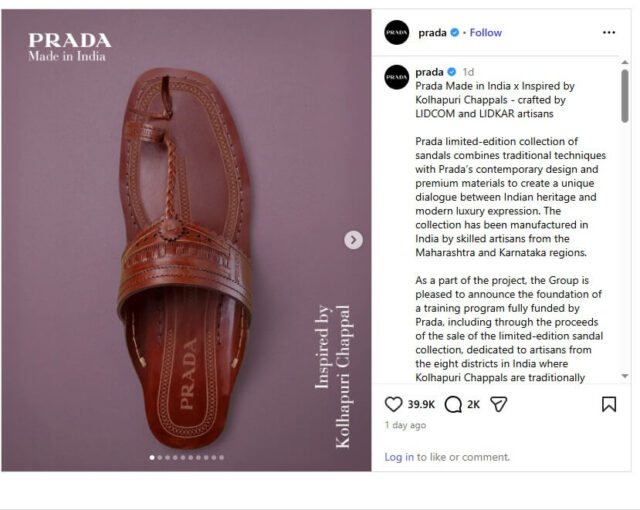
In their Instagram post announcing the collection, Prada wrote, “Prada limited-edition collection of sandals combines traditional techniques with Prada’s contemporary design and premium materials to create a unique dialogue between Indian heritage and modern luxury expression. The collection has been manufactured in India by skilled artisans from the Maharashtra and Karnataka regions.”
The brand even announced a training program, writing, “As a part of the project, the Group is pleased to announce the foundation of a training program fully funded by Prada, including through the proceeds of the sale of the limited-edition sandal collection, dedicated to artisans from the eight districts in India where Kolhapuri Chappals are traditionally manufactured.
Developed in collaboration with LIDCOM, LIDKAR and leading design institutes – the National Institute of Fashion Technology (NIFT) and the Karnataka Institute of Leather & Fashion Technology (KILT) -, the program is designed to strengthen design and technical skills, enabling artisans to create products that meet evolving market needs, while ensuring the continued relevance of this traditional craft.”
The brand even posted a video, showing the creation of the shoes at the Lidcom Facility in Kolhapur, Maharashtra.
View this post on Instagram
Prerna Deshbhratar, LIDCOM managing director, said: “Once Prada endorses this craft as a luxury product, definitely the domino effect will work and result in increasing demand for the craft.”
Tanu Kashyap, director general at NIFT, put the significance plainly: “It is time that Indian traditional crafts take their rightful place on the world stage.”
While Prada definitely doesn’t need to be hailed just for doing the bare minimum, such as giving credit where due, it is worth noting that among all the brands that have been named and shamed over Indian craft appropriation, it is one of the very few that has actually turned the episode into something tangible for the artisans involved.
They’ve introduced this line of footwear with the proper credits, correct nomenclature being used, which includes the words India and Kolhapuri in it, along with shedding light on local facilities and organisations of Indian artisans that are the hands behind such products.
This is a good start; better late than never. Still waiting for Ralph Lauren, Dior and more to get on board as well.
Read More: Why Are Indians Buying From Homegrown Sneaker Brands Over Popular Western Ones?
The Mirror We Need to Hold Up to Ourselves
Here is the part of the story that tends to get lost in the immediate outrage cycle: the Prada chappal episode did not happen in isolation.
It is simply the latest instalment of an intellectual and cultural extraction that the West has been running on India since the colonial period, and which, for much of that period, had the full force of imperial law behind it.
Just take the “pashmina” for instance. Kashmiri artisans spent centuries developing the craft of spinning pashm wool into the finest shawls in the world.
By the time the colonial machinery had finished with that knowledge, the word had been genericised, the craft had been industrially replicated across Europe, and the original artisans were competing, on unequal terms, with the very knockoff industry that had stolen their technique.
Basmati rice tells the same story at an agricultural scale. In 1997, the American corporation RiceTec patented basmati rice, appropriating a cultural staple and attempting to turn it into a generic brand. India fought back legally and eventually won, but the case took years and cost resources for the farmers.
The unfortunate reality, though, of this is that the Western brands were able to do this so easily and simply because the Indian crafts and arts sector still remains a very under-credited and under-appreciated area.
Artisans, groups and organisations seldom have the backing of corporate structures that would help them get such things patented or protected so that they cannot be misused or appropriated by anyone.
Despite all this, Indian consumers still seem to be holding onto that colonial mindset where they will cheerfully spend five lakh rupees on a luxury handbag but scoff or mock local Indian textiles.
The irony in this, though, is that many of the times those items are not even made in the iconic Italian or French factories, but instead were mass-produced in China and other related regions.
The Influencer Generation Is Actually Mining This Correctly
An interesting and positive shift is being noticed, though, especially in the influencer and content creator area, where they, whether out of genuine interest or just to stand out from the crowd, are shedding light on Indian arts and crafts, artists, textiles, and their cultural and historical roots.
Designer Gaurav Gupta told CNN, “It’s a powerful shift, almost like we’re reclaiming our own narrative,” adding, “Designers from India are now presenting on the global stage not as ‘ethnic’ alternatives, but as innovators with our own language, our own shapes, our own ideologies. We’re not adapting to fit in anymore; we’re expressing to stand out.”
In a content landscape so saturated with Dior unboxings and Chanel hauls that they have become visual background noise, a creator who can explain the mathematics of a Patola sari, or demonstrate the physical labour behind a Benarasi weave, or trace the history of block printing in Bagru, has something no amount of luxury brand access can replicate: genuine, irreplaceable specificity.
View this post on Instagram
View this post on Instagram
The Patola sari is an excellent example of an Indian textile, one that is extremely technically demanding and demands a mathematical precision that researchers have described as genuinely staggering.
To create a single double-ikat Patola, a weaver must calculate and pre-dye each thread before a single pass of the loom, accounting for every colour shift in the final pattern before the weaving has even begun.
The process for a single sari can take months. The knowledge required to execute it takes years to learn and generations to develop.
Image Credits: Google Images
Sources: Firstpost, The Economic Times, Reuters
Find the blogger: @chirali_08
This post is tagged under: culture theft, kolhapuri chappal, kolhapuri chappal history, kolhapuri chappal india, kolhapuri chappal origins, Prada, prada 2026 runway, Prada chappal, Prada kolhapuri, Prada kolhapuri chappal, Prada kolhapuri chappal news, prada milan show, reverse globalisation
Disclaimer: We do not own any rights or copyrights to the images used; these images have been sourced from Google. If you require credits or wish to request removal, please contact us via email.
Other Recommendations:
Margot Robbie’s Mughal Necklace Is Indian Loot; Cartier’s Racism Comes To Light Again