





























It has been almost 7 weeks since the United States (US) and Israel attacked Iran and started the war. And yet, each time peace seems to be on the horizon, something happens, either the US or Israel’s doing, that pushes it back further.
The recent US blockade of the Strait of Hormuz, the crucial maritime chokepoint for energy trade, is just the latest one to join the list.
On April 14, 2026, after six weeks of air strikes, a fragile ceasefire, and marathon negotiations that collapsed in Islamabad, the world woke up to an announcement.
President Donald Trump announced the U.S. Navy was imposing a blockade on all ships entering or leaving Iranian ports and coastal areas, including those along the Arabian Gulf, Gulf of Oman, and the Arabian Sea east of the Strait of Hormuz.
What Is A Naval Blockade, And Is This One Legal?
On Sunday, US President Donald Trump first announced plans to block the Strait of Hormuz.
In a Truth Social post, he wrote, “So, there you have it, the meeting went well, most points were agreed to, but the only point that really mattered, NUCLEAR, was not. Effective immediately, the United States Navy, the Finest in the World, will begin the process of BLOCKADING any and all Ships trying to enter, or leave, the Strait of Hormuz.”
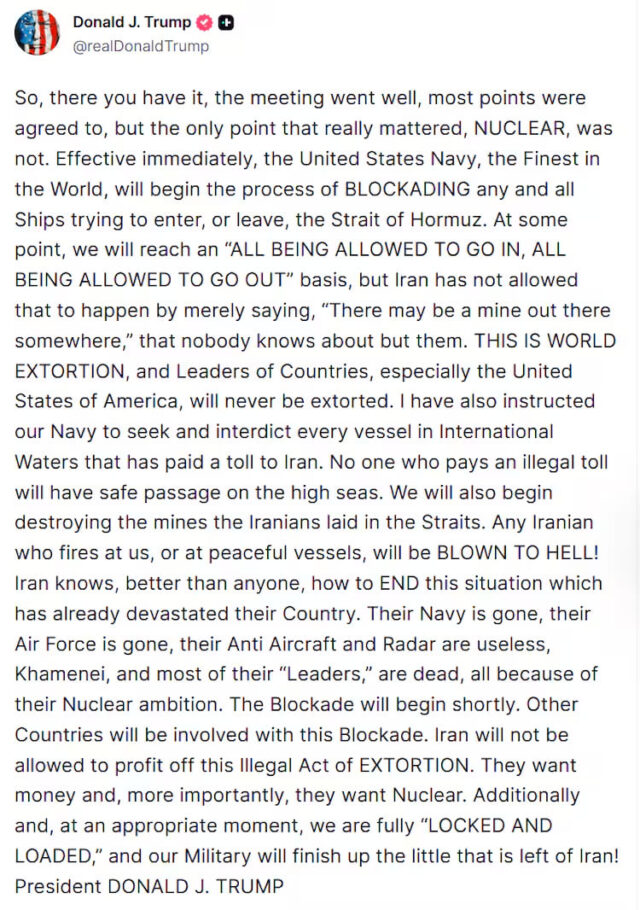
He further wrote, “At some point, we will reach an ‘ALL BEING ALLOWED TO GO IN, ALL BEING ALLOWED TO GO OUT’ basis, but Iran has not allowed that to happen by merely saying, ‘There may be a mine out there somewhere,’ that nobody knows about but them.
THIS IS WORLD EXTORTION, and Leaders of Countries, especially the United States of America, will never be extorted. I have also instructed our Navy to seek and interdict every vessel in International Waters that has paid a toll to Iran.
No one who pays an illegal toll will have safe passage on the high seas. We will also begin destroying the mines the Iranians laid in the Straits. Any Iranian who fires at us, or at peaceful vessels, will be BLOWN TO HELL! Iran knows, better than anyone, how to END this situation which has already devastated their Country. Their Navy is gone, their Air Force is gone, their Anti Aircraft and Radar are useless, Khamenei, and most of their “Leaders,” are dead, all because of their Nuclear ambition.
The Blockade will begin shortly. Other Countries will be involved with this Blockade. Iran will not be allowed to profit off this Illegal Act of EXTORTION. They want money and, more importantly, they want Nuclear. Additionally and, at an appropriate moment, we are fully “LOCKED AND LOADED,” and our Military will finish up the little that is left of Iran!”
The US Central Command (CENTCOM) confirmed the announcement in a post on X/Twitter on Monday, April 13, 2026. They wrote, “US Central Command (CENTCOM) forces will begin implementing a blockade of all maritime traffic entering and exiting Iranian ports on April 13 at 10 a.m. ET, in accordance with the President’s proclamation.”
The statement further explained, “The blockade will be enforced impartially against vessels of all nations entering or departing Iranian ports and coastal areas, including all Iranian ports on the Arabian Gulf and Gulf of Oman.
CENTCOM forces will not impede freedom of navigation for vessels transiting the Strait of Hormuz to and from non-Iranian ports. Additional information will be provided to commercial mariners through a formal notice prior to the start of the blockade.
All mariners are advised to monitor Notice to Mariners broadcasts and contact U.S. naval forces on bridge-to-bridge channel 16 when operating in the Gulf of Oman and Strait of Hormuz approaches.”
A naval blockade, in the formal language of maritime law, is the use of warships to prevent vessels from entering or exiting a port or stretch of coastline belonging to an enemy.
The Newport Manual on the Law of Naval Warfare, the authoritative text on such matters, defines a blockade as including “the capture of contraband, and the capture or destruction of enemy property found at sea,” with the stated purpose being to “deny an enemy the chance of economic revenue from its exports and the benefits of imports that support its war effort.”
To be legal under international law, a blockade must meet specific criteria: it must be formally declared and notified in advance, it must be enforced impartially (it cannot target some nations while sparing others), and it must not extend into neutral waters in a way that cuts off access for uninvolved countries.
The problem is that the U.S. blockade sits in a deeply contested legal space. Multiple military experts and legal scholars have called it, plainly, an act of war.
Speaking to NPR’s Morning Edition on Monday, retired U.S. Admiral James Foggo put it in stark terms: “Technically speaking, a blockade of a country or a country’s ability to export goods and services is an act of war. But it’s also illegal to charge $2 million a ship for transit through the straits, which is what Iran has been doing.
And if you extrapolate that to a hundred ships a day and 365 days a year, that’s a profit of $73 billion. That’s more than the US Navy got for its shipbuilding budget. So they’d be able to reconstitute those things that have been taken away from them.”
Retired Canadian Vice-Admiral Mark Norman, a fellow with the Canadian Global Affairs Institute, agreed with that legal assessment but added an important distinction: “The act of a blockade itself…is an act of war. Now, to board and seize a vessel of another flagged nation — that is right up against the line of a similar act of war. As soon as you blockade a country, that is, under international law, an overt act of war.”
He described the move as “the only significant remaining pressure point” short of a ground invasion, but also as “a somewhat desperate act,” and expressed doubts about its strategic wisdom: “I’m not convinced strategically that it’s necessarily the best solution, but I think the US have painted themselves into a bit of a corner here.”
Philip Mercogliano, a maritime historian who has testified before the US Senate and written for the US Naval Institute, framed the issue in terms of a foundational international principle, asking, “We are challenging the concept of freedom of the seas,” on his “What’s Going on With Shipping?” podcast.
Read More: Is Trump Using The Madman Theory In The US-Israel War With Iran?
Meanwhile, Iran wasted no time rejecting the blockade’s legal basis. Iran’s armed forces called it “an illegal act” and “piracy.” Ebrahim Rezaei, a spokesman for the Iranian parliament’s National Security Commission, was blunt: “The claim that Trump has said he will begin a naval blockade of Iran is a bluff rather than reality, because such a move would be considered an act of war and we would respond.
It would further complicate the situation he has already gotten himself into and would unsettle markets that are already reacting with anger, and we may also reveal other ‘cards’ that we have not yet used in this game. If you want the situation to improve, respect Iranians, accept your defeat, and do not demand at the negotiating table what you failed to achieve in war.”
The Iranian consulate general in Mumbai, in an April 13, 2026, tweet, wrote, “Bro forgot that even after ‘smashing fleets,’ control of the Strait of #Hormuz decides the game.
1980s: massive war, full backing for #Saddam… yet #Iran held the choke point and outlasted the noise.
2026: same script, new actors. Baaki sab filmy dialogue hai boss.”
How Does a Naval Blockade Actually Work?
Basically, the naval blockade is a way to make it difficult for commercial tanker ships to get through the passage by using warships. As of early this week, the US military had confirmed at least 15 warships in the region capable of joining the blockade.
Retired Admiral James Stavridis, who previously served as NATO’s Supreme Allied Commander Europe, told CNN’s Fareed Zakaria that a proper blockade would require even more, saying, “Two aircraft carrier strike groups that would provide air cover, plus a dozen destroyers and other surface ships outside the gulf to patrol the Strait of Hormuz at its entrance.”
He characterised the strategic logic of a blockade as, “It puts economic pressure on Tehran without destroying the oil facilities, which you should want to preserve into the future. So a big complicated undertaking, hardly a trivial move on the chessboard we’ve been watching.”
But what happens if a tanker still tries to go through the blockade?
According to reports, the US would be more likely to intercept, board, and seize ships than to sink them. The Newport manual allows “belligerents at sea” to capture enemy merchant vessels and goods outside neutral waters.
Jennifer Parker, a former Royal Australian Navy officer and a nonresident fellow at the Lowy Institute, explained on her X/Twitter page that, “So rather than a blockade (as stated), what we are more likely to see is selective interference with shipping under prize law to influence shipping routes, reduce Iranian control, and generate economic leverage.”
Who Has The Upper Hand?
But analysts believe that focusing on just military power is not the way to go.
Dana Stroul, a former senior Pentagon official in the Biden administration who is now at The Washington Institute for Near East Policy, identified the core strategic problem with blunt precision: “Trump wants a quick fix. The reality is, this mission is difficult to execute alone and likely unsustainable over the medium to long-term.”
Iran is not without its toys, though, having a ballistic missile arsenal that is considered among the largest in the Middle East, with more than 3,000 missiles.
That, combined with their drone program, has forced the United States to burn through extraordinarily expensive interceptors. At the same time, Iran has been dealing with almost six weeks of sustained American and Israeli air strikes.
However, the Iran War Updates analysis explained it as, “A conventional force-on-force comparison misses the point: Iran has spent decades preparing for an asymmetric conflict against a technologically superior adversary, and its doctrine is built around imposing costs, rather than winning battles.”
Retired Admiral James Stavridis, speaking with CNN, also raised the risks here, saying, “We need to be very wary here, very alert as we go into this phase. Iran still has cards to play, Tehran could use its remaining arsenal of missiles and drones to strike vessels in the strait and target Gulf region oil, gas and fertilizer facilities.
It also could employ cyberwarfare, potentially aided by Russia or China, or terrorism in the American homeland.”
Image Credits: Google Images
Sources: Hindustan Times, BBC, The Guardian
Find the blogger: @chirali_08
This post is tagged under: us naval blockade, us blockade of hormuz, us blockade map, strait of hormuz, strait of hormuz blockade, strait of hormuz us blockade, us blockade, us blockade iran, iran, us, donald trump, naval blockade of iran, hormuz blockade
Disclaimer: We do not own any rights or copyrights to the images used; these images have been sourced from Google. If you require credits or wish to request removal, please contact us via email.
Other Recommendations:
Top Reasons Why India Is Watching The US-Israel-Iran War As A Silent Spectator