






























At the recent Fall 2026 women’s show at Paris Fashion Week, the mood on the runway was unmistakably polished, with long coats, leather boots, crisp tailoring, and a distinctly vintage aesthetic that is iconic of the Ralph Lauren label.
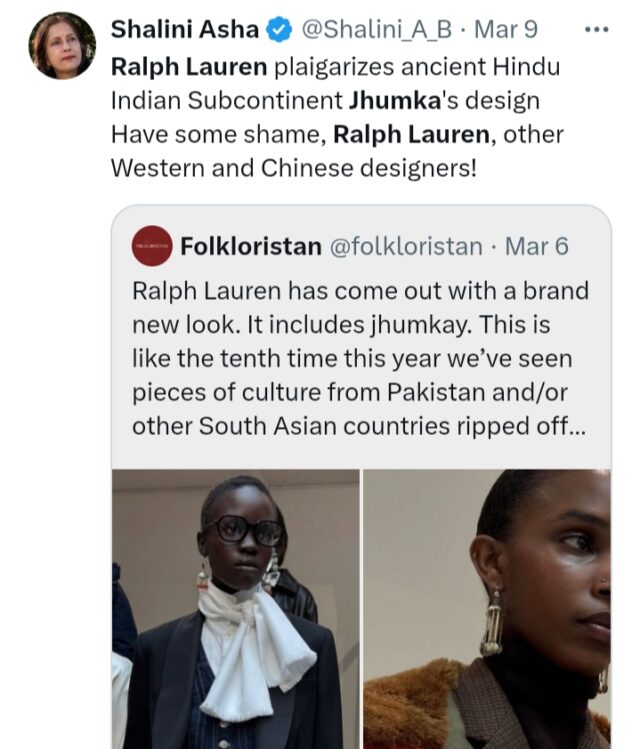
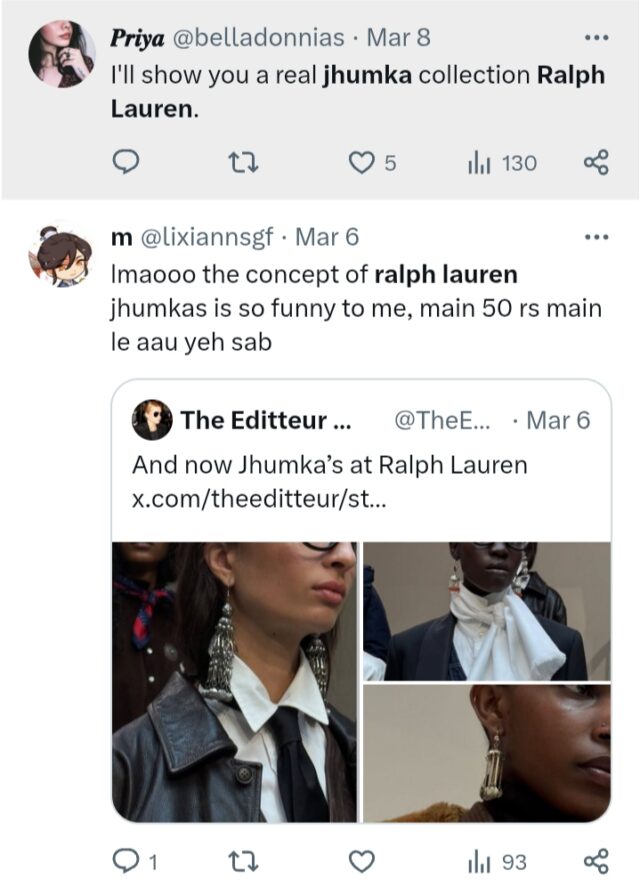
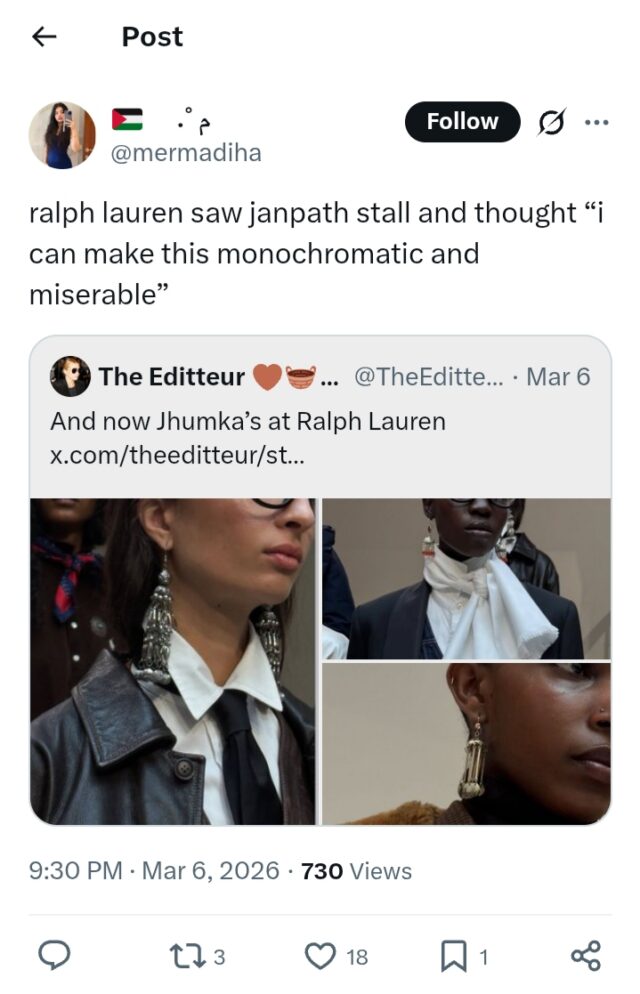
But as videos from the show began circulating online, viewers quickly noticed something familiar swinging from the models’ ears: bell-shaped silver earrings that looked strikingly similar to the South Asian jhumka.
The brand’s show notes described the accessories simply as “vintage earrings,” without any mention of South Asia or the centuries-old jewellery tradition they resemble. What followed was predictable yet revealing: a social media backlash accusing the label of cultural appropriation.
The debate was not just about a pair of earrings. It reopened a much larger conversation about who gets credit and profit when global fashion houses reinterpret traditional craft from the Global South.
The Jhumka With A Long History
The jhumka is not merely decorative jewellery. Historians trace its origins to around 300 BCE, when temple sculptures in southern India began depicting dancers and deities wearing bell-shaped earrings.
Many art historians link these designs to the aesthetics of temple dance traditions, particularly Bharatanatyam, where ornate jewellery forms part of ritual costume and symbolism.
Over centuries, the design travelled across the Indian subcontinent, becoming a staple in bridal jewellery, classical dance costumes, and everyday adornment.
Today, jhumkas exist in hundreds of regional variations, from the elaborate gold designs of South India to silver tribal versions in Rajasthan and Uttarakhand.
According to India’s Export Promotion Council for Handicrafts, the handicraft sector supports more than 7 million artisans, many of whom work in jewellery and metal crafts that sustain local economies.
Cultural Borrowing Or Cultural Erasure?
Globally, the line between inspiration and appropriation has always been blurry. Designers frequently look to traditional cultures for motifs, silhouettes, and craftsmanship. But the problem arises when these elements are detached from their origins and repackaged as something new.

Harshita Srivastava, senior faculty of fashion styling at Pearl Academy, told The Indian Express that this pattern is deeply familiar.
She explains, “The list of such trends is endless: yoga, chai tea lattes, turmeric milk, incense sticks, curry sauce, “namaste”, henna tattoos, naan bread, mango lassi… The point is, this isn’t an isolated event, and certainly not the first time Europe or America have viewed itself as the centre of the world.”

She adds that these moments are not culturally neutral. “We live in a world that has been tilted, one where no act of borrowing from another culture can exist without historical context. When a privileged community adopts from a marginalised one, especially one that has faced historic oppression or colonisation, they trigger and repeat the original trauma. Imperialism, identity, and systemic erasure are linked.”
Also Read: After Prada, Dior Uses Indian Textile Art Mukaish Without Acknowledgment In Rs 1.7 Cr Jacket
The Internet Calls It Out
Social media ensured that the conversation moved far beyond fashion insiders. Videos from the show circulated rapidly across Instagram and X, where users questioned why a design so closely associated with South Asia appeared on the runway without acknowledgement.
Snigdha Sur, founder and CEO of The Juggernaut, wrote on X, “Western fashion houses keep monetising, rebranding, and selling cultural pieces from South Asia for big bucks while rarely crediting the cultures they come from.”

Other reactions were more sarcastic. One viral comment read, “This will cost you 50 rupees on an Indian street market. But wait till a luxury brand sells it for $500.”

Another user wrote bluntly, “Ralph Lauren doing jhumkas while not mentioning its cultural heritage is peak whitewashing.”
A Pattern The Fashion Industry Knows Too Well
This is not the first time a luxury label has faced accusations of appropriating Indian craft. In 2024, Prada drew criticism for selling sandals resembling traditional Kolhapuri chappals without initially acknowledging their origins in Maharashtra.
Only after widespread backlash did the brand clarify that the design was “inspired by traditional Indian footwear.”
Similarly, luxury brands have repeatedly drawn from Indian embroidery traditions. In 2025, a coat by Dior featuring intricate mukaish embroidery from Lucknow sparked controversy when reports suggested that the artisans who spent weeks producing the work were not credited in promotional material.
Such incidents bring to light a broader structural imbalance, where heritage crafts are treated as aesthetic resources rather than intellectual property belonging to communities.
The Economics Behind The Outrage
The debate is not simply about cultural pride; it is also about economics.
According to the Ministry of Textiles, Government of India, India’s handicrafts exports have been valued at over ₹30,000 crore in recent years, with jewellery and metal crafts forming a significant portion of the sector. When traditional designs appear globally without attribution, artisans often see none of the financial benefit.
Cultural economists argue that recognition matters because it shapes supply chains and partnerships. If brands publicly acknowledge traditional origins, doing so can open the door to collaborations, fair compensation, and sustainable craft clusters.
Without that acknowledgement, however, artisans remain invisible contributors to a global industry worth hundreds of billions of dollars.
Fashion thrives on inspiration. Every era, every culture, and every craft tradition feeds into the creative ecosystem of global design. But inspiration becomes problematic when it quietly erases the story of where something came from.
A pair of earrings on a runway might seem trivial, yet the debate around the jhumka reminds us that design carries history. If the future of fashion truly values diversity, then crediting the cultures that inspire it should be the easiest accessory to add. After all, acknowledging a tradition costs nothing, and yet it means everything.
Images: Google Images
Sources: Hindustan Times, The Indian Express, NDTV
Find the blogger: Katyayani Joshi
This post is tagged under: ralph lauren controversy, jhumka controversy, paris fashion week 2026, cultural appropriation fashion, indian jewellery heritage, jhumka earrings history, indian artisans rights, fashion industry debate, luxury fashion criticism, global fashion and culture, traditional crafts india, indian handicrafts industry, kolhapuri chappal controversy, dior embroidery controversy, fashion ethics debate, south asian culture, indian fashion heritage, cultural representation in fashion, indigenous craft recognition, fashion industry accountability
Disclaimer: We do not hold any right or copyright over any of the images used; these have been taken from Google. In case of credits or removal, the owner may kindly email us.
Other Recommendations:
Prada Outright Copies India’s Famous 800 Years Old Kolhapuri Chappals