



























Imagine a restaurant kitchen, all that hustle and bustle of preparing food for tens, if not hundreds, of people. All the cutting and prepping, sauces and gravies being made, breads going into the tandoor or oven. All the vegetables, meats and half-formed dishes are laid out on counters ready to be thrown together at a moment’s notice.
Now, just think: towards the end of the day, the restaurant is closing and yet the counters, the plates and the storage shelves have a significant amount of food left over. Because a restaurant completely selling out all its food in a single day is not exactly a very common occurrence.
The question here, though, is what happens to all this leftover food? Where does it go?
The usual answer is to the trash. But a recent LinkedIn post brought up a law France introduced almost a decade ago, and has once more started a conversation about food wastage and why governments and businesses around the world have not made it mandatory that their leftover food be given to those in need.
How Much Food Is Thrown Out?
As per Recycle Track Systems (RTS), “Americans waste about 60 million tons, or 120 billion pounds, of food every year”, and it is of “approximate value of nearly $218 billion the equivalent of 130 billion meals.”
Banwari Lal Verma, the current Minister of Consumer Affairs, Food and Public Distribution, while answering a Lok Sabha question from 2025 about food wastage in the country, said “as per UNEP Food Waste Index Report 2024, the estimated food wastage in India in 2022 is 55 kg/capita/year in India which is significantly lower than the global average of 79 kg/capita/year.”
However, a TOI report from October last year revealed that, as per the UNEP Food Waste Index, India’s food wastage stands at around 78 million tonnes annually, ranking second to China, which leads with 108 million tonnes of food waste.
On a global level, a 2025 report by the European Commission claimed that the UNEP index found that 60% of food waste comes from households, while 28% and 12% of that comes from food services and retail outlets, respectively.
That is a lot, and I mean a lot, of food being wasted per year. Meanwhile, hunger and the food crisis only seem to be rising across the planet daily. According to a 2023 report by the UN World Food Programme, approximately 733 million people go to bed hungry every night.
So one has to wonder: why are these two areas not being merged, since it is obvious to anyone that both are each other’s solution?
If restaurants, hotels and supermarkets start giving their leftover food to those in need, it will automatically reduce the amount of food wasted while also alleviating the hunger crisis.
What Did France Do?
Over the last few days, across several social media platforms, posts have been popping up talking about how in February 2016, France passed the Loi Garot, the Garot Law, which made it illegal for large supermarkets to destroy unsold food.
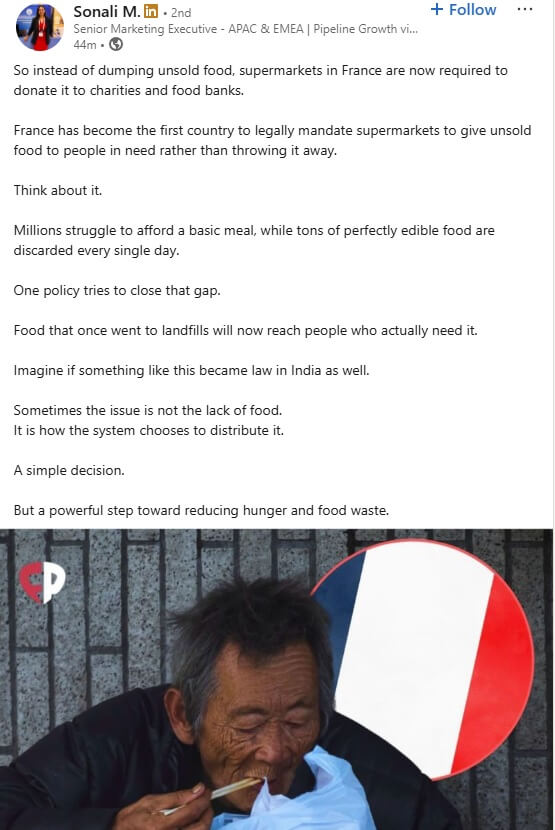
Stores with a surface area of more than 400m² were required to donate surplus food to charity instead of throwing it away. The liability excuse was removed by law. Non-compliance carries fines of up to €3,750, and in serious cases, potential prison sentences.
The results were immediate. The law led to a minimum 15% increase in food donations, generating approximately 10 million additional meals every year. The logistics problem that businesses claimed was unsolvable turned out to be very solvable, once the law gave them no choice.
It is worth noting that the law is not perfect. Retail and distribution only account for 14% of food waste in France; agriculture accounts for 32%, food processing 21%, and consumers 19%, and none of these other sources is currently addressed by the legislation.
But as a proof of concept, the French law demolished every argument against action. The logistics are solvable. The liability is manageable. The results are immediate.
It seems that France has shone a light on this topic, with various countries around the globe also introducing similar measures. These include:
Czech Republic: Since 2018, supermarkets larger than 400 square metres are legally required to donate unsold but consumable food to charities.
Spain: In 2025, Spain enacted a comprehensive law that requires all businesses in the food chain, including supermarkets, restaurants, and hotels, to have a plan for surplus food. It prioritises donation for human consumption and mandates that restaurants provide customers with free takeaway containers for their own leftovers.
Peru: Similar to France, Peru requires supermarkets and food warehouses to donate surplus food instead of throwing it away.
China: Under the 2021 Anti-Food Waste Law, restaurants can be fined up to 50,000 Yuan (~Rs 6,72,000) if they are found to be wasting food consistently. It also allows restaurants to charge diners who leave excessive leftovers.
South Korea: It is essentially illegal to throw food in the regular trash. Everyone, including households and restaurants, must use specialised bins and pay based on the weight of the food waste they generate. This has led the country to recycle nearly 96% of its food waste.
Read More: Why Is The Number Of Women Chefs So Low In Hotel Kitchens?
So Then, Why Aren’t Restaurants And Hotels Giving Their Leftover Food To The Poor?
Ask any restaurant owner why they don’t donate leftover food, and you’ll hear the same answer: “What if someone gets sick? We’ll get sued.” It sounds reasonable. It is almost entirely false.
A 2016 Food Waste Reduction Alliance survey found that 67% of manufacturers, 61% of restaurants, and 54% of retailers cited liability concerns as a barrier to donation.
Mary Risler, founder of Food Runners, a non-profit that rescues leftovers from San Francisco businesses, put it plainly: “Liability is just an excuse.”
The more honest reason is simpler and far less sympathetic: it costs more to donate food than to throw it away.
Donating requires logistics, packaging, refrigeration, coordination with charities, and staff time. Throwing away costs nothing in the short term. In a system where margins are thin and nobody is forcing businesses to change, waste is the path of least resistance.
Some restaurants and supermarkets also fear their image being affected if they donate their leftover food. As per a 2016 Boulder Food Waste Audit, “the food donated, especially produce, would likely have imperfections; there is a fear that the donations would be considered representative of the quality of food the store sells.”
On the political side, most countries, including the US, have addressed food waste by offering tax incentives and liability protections for businesses that donate, but have stopped well short of making donation mandatory.
India: The Food Safety and Standards Authority of India (FSSAI) introduced the “Save Food, Share Food, Share Joy” initiative to bridge the gap between food businesses, citizens, corporates, volunteers and more to reduce food waste.
Pawan Aggarwal, Chief Executive Officer (CEO) of FSSAI, explaining the initiative, said, “With the ‘Save Food, Share Food, Share Joy’ initiative, food banks like Food Security Foundation, Feeding India, Annekshetra Foundation and others will be connected to hotels. When there is excess food left, it will be collected by the food banks and will be distributed to the needy.”
The Reduction of Food Wastage Bill 2020 was also introduced to prohibit eateries from wasting edible food. However, the results were predictably weak.
It is also believed that governments found it convenient to let NGOs and charities absorb the hunger problem quietly without having to get involved.
And so, while perfectly good food continues to be discarded, the number of people going hungry only continues to rise. The gap between what is wasted and what is needed grows wider every year, and good intentions alone are clearly not enough to close it.
If we are serious about tackling food insecurity, we need to move beyond voluntary gestures and start treating food donation as a responsibility.
Image Credits: Google Images
Sources: The Guardian, Fine Dining Lovers, BBC
Find the blogger: @chirali_08
This post is tagged under: food, food waste, food waste global, food waste problem, food waste india, food waste law India, why do restaurants throw away food, France food waste law, food donation law, hotels wasting food, food waste and hunger, Hunger Crisis
Disclaimer: We do not own any rights or copyrights to the images used; these images have been sourced from Google. If you require credits or wish to request removal, please contact us via email.
Other Recommendations:
ResearchED: Will India Soon See Sushi Being Served By Roadside Vendors As Street Food?