
























Kerala is popularly known as God’s Own Country, stretched between the Arabian Sea and the Western Ghats. It’s a land that doesn’t shout to be seen but waits to be felt with its lush greenery, quiet confidence, and symphony of monsoon winds.
But beyond its natural charm, Kerala punches far above its weight. It industrialised early, attracted significant foreign investment, and did something few regions manage – it flipped the development script.
While many chase growth, hoping development will follow, Kerala focused on human development first, and today it is one of the richest states in India.
From One Of The Poorest To Among The Richest (Per Capita)
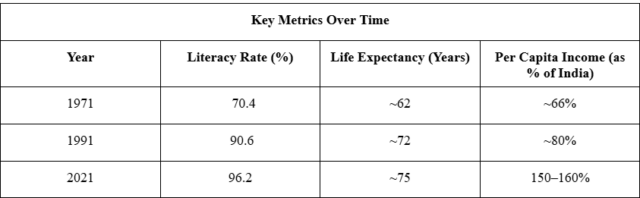
In the 1970s, Kerala’s per capita income was approximately two-thirds of the Indian national average, ranking on the bottom rung among the poorest Indian states. Agriculture was under pressure, industrial investment was drying up, and private capital wasn’t even glanced at, but by 2022, Kerala’s per capita income was 50–60% higher than the national average.
This sharp turnaround is not laudable for its magnitude but for how it happened, with early gains in health and education long before income growth occurred. While incomes were low, literacy rates, life expectancy, and health outcomes were already the best in India.
- Literacy: Kerala had a literacy rate of 70% in 1971, when the national average was just 34%.
- Life expectancy hovered above 60 years in the ’70s, outpacing India by nearly a decade.
- Infant mortality was significantly lower than in most of the country, driven by strong public health systems
- Population growth: While the Indian population grew at more than 2% annually during the 1970s, Kerala’s population growth slowed significantly due to improved education (especially female literacy) and healthcare.
Kerala was income-poor but human-development-rich, a combination that baffled economists and drew global attention. Scholars like Amartya Sen and Jean Drèze highlighted Kerala as a case where social development preceded economic growth, forming what became known as the Kerala Model.
Structural Drivers Of Kerala Model
Kerala’s social development wasn’t magic, nor was it a natural process, but rather a conscious play of key structural factors that shaped this head start.
The Princely State Legacy of Travancore and Cochin, which later merged into Kerala, spent relatively more on education and health than British-administered regions. This emphasis on development, in part, is owed to the influence of Protestant missionaries and social reformers who pushed for literacy, particularly among lower castes and women – a remarkably progressive effort during the time, which led to the region’s educational advancements.
Then the centuries of maritime trade in Kerala established early global ties that connected the region to West Asia, Africa, and Europe, introducing not only new ideas and wealth but also facilitating greater mobility among its people. This exposure set the stage for significant social and political changes in the state.
Lastly, the major land reforms and investment in public services by the strong labour movement, supported by elected Communist governments from 1957 onward, transformed the social landscape of the region and empowered its workforce.
These ingredients helped Kerala build a literate, healthy population, even without much income.
Read More: Guess India’s Richest Self-Made Actress With A Wealth Of Rs. 4,600 Crore
Migration And The Remittance Boom
Starting in the 1970s, winds of shifting waves started to flow in Kerala when its people started migrating to the Persian Gulf in large numbers, especially after the oil booms of 1973 and 1979. Construction jobs, retail work, transport – Kerala’s educated workforce filled the demand, making remittances a critical economic driver of the state.
By the 2000s, remittances made up nearly 35% of Kerala’s state GDP, and in 2018, Kerala received 19% of India’s total remittance inflow, despite being home to only 3% of the population.
This influx of capital fueled consumption, spurred real estate, and funded private hospitals, schools, and banks. The impact of this can be seen in every town, from shopping malls in Kozhikode to multispecialty hospitals in Kottayam.
Gulf migration played a critical role in the prosperity of the state as it helped maintain high consumption and investment levels, despite stagnation in traditional sectors like agriculture and manufacturing.
Income Growth: The Second Turnaround
While remittances sustained Kerala on many fronts in the 1970s, but only for a short while. In the 1990s, Kerala faced mounting fiscal pressure: agricultural investment fell sharply, public sector industries underperformed and incurred losses, and private industrial investment remained low.
But Kerala adapted. From 2000 onward, successive Left Democratic Front (LDF) governments shifted from rigid class struggle and instead started to take a more investment-friendly stance. The state promoted private participation in education and healthcare, reducing the direct public burden. Tourism infrastructure was expanded, with state-supported roads and private hospitality businesses.
Today, Thrissur and Kochi are emerging hubs in the Startup and fintech ecosystem, and Kerala now hosts one of India’s highest densities of micro, small, and medium enterprises (MSMEs).
Kerala’s Progress Isn’t All Lush Green
Kerala’s story isn’t all upward. Beneath the progress and impressive metrics lie concerning complexities.
- Environmental pressure: Floods in 2018 and 2019 exposed the cost of unchecked construction in ecologically sensitive zones. Construction booms and over-tourism have also increased flood and landslide risks in the region.
- Ageing population: Kerala is ageing faster than any other Indian state, putting pressure on health services and pensions.
- Educated unemployment: Despite high literacy, job creation hasn’t kept pace, especially in high-skill sectors, adding to the brunt that educated youth often lack job-relevant skills, while many still migrate abroad, resulting in brain drain
- Fiscal stress: Public debt levels are high, and welfare commitments remain expensive, with a fast ageing population further adding layers to the present health services.
Conclusion: A Unique Model, Still Evolving
Kerala didn’t industrialise first and then educate people. It was educated first, built strong public systems first, and much later, it saw income gains.
Kerala’s trajectory is a rare example of a region that achieved human development ahead of income. Through remittances, political adaptability, and targeted investment, it later caught up economically, though through unconventional means.
The “Kerala Model” is neither easily replicable nor universally applicable. But it offers a case study in how human development can shape long-term progress, even when initial economic indicators are weak.
As India’s economy grows and regional disparities continue, Kerala will remain an important reference point for development strategies that prioritise people before profits, and later, find profits by supporting people.
Image Credits: Google Images
Sources: Research Gate, The Borgen Project, Medium
Find the blogger: Sejal Agarwal
This post is tagged under: kerala model india, human development india, kerala economic growth, god’s own country kerala, remittance economy india, kerala social indicators, education success india, health development india, kerala literacy rate, kerala life expectancy, gulf migration kerala, kerala remittance boom, kerala tourism economy, kerala startup ecosystem, sustainable development india, indian state comparison, left politics kerala, travancore development legacy, amartya sen kerala model, kerala public health system, kerala migration trends, kerala fintech growth, kerala infrastructure development, kochi economy, thrissur startups, kerala land reforms, kerala unemployment crisis, ageing population india, kerala floods 2018, environmental risks kerala, kerala women education, kerala political economy, indian development models, state-wise economic comparison india
Disclaimer: We do not hold any rights or copyrights over the images used, as they were sourced from Google. If you would like credit or wish for an image to be removed, please contact us via email.