





























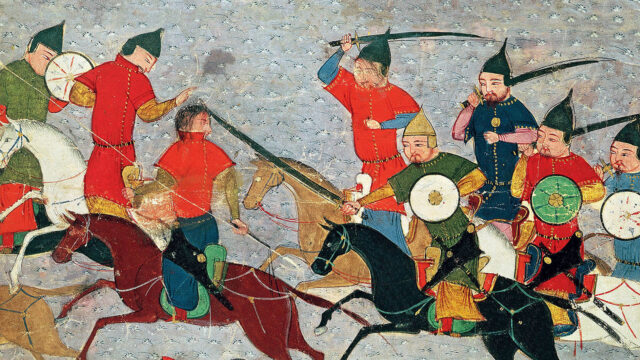
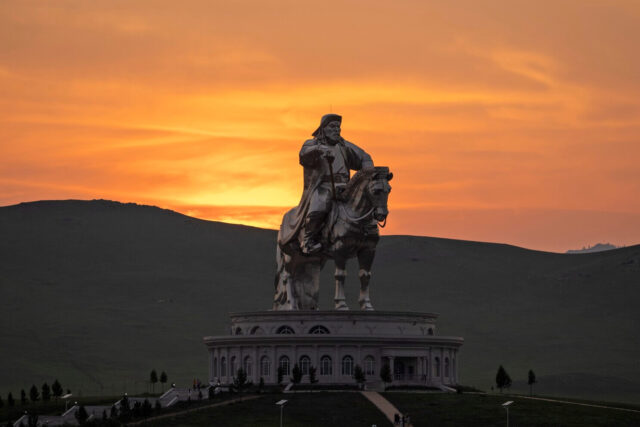
Genghis Khan is one of those historical figures who needs no introduction. The leader of the Mongols, founder of the Mongol Empire, creator of one of the greatest and deadliest fighting forces of the time, establishing him as one of the greatest conquerors in all of history, are just some of the things associated with Genghis Khan.
While Genghis Khan, a name believed to mean “universal ruler” or “oceanic ruler,” was adopted by the man born as Temujin, there is another title some seem to confer on him, that being the ‘greenest invader in history.’
Apparently, there are some claims about how, although the ruthless conqueror killed almost 40 million people during his reign, a number is still being debated, it might have indirectly benefited the earth, cooling it down and decreasing the carbon dioxide output into the atmosphere.
Did Genghis Khan Really Cool Down The Planet?
Over the years, Genghis Khan has been said to have actually affected the climate on planet Earth in a positive way. The ruler who, between the 13th and 14th centuries, established the world’s largest contiguous empires and is estimated to have killed almost 40 million people, could have inadvertently removed around 700 million tonnes of carbon from the atmosphere, according to research.
According to researchers, the Mongol army is said to have executed almost 30 per cent of the 115 million people they came across during their invasion. Thus, the global carbon reduction would have been 0.183 parts per million (ppm).
As per reports, Carnegie Institution’s Department of Global Ecology carried out research in 2011 about how Genghis Khan’s Mongol invasion affected the environment.
They found that the millions killed during this time led to the cultivated land once more becoming depopulated, which helped the forest cover recover and increase carbon absorption from the atmosphere.
According to the research, the amount of carbon scrubbed by his armies was “roughly the quantity of carbon dioxide generated in a year through global petrol consumption,” as stated in a 2011 The Guardian report.
Lead researcher Dr Julia Pongratz said, “It’s a common misconception that the human impact on climate began with the large‑scale burning of coal and oil in the industrial era. Actually, humans started to influence the environment thousands of years ago by changing the vegetation cover of the Earth’s landscapes when we cleared forests for agriculture.”
The research conducted in collaboration with colleagues from Stanford and the Max Planck Institute looked at the global land use and carbon dioxide in the atmosphere from 800 CE to 1850 CE.
It evaluated four major historical crises, the Mongol invasions, the Black Death, the fall of Ming China, and the conquest of the Americas, to see if there was any association between large-scale human mortality, land abandonment, and carbon reabsorbed through forest regrowth.
Speaking with LiveScience, Dr Pongratz explained the reason behind this study was that “We wanted to check if humans had an impact on carbon dioxide by increasing it by deforestation, but also by decreasing it.”
Through all the crises studied, the Mongol invasion that spanned from 1200 to 1380 CE allowed for both the scale and duration, for forests to regrow and remove meaningful amounts of carbon.
Read More: Watch: Five Scary Events Of Climate Change Around The World
Pongratz stated that “We found that during the short events such as the Black Death and the Ming Dynasty collapse, the forest re-growth wasn’t enough to overcome the emissions from decaying material in the soil. But during the longer-lasting ones like the Mongol invasion, there was enough time for the forests to re-grow and absorb significant amounts of carbon.”
While the study authors said that “only the Mongol invasion can compensate for concurrent emissions from the rest of the world” and “It seems likely therefore that the Mongol invasion has caused the temporary stop of CO2 growth,” however, this was a very tiny amount on the global scale.
As stated above, the estimated global carbon reduction was 0.183 ppm, a figure that didn’t really help the environment all that much.
This is because, as per researchers, it can take centuries for trees to mature and actually contribute to the environment in any significant way. The human population, on the other hand, would have rebuilt itself during that time and started inhabitation and deforestation once more.
Dr Pongratz said, “Since the pre-industrial era, we have increased atmospheric CO2 [or carbon dioxide] concentration by about 100 parts per million, so this is really a different dimension.”
She also added how rotting roots and felled vegetation would have maintained carbon emissions into the atmosphere for decades, even without human contribution.
Another factor raised was that even though the areas conquered by the Mongol army might have seen respite from human population, the rest of the world was still existing and thus maintaining steady carbon dioxide release into the environment by deforestation, crop plantations, and more.
Image Credits: Google Images
Sources: The Guardian, Live Science, Mongabay
Find the blogger: @chirali_08
This post is tagged under: Genghis Khan, Genghis Khan environment, Genghis Khan killings, Genghis Khan earth, Genghis Khan earth cool, environment, climate, climate change, earth, earth temperature,
Disclaimer: We do not hold any rights or copyrights over any of the images used; these have been taken from Google. In case of credits or removal, the owner may kindly email us.
Other Recommendations:
ResearchED: Is EV More Harmful To The Environment Than Petrol/Diesel?