




























The recent announcement made by the US government about a hike in H-1B visa fees, reportedly reaching an exorbitant $100,000 per application, caught the world, especially the Indians, by shock.
The decision is said to aim at curbing the influx of foreign workers from the IT sector in the US and creating more job opportunities for Americans.
This immediately sent shockwaves across India, as a majority of H-1B applicants (almost 71%) are Indians. Within a few hours, the news sparked debates, fears, and even outrage. It was only 24 hours later that the confusion settled slightly when the White House clarified that the fee was a one-time application cost only, not applicable to renewals.
What is the H-1B visa reform?
As defined by the US Department of Labour, “The H-1B program applies to employers seeking to hire nonimmigrant aliens as workers in specialty occupations or as fashion models of distinguished merit and ability. A specialty occupation is one that requires the application of a body of highly specialized knowledge and the attainment of at least a bachelor’s degree or its equivalent.”
This simply means that the H-1B is a non-immigrant visa program that allows U.S. employers to hire foreign workers in America. They are valid for three years and can be extended up to six years. The IT sectors extensively rely on this program.
Now, under the new reform, US President Donald Trump has announced a $100,000 fee on all new H-1B visa applications filed in the US. This fee won’t apply to existing visa holders or renewals, as it is a one-time payment only. The goal is to curb misuse of the program and ensure that only top-notch professionals can make their way into America.
India has emerged as the largest applicant of the H-1B program. For many professionals, especially in the IT sector, it opens doors to the “American Dream”, being the most direct route to Silicon Valley.
Indian IT Giants like Infosys, TCS, and Wipro rely heavily on it to send their best minds on-site to undertake U.S. projects. The abrupt imposition of a $100,000 fee could disrupt this smooth exchange, making it expensive for companies as well as individuals to build a career abroad, which explains the outrage and anger that followed this announcement.
However, this could actually be a good thing for the Indian IT sector.
How The New H-1B Reform Is The Best Thing For India
While the $100,000 fee hike seems like a drawback, it is only momentary. The coming years could actually benefit India by opening doors to a wide range of opportunities and innovations. The initial reactions might only focus on the challenges, but this reform has more to offer to the Indian IT powerhouse in the long run.
Boost To India’s Offshore activities
Mohandas Pai, former Infosys CFO and a well-known voice in the IT sector, suggested that this $100,000 price rise might lead to a reduction in new filings, naturally causing an increase in offshore activities carried out in India rather than on-site in the US.
In a report to PTI, Pai explained, “It has got limited application, because it doesn’t apply to all the H-1B visas which are already there. So there could be a limited impact for anybody applying in future; new applications will come down.”
According to him, this would naturally reduce fresh petitions as “Nobody’s going to pay $100,000 that is very true.”
Looks like Indian IT companies will now, perhaps, focus more on building onshore services than sending professionals abroad due to the high cost. This means that more talent development will happen right here at home with smarter ways to deliver globally. A good shake-up for the industry and a big opportunity to shine from within!
Read more: In Pics: 5 Times Trump Made A Fool Out Of Himself
Reverse Brain Drain
For decades, India’s best tech talent moved to the US, leaving a gap here at home. The new $100,000 H-1B visa fee is changing that, making it costlier to work onsite in the US for new professionals. This could reverse the brain drain, keeping more talent back in India, and pushing for bigger opportunities, innovation, and growth in AI, FinTech, and more.
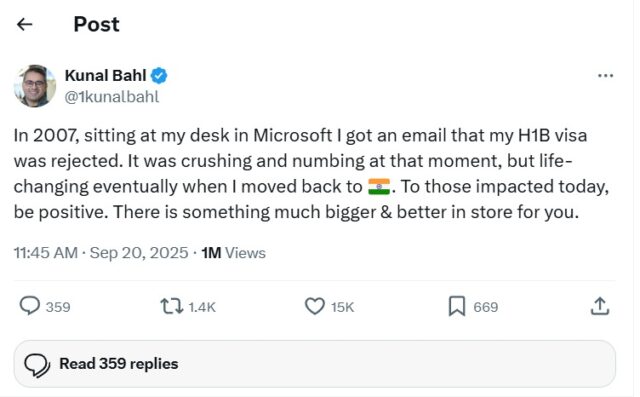
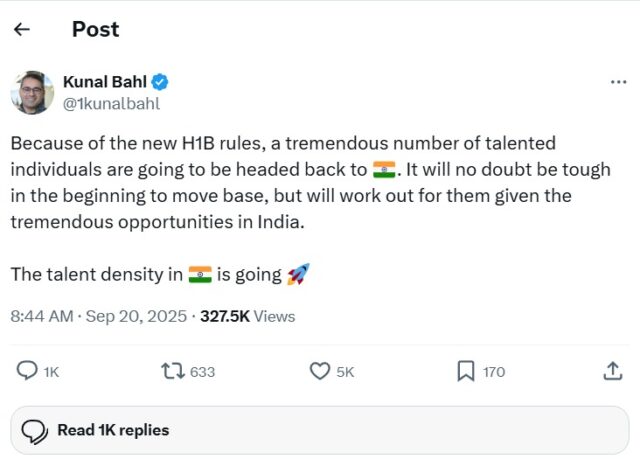
Entrepreneur Kunal Bahl, the former CEO of Snapdeal, took to X (formerly Twitter) to pen his thoughts. Instead of seeing it as a setback, he urged Indians in the US to come back to India, giving his own experience as an example. He encouraged Indians to return to their motherland and start “something much bigger and better.”
Incentives To The Startup Culture And Global Freelancing
With the return of skilled professionals to India and fewer migrating to the US, fresh minds are likely to give the startup ecosystem a major boost.
Former CEO of NITI Aayog, Amitabh Kant, posted on X (formerly Twitter), suggesting that this reform inflicts very little harm to Indians. He suggested that Founders may now turn to Bangalore, Gurugram, or even Hyderabad to build world-class startups.

The pandemic has already opened doors to remote work in India; now, with the H-1B wall rising, India could perhaps explore remote roles with companies globally.
With the right government support for digital freelancing and cross-border taxation, India has the potential to become the global hub for remote services, thus creating more opportunities for students and women, small-town coders, as well as Silicon Valley aspirants.
Step Towards A Self-Reliant India
This reform could actually be a catalyst for making India self-reliant. With more professionals staying back, there can be innovation in reforms like Digital India, AI, Make in India, etc., to help boost domestic growth.
Rather than seeing this simply as a challenge, many influential voices in the Indian IT sector see this as a key to various opportunities in India.
A post by Firstpost quotes Vivek Wadhwa, a well-known tech entrepreneur, saying, “India should hang a sign on Route 101 in Silicon Valley saying: If America does not want you, India does. The country now offers far more than elite schools.
It has a thriving digital economy, a proven track record of scaling technologies like UPI to hundreds of millions, world-class hospitals, pharmaceutical manufacturing at a global scale, and a startup ecosystem with ambition and capital.
Add to this a young workforce, lower costs, and a government eager to back science and entrepreneurship and the advantages are obvious. The outcome will be a weaker United States and a stronger India.”
In conclusion, what might seem like a roadblock today might just be a simple nudge, a much-needed wake-up call for Indians trying to chase the “American Dream” as the ultimate destination for way too long.
With the reality of steep H-1B costs, this might just be the right time to shift the focus from the American Dream to building and owning the “Indian Dream”.
Image Credits: Google Images
Sources: Firstpost, Press Trust Of India, The Times of India
Find the blogger: @shubhangichoudhary_29
This post is tagged under: Donald Trump, hb1, it sector india, freelancing, Wipro, TCS, HCL, american visa, infosys, modigovernment, BJP, Govt of India, snapdeal, kunal bahl, amitabh kant, Niti Aayog, America, silicon valley, price rise, mohandas pai
Disclaimer: We do not hold any rights or copyright over any of the images used; these have been taken from Google. In case of credits or removal, the owner may kindly email us.
Other Recommendations:
This Is Why Trump Is Attacking India With Tariff, As Per Raghuram Rajan








Definitely an eye opener and a great opportunity for young aspirants of the IT sector and it’s branches of India!!