



























 Chennai (Tamil Nadu) [India], August 7: In India’s cities, a public toilet was once a symbol of everything broken—dirty, unsafe, and invisible. To step into one was to step into compromise, especially for women, the elderly, and persons with disability. Using a “public convenience” came at the cost of personal dignity.
But in Chennai, that narrative is being upended. Not through slogans or one-time cleanups—but by rewiring the very psychology of sanitation.
This shift, unfolding quietly yet powerfully, is led by the Greater Chennai Corporation under the Government of Tamil Nadu, through a bold infrastructure-and-mindset intervention: the Design, Build, Finance, Operate, and Transfer (DBFOT) model for public toilets.
And it is doing something few would have expected—making citizens rethink, revisit, and respect public toilets.
The Mindset Behind the Mess
For decades, the idea of using a public toilet in Indian cities triggered one of three responses: disgust, fear, or avoidance. Behavioural science explains this as aversive conditioning.
Repeated negative experiences—lack of hygiene, safety concerns, exclusion—created a deep-rooted schema. It told people: these places are not for you.
That schema shaped generations. Public toilets became the physical metaphor for everything that was wrong with urban services.
FEERGRA’s Role: Building Infrastructure, Shaping Behaviour
In 2025, Urban PCT Three Private Limited, by FERRGRA, was entrusted with Package 3 of the DBFOT-HAM initiative, covering Zones 7 – Ambattur, 8 – Anna Nagar, 9 – Teynampet (excluding Marina stretch), and 10 – Kodambakkam. The award includes 395 strategically located sites in 64 wards, and an estimated 2,760 toilet seats—making it one of the most ambitious public sanitation transformations attempted by any Indian metro.
The mandate wasn’t just to build toilets. It was to make them work—functionally, visually, and psychologically.
Under the supervision of the Special Projects Department, with critical oversight by the Executive Engineer and Superintending Engineer, the initiative began to take shape.
Not Just Toilets. Social Engineering Chambers.
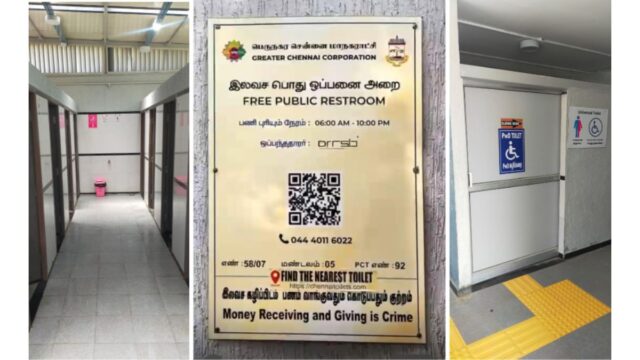
The new public toilets are structured not as construction projects, but as “experience centres” of dignity.
- Design triggers: Clean lighting, ramps, safe flooring, pad disposal bins, and children’s cubicles.
- Social inclusion: Separate units for men, women, transgender persons, and PwDs.
- Accountability systems: QR-code feedback, real-time monitoring, and CCTV coverage.
- Transparent governance: Independent Engineers (IEs) ensure tech leveraged/ AI engine-backed geo-tagged daily audits / reports, monthly reports, and fairness.
Each of these interventions works not in isolation, but collectively to break old perceptions and embed new ones.
How Psychology is Being Reprogrammed
- From disgust to dignity: Bright interiors, odour control, and visible cleanliness now spark respect—not revulsion.
- From fear to safety: The Presence of uniformed janitors, CCTV, and QR code feedback/ suggestion systems restores a sense of control.
- From exclusion to belonging: Gender-neutral and PwD access dissolve the stigma of invisibility.
- From neglect to trust: Independent Engineers act as the conscience of the project—watchful, professional, neutral.
Behavioural Nudge Meets Bureaucratic Will
Behaviour change doesn’t occur in a vacuum. It demands consistent reinforcement.
The GCC has embedded daily cleaning protocols, IEC campaigns across schools and RWAs, and a grievance redressal timeline that citizens can actually trust.
By repeating positive user experiences, the DBFOT model has tapped into a classical behavioural technique—habit formation through exposure and reward.
Toilets as Governance Mirrors
It’s a strange truth in urban development: the state of your city’s public toilets mirrors the quality of its governance.
A clean, safe, inclusive toilet says something powerful to a citizen:
“We see you. We respect you.”
That simple message empowers daily wage workers, young girls, caregivers, and the janitors themselves—who now work with better training, PF, ESI, uniforms, and dignity.
The Maslow Effect
At its core, this shift ties into Maslow’s hierarchy of needs:
- Clean toilets satisfy physiological and safety needs.
- Inclusive design and feedback systems address esteem and belonging.
- Consistency across locations builds trust—a civic need too often unmet.
It’s not just about flushing waste anymore. It’s about flushing away a culture of neglect.
The Bigger Message: Toilets as Transformation
What Chennai is demonstrating is this: when you invest in dignity, you get discipline.
Citizens don’t deface toilets they feel proud of. Children grow up normalizing hygiene. Mothers allow daughters to use public spaces without anxiety. And sanitation workers no longer hide their job—they own it.
This is urban psychology by design, not accident.
Legacy in the Making
In a nation where access to basic sanitation is still a pressing challenge, Chennai has quietly rewritten the script—not with slogans, nor with social media gimmicks, but with enduring infrastructure and behavioural shifts that speak for themselves.
Under the astute leadership of the Greater Chennai Corporation, guided by the Commissioner, the Deputy Commissioner (Works), and strengthened by the unwavering commitment of the zonal teams, the city has delivered a model of silent, scalable transformation.
In 2024, DrRSB was entrusted with the stewardship of Zones 5, 6, and 9 (Marina stretch)—an operational footprint that now includes 3,271 public convenience seats across in 30 wards and the iconic Marina stretch (260 locations).
These are not mere structures. These public toilets stand as civic sanctuaries—symbols of a city reclaiming its self-worth through dignity, discipline, and design.
One Flush at a Time
If urban India wants to clean its cities, it must first cleanse its own mental model of public services.
Chennai’s DBFOT model proves that you don’t just build toilets to fix a city.
You build belief.
And when that belief is built on design, equity, and daily discipline—
You don’t just change how people relieve themselves.
You change how they see themselves.
Read more