




























At the World Economic Forum this January, the usual scenes of closed-door meetings and power breakfasts were punctuated by something much humbler: long queues for masala chai, samosas, and bowls of khichdi.
The Akshaya Patra Foundation, a large Bengaluru-based NGO, was serving free khichdi on Davos’s main promenade; corporate stalls from the Tata group and others were dishing out tea and snacks nearby.
The image of delegates, from Indian ministers to visiting CEOs and even a Japanese attendee who told reporters the khichdi “felt like home”, lining up for a hot, plain meal caught attention not because it was exotic, but because it was ordinary and immediate.
That small scene mattered. It was a sensory, public moment where Indian everyday food was not a cultural exhibit on a banquet table but a practical, accessible offering on the street.
Indian cuisine is no longer confined to diaspora neighbourhoods or niche restaurants. It is increasingly visible in mainstream global spaces, and that has implications for tourism, trade, and how India projects soft power abroad.
Khichdi On The Promenade
Akshaya Patra’s stall drew steady lines through freezing weather. Volunteers ladled simple khichdi, rice, lentils, a little ghee, and mild seasoning into paper bowls and handed them out to delegates stepping out of conferences.
Visuals and short video clips circulated rapidly on social platforms and in news feeds: a visitor from Japan saying the dish felt like home, entrepreneurs and ministers casually tucking into a comfort meal, and social-media posts noting how billionaires and delegates were sharing the same food experience.
Those images amplified the moment beyond a single food counter and turned it into a talking point.
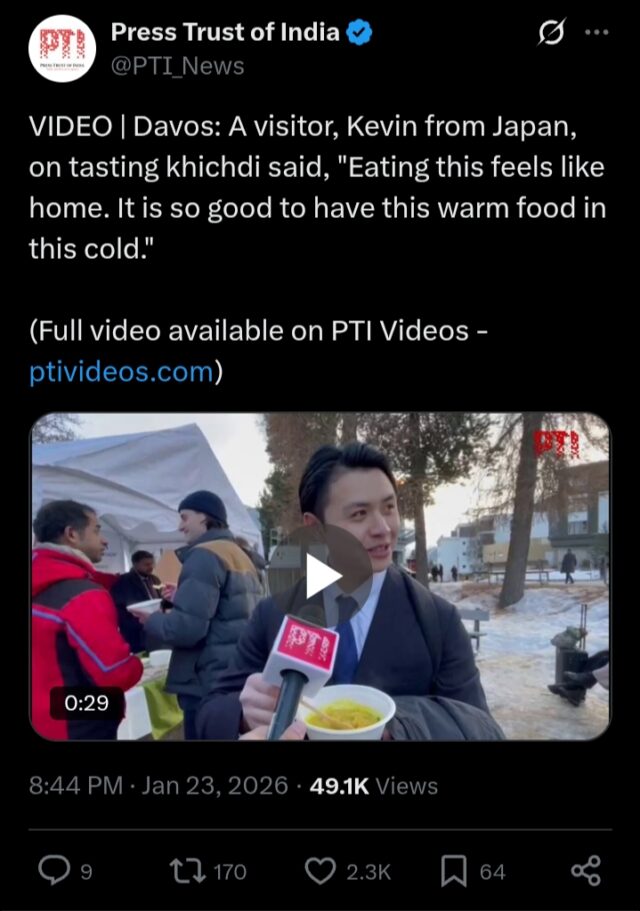
For some Indians at Davos, it was a brief taste of home; for others, it was curiosity about a one-pot meal low on ceremony but high on warmth. For organisers and corporate hosts, from Tata’s “Chai Central” to HCL Tech’s tea stall, food performed a practical role (warming delegates, keeping conversation flowing) and a reputational one (an everyday, inviting face of India).
Corporate Kitchens, The India Pavilion And Culinary Visibility
The Tata group mounted a tea stall called “Chai Central,” HCL set up beverage counters, and an India Pavilion hosted food from several states and ministries. It wasn’t only khichdi. The stalls run by major Indian companies and state pavilions dotted Davos’s main streets, offering masala chai, paranthas, samosas, biryanis, and more.
For attendees, these were convenient stops; for India, they were curated opportunities to present familiar flavours in plain sight. Corporate lounges and state pavilions also used food as ice-breakers, something that loosens formalities and starts conversations in an otherwise tightly scheduled forum.
These pop-up kitchens and company lounges turned segments of Davos into an extended, aromatic India Pavilion where conversations were often lubricated by tea and snacks as much as by networking agendas.
The visible corporate and state presence, from India Pavilion offerings to Indian company lounges, mattered for two reasons. Practically, warm food and familiar flavours met delegates’ immediate comfort needs in freezing weather. Symbolically, they showcased how India uses food as an approachable face of business and diplomacy, a reminder that policy and trade sometimes begin with a shared plate.
Demand, Exports, And The Size Of The Industry
The Davos moment fits into measurable growth in India’s food sector. India’s processed-food exports were valued at about USD 7.89 billion in 2024–25, a sign that Indian packaged foods and value-added products are reaching overseas markets in meaningful volumes.
At the same time, India’s food-processing market is large and growing; industry trackers estimate the sector reached roughly Rs 30.5 lakh crore (about USD 354.5 billion) in 2024 and is forecast to expand further in the near term. Those figures point to both supply-side capacity and export readiness.
On the services side, the domestic food-services market is also a growth engine: forecasts suggest robust expansion over the next few years with projections that place the sector near USD 93 billion by 2028.
At the product level, certain Indian staples continue to dominate global corridors; basmati rice and spices, for instance, are major export categories that keep growing year on year. Taken together, these numbers show that Indian food is not only culturally visible but also backed by commercial scale and trade links.
Also Read: ResearchED: Will India Soon See Sushi Being Served By Roadside Vendors As Street Food?
Why Indian Food Travels
There are clear reasons Indian food adapts well to global appetites. It is diverse, the cuisine umbrella covers meat, fish, vegetarian, and vegan options, and many dishes are compatible with current global dietary trends (plant-forward, spice-led, convenience formats).
Exported spices, ready-to-heat meals, frozen parathas, and instant mixes have made it easier for non-Indian kitchens to replicate flavours with consistent results. Moreover, the global Indian diaspora acts as the first market, then early adopters, and, finally, influencers who popularise foods in mainstream outlets.
Beyond economics, there is a diplomatic logic. Scholars and practitioners of culinary diplomacy argue that food creates “soft” connections, it humanises foreign policy, opens conversations, and builds curiosity without formalities.
A bowl of khichdi in the snow does that work: it’s relatable, unpretentious, and easy to share. Countries and companies that present everyday food, not just luxury state dinners, often win quicker cultural traction because people connect to what they can taste and remember.
What Davos Actually Means For Policy
Moments like Davos do not translate into trade gains automatically, but they reveal where policy intent and market interest already intersect. Indian food exports are no longer limited to raw commodities; demand is shifting toward value-added products such as ready-to-eat meals, frozen foods, spice blends, and millet-based staples.
However, exporters consistently face bottlenecks, uneven quality certification, fragmented cold-chain infrastructure, and difficulty meeting differing food safety standards across the EU, UK, and North America. Visibility at global forums highlights demand, but policy must address these structural frictions to convert attention into sustained orders.
There is also a coordination gap. While APEDA, the Ministry of Commerce, and industry bodies promote Indian food abroad, support for small and mid-sized producers remains uneven. Davos shows that interest often centres on everyday Indian food, not luxury formats.
This calls for targeted export clusters, region-specific branding (such as khichdi mixes, millet meals, or regional rice-lentil combinations), and faster approvals for global certifications. Without these interventions, India risks remaining a flavour inspiration rather than a dominant supplier in global food value chains.
The khichdi queues at Davos were not symbolic because they were charming; they were revealing because they showed what global consumers are willing to accept: simple, nutritious, familiar Indian food at scale. For India, the opportunity lies in aligning this demand with policy clarity. Export incentives need to move beyond bulk commodities to processed and semi-processed foods, logistics investments must prioritise perishables, and food diplomacy should be integrated into trade strategy rather than treated as cultural add-ons.
If leveraged correctly, such moments can strengthen India’s position not just as a source of spices or rice, but as a reliable supplier of affordable, everyday food to global markets. Davos offered a glimpse of that possibility. Whether it becomes a trade advantage will depend less on visibility and more on how decisively policy closes the gap between interest and infrastructure.
Images: Google Images
Sources: Moneycontrol, Hindustan Times, ET Now
Find the blogger: Katyayani Joshi
This post is tagged under: Indian Food, Indian Cuisine, Davos 2025, World Economic Forum, India at Davos, Khichdi, Chai Culture, Food Diplomacy, Culinary Diplomacy, Soft Power, India Global, Global Food, Food Politics, Trade Policy, Food Exports, Indian Exports, Processed Food, Agri Exports, India Trade, Global Markets, Food Economy, Policy Explained, India Means Business, Make in India, Vocal for Local, Indian Brands, Global India, Food and Policy, Cultural Power, Everyday India
Disclaimer: We do not hold any right, copyright over any of the images used, these have been taken from Google. In case of credits or removal, the owner may kindly mail us.