






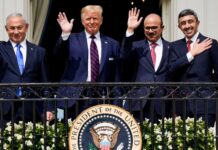




















In recent years, critics, commentators, and even some political figures have drawn parallels between modern leaders like Donald Trump and Benjamin Netanyahu and authoritarian figures of the past, specifically Hitler, pointing to nationalism, militarism, and the erosion of democratic norms.
Even when exaggerated, these comparisons reveal something deeper: a growing global anxiety about power, war, and unchecked leadership.
The Hitler Comparisons
According to reports by Firstpost and Times of India, Iran’s Revolutionary Guard Corps (IRGC) released a video showing a missile that had an image of U.S. President Donald Trump as Adolf Hitler, along with the message “America will be destroyed by Trump himself”.
The authenticity of this video, though, is debatable, since no other major media house has reported on it, nor can an official source by the IRGC be found that posted such a video.
However, this is not the first time that Trump and, in relation, Israel and its PM Benjamin Netanyahu have been compared to Hitler in recent history.
Turkish President Recep Tayyip Erdogan, in a speech from December 2023, said there was “no difference” between Benjamin Netanyahu and Adolf Hitler as he stepped up his attacks on the Israeli leader over the war in Gaza.
“There is no difference between the actions of Netanyahu and Hitler,” he said during a ceremony in the capital, Ankara.
Erdogan added, “He (Netanyahu) is richer than Hitler. All kinds of support come from the West and the United States.”
The Turkish leader has lashed out repeatedly at Israel for the scale of death and destruction caused by its response to Hamas’s October 7 cross-border attack.
During a 2023 science awards ceremony, Erdogan further said, “How do you (Netanyahu) differ from Hitler? These (actions) will make us look for Hitler as well. Is there anything Netanyahu does that is less than Hitler? No.”
In 2016, memes went viral where Trump, at a rally, asked the supporters there to raise their right hand and pledge their vote to him. The images that went viral, however, were said to be eerily similar to the Nazi salute and invited another round of Trump and Hitler comparisons.
In 2023, Trump’s remark about how immigrants who come to the US were“poisoning the blood of our country” was compared to similar words said by Adolf Hitler.
Trump, during a rally in New Hampshire in December 2023, speaking about immigrants, said, “They let, I think the real number is 15, 16 million people into our country. When they do that, we have got a lot of work to do. They’re poisoning the blood of our country.”
He added, “That’s what they’ve done. They poison mental institutions and prisons all over the world, not just in South America, not just in three or four countries that we think about, but all over the world. They’re coming into our country from Africa, from Asia, all over the world.”
In another Truth Social post, Trump wrote, “illegal immigration is poisoning the blood of our nation. They’re coming from prisons, from mental institutions, from all over the world.”
Several reports picked up on the phrases “poisoning” and “blood” because a similar phrase was used by Hitler in his manifesto, Mein Kampf.
Hitler, criticising immigration and race mixing, wrote, “All great cultures of the past perished only because the originally creative race died out from blood poisoning.”
The Biden campaign also brought this to light in a statement, writing, “Donald Trump channelled his role models as he parroted Adolf Hitler, praised Kim Jong Un, and quoted Vladimir Putin while running for president on a promise to rule as a dictator and threaten American democracy. Trump is not shying away from his plan to lock up millions of people in detention camps and continues to lie about that time when Joe Biden obliterated him by over 7 million votes three years ago.”
Uday Kotak’s Colonialism Remark
Economic power is now as contested as military power.
Indian banker Uday Kotak sparked debate when he criticised discussions around external control over strategic trade routes like the Strait of Hormuz, describing such thinking as a “return to colonial-era mindset.”
On April 7, 2026, the same day Trump threatened to destroy a civilisation and then announced a ceasefire, one of India’s most respected business figures offered a different kind of diagnosis: a structural economic one.
Uday Kotak, founder and non-executive director of Kotak Mahindra Bank, speaking at the FICCI Foundation Day in New Delhi, warned that the world was witnessing something it had not seen in living memory.
“We are at an important cusp of what I call the return of global colonialism.”
Kotak was specific about what had prompted this conclusion. He cited two statements made by Trump that week:
“I’m just repeating facts from the speech of Donald Trump in the White House. He made two points which clearly identified that we are in a very different world.
One, he said, whoever wins the war, keeps the spoils.
And two, if we get control of the Strait of Hormuz, we, the United States of America, will charge a rent. You are getting back to a world of true colonialism.
And it reminds me, especially on this occasion, of how the British took control of India.”
View this post on Instagram
The Strait of Hormuz handles a significant portion of global oil flows. Control over it has always meant influence over the global economy.
Kotak further said, “And at this point in time, from a business and economics point of view, I see two possible scenarios coming into play at this point in time. The first is a scenario of what I call as the world post 1945. For the last 80 years, between 1945 and 2026, whenever there has been a crisis, we have seen a reversion to mean now whether that reversion happens in one day, one week, one month, three months, or one year.
But every crisis is an opportunity for business, industry and finance to take the downturn as a positive. Because sooner or later, you will see reversion to mean; this is the history of the world for the last 80 years.”
“So this is scenario one. Scenario two, which is a scenario of thousands of years prior to 1945, is that whenever there is a crisis, there is a structural change happening in the world. And we have seen it time and again, lands conquered, rulers changed, fights between the church and the state, fights between continents, fights between small countries versus large, but in general, the world prior to 1945 was extremely tribal,” added Kotak.
Kotak’s framing taps into a wider concern: that global power structures may be shifting, not away from domination, but towards new forms of it.
Read More: Iran Is Beating US Even At The Meme And Roasting Game: Here’s How
Israel Doesn’t Want The War To End
To understand why experts believe Israel has no structural incentive to stop this war, you have to begin with the strategic framework that scholars say underpins it.
Writing in March 2026, Professor Jeffrey D. Sachs, University Professor and Director of the Centre for Sustainable Development at Columbia University, and a long-serving adviser to the United Nations Secretary-General, laid out the thesis plainly in a co-authored piece published by Common Dreams and republished widely:
“The conflict is likely to spiral out of control because the US and Israel are dead set on hegemony in the Arab world and West Asia, one that combines Israeli territorial expansion with American-backed regime control across the region. The ultimate goal is a Greater Israel that absorbs all historic Palestine, combined with compliant Arab and Islamic governments stripped of genuine sovereignty, including on choices as to how and where they export their oil and gas.”
Sachs did not stop at diagnosis. He named the architects:
“Who would lose? Only the backers of Greater Israel, led by Benjamin Netanyahu, Itamar Ben-Gvir, Bezalel Smotrich, and Mike Huckabee, who have brought the world to the brink of destruction.”
Sachs also provided a historical map. He traced the current conflict to what he called the “Clean Break” strategy.
This was a document developed by Netanyahu and American neoconservative advisers in 1996, calling for Israel to achieve regional hegemony through wars of regime change, with the United States as implementing partner.
“As NATO Supreme Commander Wesley Clark revealed after 9/11, the US drew up plans a quarter of a century ago to overthrow governments in seven countries: ‘starting with Iraq, and then Syria, Lebanon, Libya, Somalia, Sudan and, finishing off, Iran.’ We are therefore living through the culmination of a long-standing plan by Israel and the US to dominate the Arab world and West Asia, create a Greater Israel, and permanently block Palestinian statehood.”
This is not fringe commentary. Sachs is cited by Time magazine as “the world’s best known economist.” His diagnosis, that the war serves a decades-old territorial and hegemonic strategy, is now being echoed across a remarkably wide ideological spectrum.
Israel’s Prime Minister Benjamin Netanyahu himself confirmed the continuity of objectives when asked about the ceasefire on April 8.
He said that the two-week pause was “not the end of the campaign” against Iran, but a “station on the way to achieving all of our goals.”
He listed among those goals: the destruction of Iran’s missile production capabilities, the prevention of nuclear enrichment, and continuing military operations in Lebanon and Gaza.
Within hours of the ceasefire being declared, Netanyahu declared Lebanon was not covered, and Israeli warplanes launched what Haaretz called the “biggest blow” Hezbollah had suffered since the 2024 pager operation: 100 targets struck in 10 minutes.
This was despite most reports claiming that “Lebanon and elsewhere” were all covered under the ceasefire deal.
Dania Arayssi, a senior analyst at the New Lines Institute for Strategy and Policy, explained the logic directly to Al Jazeera: “Netanyahu wants to take advantage of the fluid situation to maximise operational achievements in Lebanon.
He must take into account that a US-Iran deal might include ceasing the war on Iranian proxies, which would greatly complicate the Israeli war effort against Hezbollah in Lebanon.”
Image Credits: Google Images
Sources: The Economic Times, Firstpost, Modern Diplomacy
Find the blogger: @chirali_08
This post is tagged under: Hitler, trump Hitler, iran Hitler missile, iran missile trump hitler, israel, us israel, us iran ceasefire, Geopolitics, Global politics, Global security, global tensions, International Relations, iran, Iran US fight, Iran war, us iran, us Iran attack, us iran israel war, War, world politics
Disclaimer: We do not own any rights or copyrights to the images used; these images have been sourced from Google. If you require credits or wish to request removal, please contact us via email.
Other Recommendations:
Is Trump Using The Madman Theory In The US-Israel War With Iran?