


























Jeffrey Epstein was an American financier who cultivated extraordinary access to the world’s most powerful people despite having no clearly traceable source of wealth. He presented himself as a billionaire money manager, philanthropist, and intellectual patron, funding universities, scientists, and cultural institutions while socialising with politicians, royalty, corporate leaders, and celebrities.
Much of his influence came not from formal authority but from positioning himself as a connector, someone who could open doors, broker introductions, and make people feel important.
Behind this carefully curated image, Epstein was running a long-term sex-trafficking operation. For years, he abused and exploited underage girls, some as young as 14, across multiple properties in the United States and the Caribbean.
Victims described a pattern of grooming, coercion, and silence, aided by money, non-disclosure agreements, and a network of enablers. In 2008, Epstein received an unusually lenient plea deal in Florida, serving little jail time and avoiding federal prosecution. This decision is now widely viewed as a grave miscarriage of justice.
In 2019, Epstein was arrested again on federal sex-trafficking charges, raising the possibility that his powerful network would finally be scrutinised in court. That reckoning never came. He was found dead in his New York jail cell in August 2019 in what authorities ruled a suicide, under circumstances marked by surveillance failures and procedural lapses that fuelled public suspicion. His death ended the criminal case but not the questions.
The U.S. Department of Justice published a large tranche (millions of pages, images, and videos) of documents related to Jeffrey Epstein in early 2026. The material includes emails, messages, notes, and court records that mention many public figures worldwide. The DOJ says it released millions of pages while withholding documents for legal/privacy reasons.
The recently unsealed Jeffrey Epstein files have reignited scrutiny over the disgraced financier’s vast global network of elite connections. While most media coverage has focused on his ties to powerful Western figures, a lesser-explored but deeply revealing component of the documents involves Epstein’s interactions with Indian personalities, places, and political contexts.
From billionaires and spiritual gurus to Bollywood directors and racist diatribes, the India connection emerges as a patchwork of social leverage, transactional diplomacy, and personal prejudice.
Anil Ambani
Indian billionaire Anil Ambani, head of the Reliance Group, features prominently in Epstein’s communications, especially surrounding Prime Minister Narendra Modi’s diplomatic manoeuvres in 2017. In a message dated March 16, 2017, Ambani wrote to Epstein:
“I am looking to reach out to Jared Kushner and Steve Bannon about PM Modi’s possible visit to the US in May. Can you advise?“
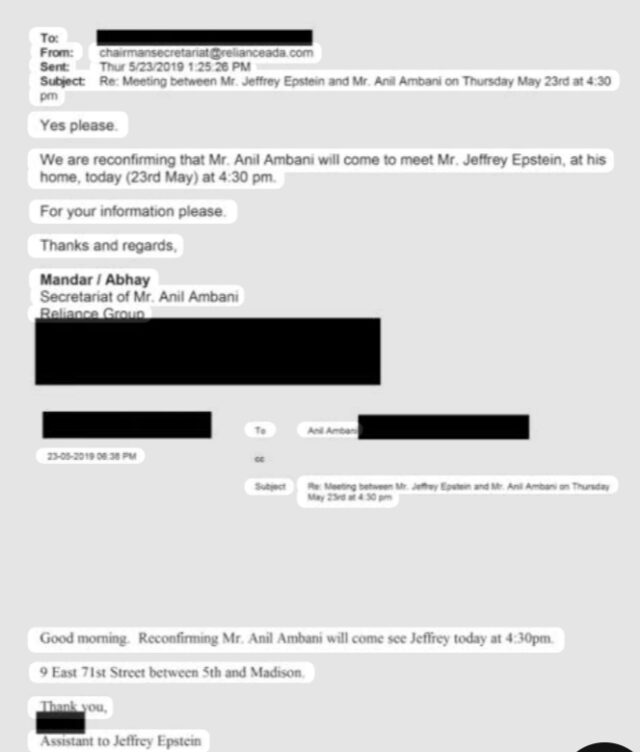
Just days later, Epstein’s handwritten notes state, “Discussions re israel strategy dominating modi dates,” clearly linking his involvement to Modi’s international itinerary. On March 18, Ambani confirmed:
“Modi would visit Israel in July,” and asked Epstein, “Who do u know” to help facilitate that visit.
Epstein responded with further coordination and even bragged later that Modi had followed his advice:
“Modi took advice and danced and sang in Israel… it worked!“
These messages suggest Epstein positioned himself as an informal backchannel between Ambani and figures in the Trump administration.
Narendra Modi
Though Prime Minister Narendra Modi himself does not appear to have communicated with Epstein, his name surfaces repeatedly in contexts that imply strategic planning. In 2019, Epstein emailed Steve Bannon:
“Modi sending someone to see me on Thurs.”
After meeting with Ambani again, he updated Bannon:
“Really interesting Modi meeting… Modi on board.”
One document summarised Epstein’s claim:
“He would set up Modi meetings for Steve Bannon after India’s 2019 elections.”
The Indian Ministry of External Affairs issued a rebuttal, calling the statements “baseless” and “trashy ruminations of a criminal.“
Still, the volume and tone of messages suggest that Modi’s political calendar and international engagements were a point of frequent discussion between Epstein and Indian intermediaries.
Deepak Chopra
Spiritual wellness author Deepak Chopra appears in several of Epstein’s emails, revealing a dynamic that has since drawn criticism. In a now-notorious 2017 exchange, Epstein wrote:
“God is a construct. Cute girls are real.”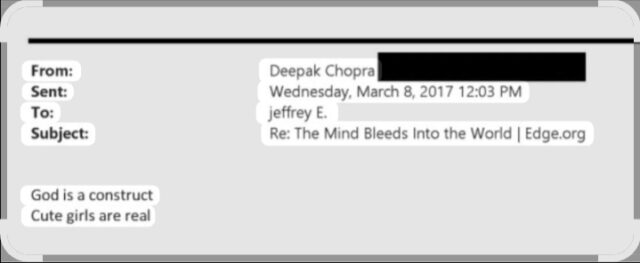
Chopra responded in a tone that sparked public backlash. While the complete thread remains only partially public, news organisations have verified the flippant nature of their exchanges. In another message, Chopra asked Epstein:
“What’s the story with Marla Maples these days?“
Chopra has since stated publicly:
“My contacts with Epstein were limited and unrelated to any criminal or exploitative conduct. I regret the tone of some past emails.”
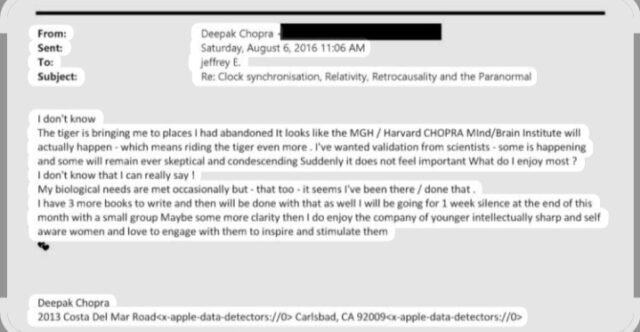
Nonetheless, the files place Chopra in the proximity of late-night events, suggesting a more engaged association than previously acknowledged.
Mira Nair, Nandita Das, And Anurag Kashyap
Filmmaker Mira Nair was mentioned in a 2009 email sent by publicist Peggy Siegel, listing guests at an after-party for the screening of Nair’s film Amelia:
“Guests include Bill Clinton, Jeff Bezos, Jean Pigozzi, and director Mira Nair.“
There is no indication of direct interaction between Nair and Epstein; her name is part of a social guest list. Similarly, Nandita Das appears in association with cultural speaking engagements attended or sponsored by individuals affiliated with Epstein. One email describes her appearance at an academic symposium.
Anurag Kashyap, labelled in an internal email as the “Bollywood guy,” appears in a list of invitees for a conference on technology and spirituality. Media outlets confirm:
“Kashyap was mentioned in the context of possible workshops. There is no evidence of meeting Epstein or criminal involvement.”
These references, while indirect, show how Epstein’s networks attempted to interface with Indian intellectual and artistic circles.
Hardeep Singh Puri
Current Indian Union Minister Hardeep Singh Puri is named in multiple emails exchanged with Epstein. In 2014, Puri coordinated a potential India visit for LinkedIn co-founder Reid Hoffman, writing:
“India’s innovation environment would benefit from Silicon Valley collaboration.”
He met Epstein at least three times in Manhattan (Feb 4, 2015; Jan 6, 2016; May 19, 2017) according to visitor logs. These meetings were reportedly centred on investment opportunities and global technology transfer.
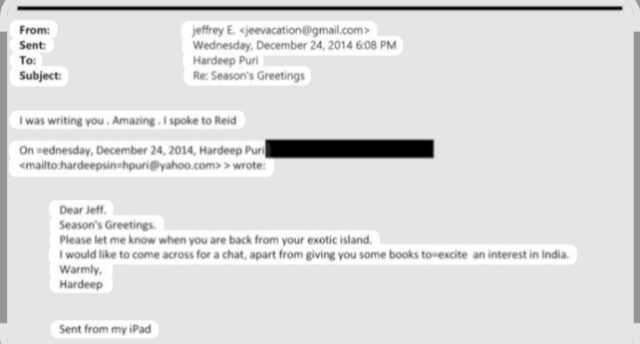
Though no improper conduct is alleged, Puri’s documented visits reinforce how Indian policymakers appeared on Epstein’s radar when tech and money were involved.
India, The Place: Disdain And Derision In Private Words
While Epstein networked with powerful Indians, his personal views of the country were starkly negative. In one private email to an associate, he wrote:
“I want nothing to do with India. Hot, smells like shit, filthy.“
In another thread with Boris Nikolic, Bill Gates’s science advisor, Nikolic described Delhi and Pune as “filthy” and “middle of nowhere.” Epstein replied:
“I fully understand… Leaving India. HATE it.”
These emails reveal a sharp disconnect between Epstein’s social capital in Indian circles and his personal contempt for the country. The contrast underscores his transactional approach to relationships.
The Norwegian Racist Remark
In a shocking 2015 email, Norwegian diplomat Terje Rød-Larsen wrote to Epstein:
“Have you heard the saying: when you meet an Indian and a snake, kill the Indian first!”
Epstein replied curtly:
“Two faced.”
Larsen replied:
“The question is, how do you tell one from the other.”
This grotesque exchange reveals overt racism within Epstein’s elite circles. While Epstein did not endorse the sentiment directly, he continued to maintain relationships with such individuals, reinforcing a culture of dehumanising elitism.
Indian Women And Victims
One lesser-discussed angle in the files is the mention of Indian women in sexualized or victim-related contexts. In 2009, an email described:
“A beautiful Indian model who lives in Dubai, she is 22 and recently featured in a YouTube clip.”
The link is now defunct, and there is no proof that the woman was trafficked, but the phrasing is consistent with other recruitment-style language.
In a 2020 legal letter, attorney Brittany Henderson wrote:
“One victim is currently living in India and requires trauma-informed therapy.”
This reference, though vague, suggests that the ripple effects of Epstein’s operations may have extended into India, whether through victims or global recruitment.
Also Read: How Has Trump’s Family Wealth Boomed After Being Re-Elected As US President?
Epstein’s Self‑Declared Interest In India: Utility Without Affection
Beyond individuals and events, the files repeatedly reveal Epstein’s strategic but deeply cynical interest in India.
India appears in his correspondence not as a place of cultural curiosity or moral engagement, but as a geopolitical and economic asset, a large democracy whose elites could be leveraged for access in Washington, Tel Aviv, and Silicon Valley. His communications suggest he viewed India primarily through the lens of influence management.
In several emails, Epstein positioned himself as someone who could “interpret” Indian political behaviour for Western actors. One message describing Modi’s Israel visit framed it as a performance exercise, not diplomacy.
His tone, “it worked“, reduces a head‑of‑government’s foreign visit to a tactical success for image‑building, revealing how Epstein understood international politics: as theatre managed by intermediaries.
At the same time, his private contempt for India as a country exposes the transactional core of his interest. The contradiction is stark: Epstein cultivated Indian billionaires, ministers, and cultural figures while simultaneously expressing disgust for Indian cities and living conditions. This duality mirrors patterns seen in elite, extractive power structures.
India As A Node In Epstein’s Global Network
The Epstein files make clear that India was not an isolated curiosity but one node in a sprawling transnational network. References to Israel, the United States, Dubai, and Europe repeatedly intersect with Indian names and timelines.
Modi’s Israel visit, Ambani’s outreach to Trump officials, Indian models in Dubai, and victims residing in India all point to India’s entanglement in a global elite circuit.
What is striking is the absence of formal institutional pathways. These were not embassy cables or official diplomatic channels, but private emails, handwritten notes, and personal favours. Epstein operated in the shadows between states, using personal trust, money, and mystique to insert himself into decision‑making ecosystems.
India’s appearance in this network reflects its rising global stature during the 2010s, a moment when access to Indian leadership, markets, and cultural capital became valuable currency. Epstein understood this shift and attempted to monetise proximity to it.
Media, Misinformation, And The Indian Names In The Files
The release of the Epstein files triggered an immediate misinformation cycle, particularly around Indian public figures. AI‑generated images, misleading headlines, and insinuation‑driven social media posts blurred the line between documented mention and criminal implication.
This has been especially visible in cases involving Mira Nair, Nandita Das, and Anurag Kashyap.
Fact‑checks repeatedly emphasise that appearing in a guest list, email chain, or invite document is not evidence of wrongdoing. Yet the reputational damage persists, illustrating how document dumps without narrative discipline can produce moral panic rather than accountability.
This phenomenon is itself part of the Epstein legacy: a toxic archive that implicates some, brushes against many, and forces journalists to practice exceptional evidentiary restraint, particularly in the Indian media ecosystem.
What The Files Ultimately Tell Us About Power And India
Taken together, the Epstein files do not prove criminality by Indian figures named within them. What they do reveal is how Indian power, political, cultural, spiritual, and economic, was courted, instrumentalised, and sometimes mocked by a man who thrived on elite access.
India’s presence in these documents is a reminder that globalisation of power also globalises vulnerability. As Indian elites entered transnational circuits of influence, they became visible and usable to actors like Epstein who operated without accountability.
The most disturbing takeaway is not who attended which dinner or exchanged which email, but how easily informal power bypassed institutions. In that sense, the India connection is not peripheral to the Epstein story; it is emblematic of the world that allowed him to exist.
Images: Google Images
Sources: Financial Express, The Times Of India, NDTV
Find the blogger: Katyayani Joshi
This post is tagged under: Jeffrey Epstein, Epstein files, Epstein case explained, global elite and power, sex trafficking scandal, abuse of power, justice system failure, institutional failure, elite accountability, power and privilege, trafficking survivors, systemic abuse, silence and complicity, political influence, wealth and crime, media investigations, unsealed court documents, truth and accountability
Disclaimer: We do not hold any right or copyright over any of the images used; these have been taken from Google. In case of credits or removal, the owner may kindly email us.
Other Recommendations:
New Book Talks About Bill Gates’ Inappropriate Behaviour Around Young Interns/Women In His Company