





























Delhi University might be witnessing a concerning trend of a consistent dip in female student enrollment. One of the reasons for this is claimed to be the Central University Entrance Test (CUET), introduced in 2022 for both undergraduate and postgraduate courses.
But is that really the case?
Are There Really Fewer Female Students In DU Now?
A recent report by The Indian Express claimed that in 2021, before CUET was implemented, Delhi University (DU) saw 54,818 female student admissions across several undergraduate courses.
However, in 2022, when the entrance test was introduced, it saw a dip to 34,120 admissions of women. The numbers fluctuated over the years, with 2023 seeing 36,039 and 2024 having 38,096 admissions.
CUET has been a very contentious and controversial exam, with pre-CUET having Delhi University institutions releasing cut-off lists based on the Class XII Board exam results. Students who met the cut-off of a specific college and course based on their 12th Board results could then apply for admission there.
The difference is more stark when compared against numbers from years prior to CUET, with 2019 having 1.29 lakh women seeking admission into DU against 1.28 lakh men.
Even 2020 saw an impressive number of 1.16 lakh female applicants in the unreserved category, surpassing the number of male candidates that stood at 1.05 lakh. 2021 also had a strong number of female applicants, overtaking male applicants with 1.49 lakh female applications to 1.37 lakh male applications.
Anita Rampal, former Dean of Education at Delhi University, explained that a reason behind this could be that families do not want to invest in extra training for female students for entrance tests.
She said, “Whenever a centralised external examination is introduced, students are forced to rely on coaching centres to cope with the overly competitive situation. This, however, disproportionately puts women at a disadvantage, as fewer families are willing to invest in coaching for daughters.”
Poonam Batra, former professor at the Central Institute of Education, DU, further expressed that “Multiple studies have consistently shown that girls, especially from marginalised and even modest backgrounds, have limited access to digital devices and typically gain access to online opportunities after entering higher education.
In this case, many female students may not have had adequate access to online study materials. On the other hand, male students are more likely to access cyber cafés to practice for online tests, something girls in many parts of the country are simply not encouraged to do.”
Read More: How Good Will The Indian Campuses Of Foreign Universities Be In Terms Of Repute And Job Placements?
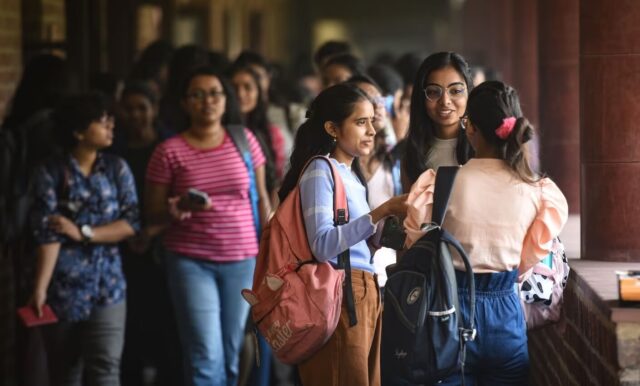
This is not the first time that issues with CUET have popped up, specifically related to a drop in student enrollment. For girls, this has reportedly been seen earlier as well.
A 2023 Indian Express report also claimed that DU witnessed a 25.5% dip in admissions for that year, with the biggest bulk due to a decrease in female students looking for admission in the university. There was a reported 37.75% drop in 2022-23, seeing only 34,120 female admissions, while 2021 saw 54,818 enrollments.
The male side didn’t see much change, only seeing a dip by 1,585, that is 30,795 in 2022-23 from 32,380 in 2021.
Tanvir Aejaz, an associate professor in the political science department at Ramjas College, commenting on this, had said, “During the admission process, my colleagues and I observed that after CUET, the number of girl students had gone down… In rural areas and small towns, CUET would have made it difficult for girls to attend the exam. It was quite confusing; there were different centres and multiple exams over several days, which kept getting cancelled.”
As per an ET Education report from April this year, DU has suffered a loss in revenue of almost Rs. 21 crore due to vacant seats after the adoption of CUET.
The report explains how approximately 15,000 seats have gone vacant over the past three years, resulting in both a loss of revenue for the institute and students who are unable to study in DU. The number of vacant seats also seems to only be increasing over the years, with 2022, the year CUET was adopted, witnessing 5,000 empty seats and the number rising to 7,000 in 2023.
In 2024, the number of unfilled seats dropped to 3,000, and reports indicate that an average of 5,000 seats go vacant each year. This results in DU potentially losing out on Rs 7 crore of revenue annually.
Cancelled student admissions remains a big problem for the university, with Prof Abha Dev Habib, a faculty member at Miranda House and an Academic Council member stating how “CUET has disrupted the entire admission ecosystem at DU,” adding “We have seen an impact on the diversity of our student intake, gender balance, and timely commencement of academic sessions. Even faculty workloads are affected because everything is delayed.”
A Sharda University student, Yohan, also said, “I always wanted to study at DU. Earlier, I couldn’t get in because of the high cutoffs, and now CUET delays made it impossible. I ended up joining a private university and paying a huge fee because I wasn’t sure if DU would finish admissions on time. Now that I hear thousands of seats go unfilled, it feels like such a waste — not just for me, but for many students who deserve a shot.”
Image Credits: Google Images
Sources: The Indian Express, Feminism In India, ET Education
Find the blogger: @chirali_08
This post is tagged under: Delhi University, Delhi University women, Delhi University admission, Delhi University female students, Delhi University cuet, cuet, cuet exam, cuet exam problems
Disclaimer: We do not hold any rights, copyrights over any of the images used; these have been taken from Google. In case of credits or removal, the owner may kindly email us.